Our Moving Planet
Time Keeps on Ticking...
Anatomy of the Earth
Our Habitable Home
Sensational Seasons
100
Vibrant displays of color produced when particles from the sun interact with the atmosphere.
What is the aurora?
100
The sun appears to rise in the __________.
East.
100
The imaginary line that runs around the middle of the Earth, dividing it into two hemispheres.
What is the equator?
100
The magnetic region shielding Earth from dangerous solar radiation and energetic particles.
What is the magnetosphere?
100
What season is it in the NORTHERN hemisphere at #2 in the diagram?
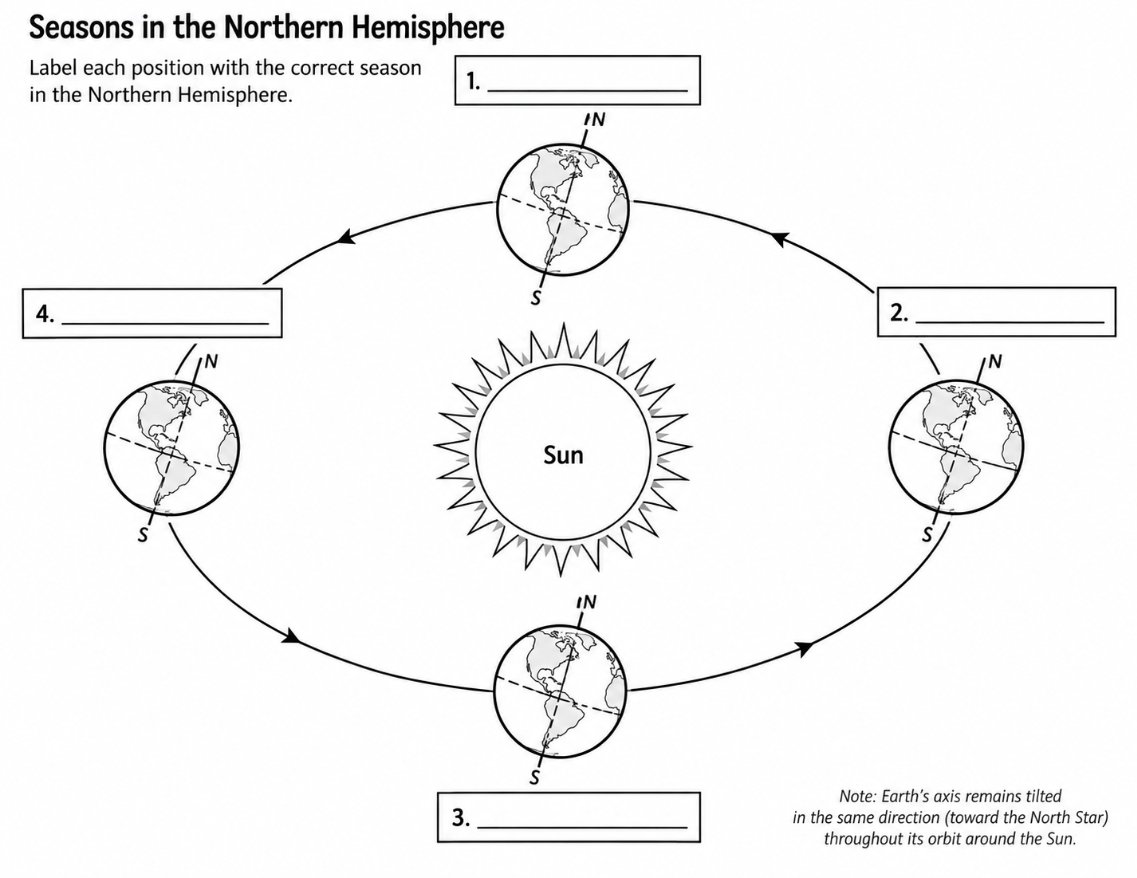
Winter
200
The curved trajectory around the Sun which the Earth travels.
What is its orbit?
200
The sun appears to set in the ___________.
West.
200
The southernmost point on Earth, located at 90° North latitude.
What is the South Pole?
200
The invisible force that draws objects toward one another.
What is gravity?
200
What season is it in the NORTHERN hemisphere in #1 on this diagram?
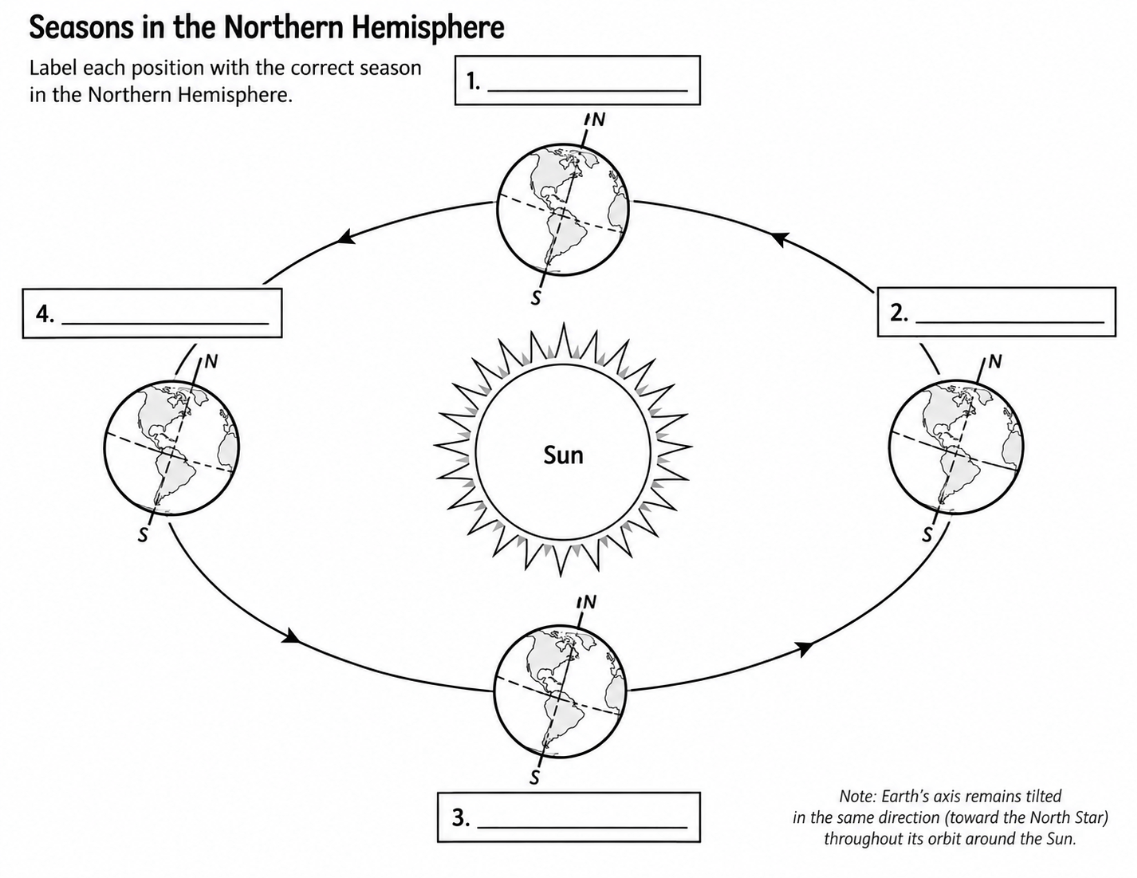
Spring
300
The imaginary line running from the North to the South pole around which the Earth spins.
What is its axis?
300
How long it takes for the Earth to complete one rotation on its axis.
What is (approximately) 24 hours?
300
The northernmost point on Earth, located at 90° North latitude.
What is the North Pole?
300
Earth-like, rocky planents, like Venus, Mecury, and Mars, are known as ______________ planets.
Terrestrial
300
DOUBLE JEOPARDY!
What seasons is it in the NORTHERN hemisphere on #4 on the diagram?
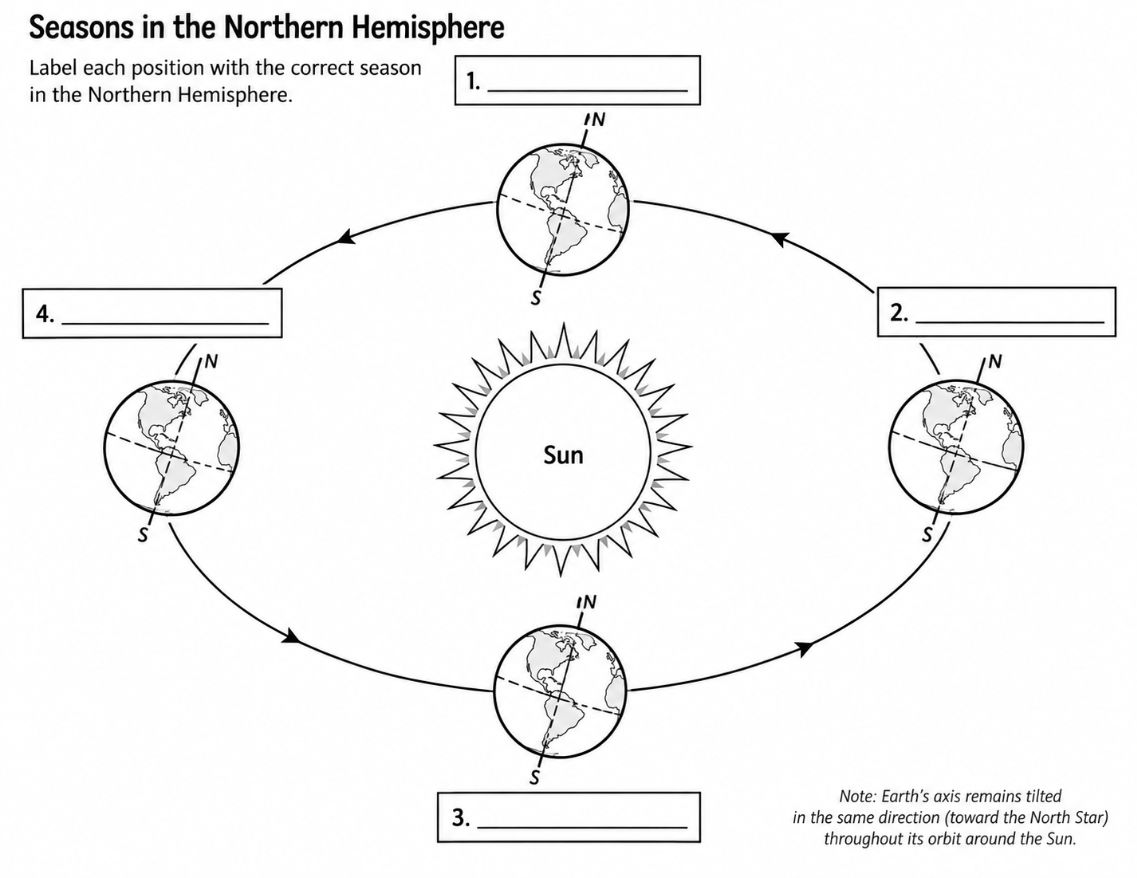
Summer.
400
DOUBLE JEOPARDY!
The motion of the Earth spinning on its axis.
What is rotation?
400
How long it takes for the Earth to complete one revolution (orbit) around the Sun.
What is (approximately) 365 days?
400
The half of the Earth north of the equator.
What is the Northern Hemisphere?
400
Position in the solar system where organisms might survive.
What is the habitable zone?
400
What season is it in the NORTHERN hemisphere on #3 on this diagram?
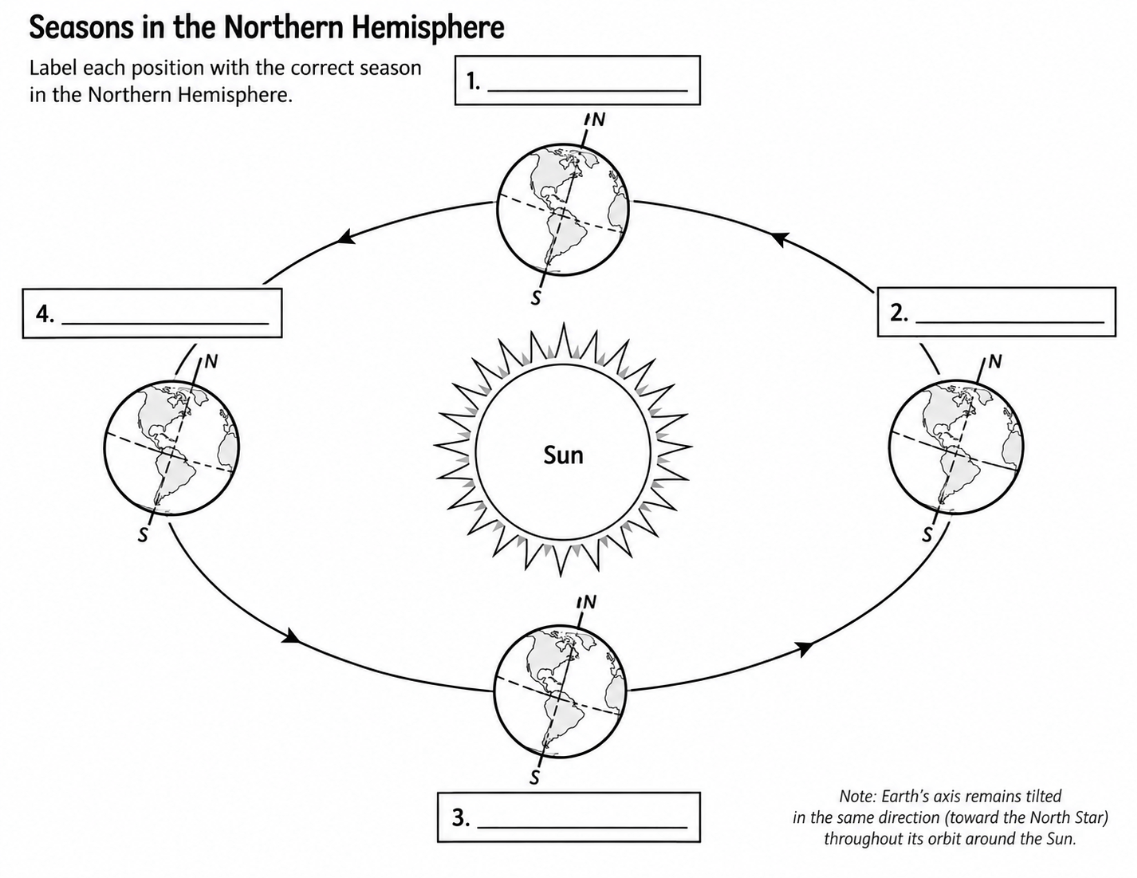
Autumn/Fall.
500
The motion of the Earth orbitting around the Sun. (Another word for orbit.)
What is revolving or revolution?
(Note: You could say it takes one year for the Earth to orbit around the Sun or that it takes one year for the Earth to complete one revolution around the Sun.)
500
We say the sun rises and sets, but that isn't really what happens at all. Explain how the cycle of day and night actually work.
Answers will vary, but good response would be something like:
As Earth rotates, the side facing the Sun experiences daylight, while the side facing away from the Sun experiences darkness. As Earth continues to rotate, different parts of Earth move into and out of sunlight, creating the cycle of day and night. The Sun only appears to rise and set because Earth is rotating.
500
The half of the Earth south of the equator.
What is the Southern Hemisphere?
500
Explain why a planet can't be too close or too far from its sun in order for life to be possible on its planet.
Answers will vary, but a good answer would be something like:
Life as we know it requires liquid water to survive, so a planet that is too far from its sun would be too cold for liquid water to remain on its surface, making it difficult for life to exist. However, if a planet is too close to its sun, it would be too hot for liquid water to remain on its surface, and life as we know it could not exist there.
500
Explain what causes seasons on Earth.
Answers will vary, but it should be something like:
The revolution (orbit) of Earth around the Sun and the tilt of Earth on its axis cause the hemispheres to receive different amounts of the Sun’s energy at different times of the year. As Earth moves around the Sun, each hemisphere alternately receives more or less direct sunlight, causing the seasons to change.