Seasons
Random
Vocab
Gravity, Inertia, other stuff
Planets/Other things/FINAL QUESTION
100
What Season is the Northern Hemisphere at POINT A?
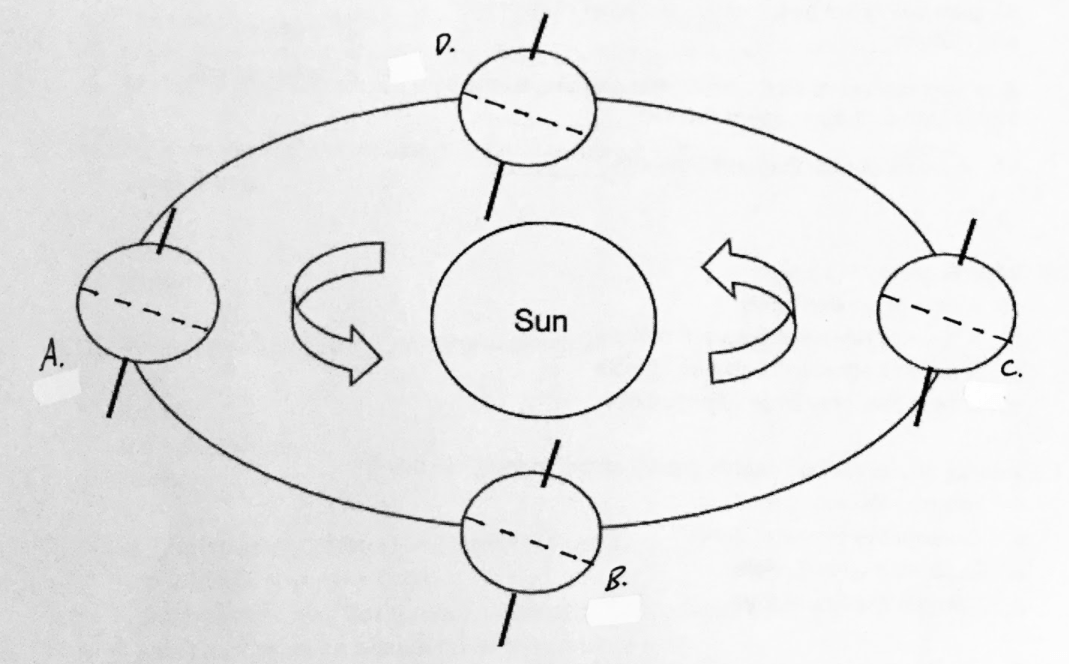
Summer
(tilted toward the sun = more direct sunlight = warmer weather)
100
What degree is the Earth tilted at in relation to its revolution?
23.5 degrees
100
The region of the solar system between Mars and Jupiter???
Answer choices: star / asteroid / comet / meteor / asteroid belt
asteroid belt
100
In what direction does earth’s gravity attract objects?
A. Towards the equator
B. Towards the center of earth
C. Towards the North Pole
D. Towards the South Pole
B. Towards the center of Earth
100
Because of inertia, a resting object will remain at ________.
A. Rest
B. School
C. A constant speed
D. Inertia
A. Rest
200
What Season is the Southern Hemisphere at POINT B
Spring
The Southern Hemisphere just got out of Winter and is headed towards summer at point C. Spring comes first :)
200
When is the Winter Solstice for the Northern Hemisphere???
December
200
Giant ball of hot gas, mainly composed of Hydrogen and Helium???
Answer choices: star / asteroid / comet / meteor / asteroid belt
Star
200
What is gravity?
A. A type of applied force
B. A force of repulsion between objects
C. A force of attraction between objects
D. A force that only large objects exert
C. A force of attraction between objects
200
Which of these planets is not a gas giant?
-Jupiter
-Uranus
-Mars
-Saturn
Mars
300
What Season is the Northern Hemisphere at POINT D?
Spring
Leaving Winter at point C, the Northern Hemisphere is now at Spring. It is getting warmer and warmer every day.
300
What causes DAY and NIGHT on Earth?
Earth's Rotation
**spinning on its axis
As the Earth ROTATES, when it faces the sun, we have daytime and when the Earth faces away, this would be nighttime.
300
A cold mixture of dust and ice that gives up a long trail of light as it approaches the sun???
Answer choices: star / asteroid / comet / meteor / asteroid belt
Comet
300
Gravity depends on what two factors?
A. Mass and distance
B. Size and shape
C. Mass and volume
D. Volume and density
A. Mass and Distance
300
Which is an example of the law of inertia?
A. A rocket taking off from Earth
B. A crash test dummy flies through the windshield in a collision
C. A small rock skips on a pond faster than a large rock
D. A soccer ball accelerates faster than a bowling ball when kicked
B. A crash test dummy flies through the windshield in a collision
400
What Season is the Southern Hemisphere at POINT D?
Fall
It was just summer at point C for the Southern Hemisphere and things are beginning to get colder and colder.
400
When is the Spring (Vernal) Equinox for the Northern Hemisphere???
March
400
A chunk of rock that orbits the sun???
Answer choices: star / asteroid / comet / meteor / asteroid belt
Asteroid
400
Inertia is the tendency of an object to resist a change in its ___________.
A. Temperature
B. Size
C. Shape
D. Motion
D. Motion
400
What are the four inner/terrestrial planets?
(My Very Eager Mother...)
Mercury, Venus, Earth, and Mars
500
Where would March be for the Northern Hemisphere?
Point D
500
When is the Summer Solstice for the Northern Hemisphere???
June
500
___________ - the Gravitational force exerted on an object
(this will change depending on Gravity)
(higher gravity = this will go up)
WEIGHT
weight depends on gravity
500
What might happen to the Earth if its orbit moved farther away from the Sun?
A. The sun’s gravitational pull on the earth would increase
B. The earth’s gravitational pull on the moon would increase
C. The sun’s gravitational pull on the earth would stay the same
D. The sun’s gravitational pull on the earth would decrease
D. The sun’s gravitational pull on the earth would decrease
500
What are the four outer/gas giant planets?
(Just Served Us Nachos...)
Jupiter, Saturn, Uranus, and Neptune
600
What causes Earth's Seasons??
Earth's tilt (23.5 degrees)
Revolution
Amount of direct and indirect sunlight
As the Earth revolves around the the sun, it is tilted on its axis at 23.5 degrees. The Earth continues to be tilted at 23.5 degrees and it points in the same direction. As it revolves around the sun, it will receive different amounts of direct and indirect sunlight. The more direct the sunlight, the warmer the temperature will be (summer). As the Earth receives more indirect sunlight, that sunlight is more spread out and will give cooler temperatures (winter).
600
When is the Fall (Autumnal) Equinox for the Northern Hemisphere???
September
600
________ - the amount of matter in an object
(this will NOT change depending on Gravity)
(no matter where you go, this remains constant)
MASS
Mass never changes depending on where you are!
600
Explain the terms ROTATION and REVOLUTION. You must use the following key phrases in your explanation: day and night, year, and axis. Use complete sentences.
***This is an exact essay question on your test!!! You should be ready to fully answer this question on the test ;)
Rotation is when an object, let's say Earth, is spinning on its axis. That spinning motion is what causes day and night on Earth. When we are on the part of the Earth that is rotated towards the sun, it is day time and vise versa for night time. Revolution is the path of orbit an object goes around a celestial body. The Earth revolves around the sun. One full revolution is equal to a year on Earth.
600
List the planets in the correct order from furthest outward (near Pluto) and moving inward towards the Sun.
Neptune, Uranus, Saturn, Jupiter, Mars, Earth, Venus, Mercury
700
Spring in the Northern Hemisphere would be between which TWO points?
D to A
700
What is the difference between an Meteor, Meteoroid, and Meteorite?
Meteoroid is floating out in space
Meteor is burning up in Earth's atmosphere
Meteorite hit a planet
700
What happens to the Gravitational Force of two objects when they are closer together?
The closer two objects are to one another the GREATER the gravitational force will be.
700
Why was Pluto demoted to a dwarf planet status?
- Orbits the Sun – Pluto does this. ✅
- Has enough gravity to be spherical – Pluto is round. ✅
- Has cleared its orbit of other debris – Pluto fails this requirement. ❌
800
What happens to the gravitational force of an object if the mass decreases?
As mass decreases, the gravitational force of an object will DECREASE.
900
Final Question --> decide what your team is going to wager on this question. You can wager as many points as your team has.
Not all locations on Earth experience seasons. The two areas that experience seasons are from the Tropic of Cancer to the Arctic Circle AND the Tropic of Capricorn to the Antarctic Circle.
What are the two sets of degrees for these locations?
23.5 degrees N/S to 66.5 degrees N/S