Shadows and Alignment
Lunar Eclipses
Solar Eclipses
Types and Timing
History and Science
100
What is an eclipse?
An event in which one celestial body moves into the shadow of another.
100
What is the correct order of the celestial bodies for a Lunar Eclipse to occur?
Sun - Earth - Moon
100
What is the correct order of the celestial bodies for a Solar Eclipse to occur?
Sun - Moon - Earth
100
What is this outer layer of the Sun called?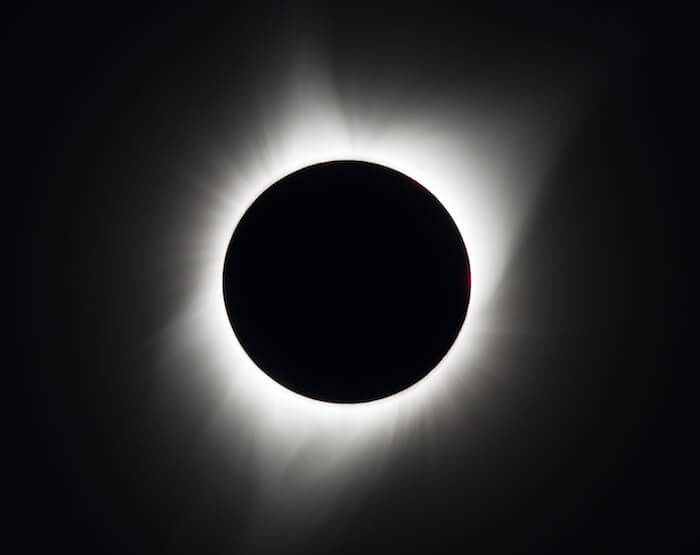
The Corona
100
According to ancient Chinese culture, what creature did they believe ate the Sun during an Eclipse?
A Dragon
200
What is Letter B pointing to?

What is the umbra?
200
During which phase of the Moon can a lunar eclipse occur?
A Full Moon
200
During which phase of the Moon can a solar eclipse occur?
A New Moon
200
What causes a solar eclipse not to occur during every new moon?
The Moon's orbit is tilted about 5°, so the Sun, Earth, and Moon do not align closely enough every month.
200
A Lunar or Solar Eclipse occurs when the orbital planes of the Moon and Earth are aligned at what are called...?
Nodes
300
How does the umbra differ from the penumbra?
The umbra blocks all direct light from the source, while some light reaches the penumbra.
300
What is this event commonly called?
A Blood Moon
300
What is this strip called, where observers experience a total solar eclipse?
The Path of Totality
300
What type of Eclipse is occuring?

An annular solar eclipse
300
About how often does Earth enter an eclipse season, when eclipses become possible?
About every 6 months
400
What happens to the umbra when the light source is small and the object is larger?
The umbra becomes larger, with less penumbra.
400
Why can the Moon appear red during a total lunar eclipse?
Earth's atmosphere scatters blue light and bends red light into Earth's shadow toward the Moon.
400
Why does a total solar eclipse last only a few minutes in one location?
The Moon's relatively small shadow moves quickly across Earth; totality usually lasts about 2–7 minutes.
400
What is the name of the shadow region that allows the Moon to appear entirely within the Sun's disk, creating an annular eclipse?
The Antumbra
400
Name two things scientists study during a total solar eclipse.
The Sun's corona, solar wind, magnetic fields, space weather, or solar heating.
500
Why must the Sun, Earth, and Moon line up correctly for an eclipse to happen?
They must align so that one celestial body's shadow falls on another body.
500
What type of lunar eclipse is shown?
A partial lunar eclipse.
500
What must people wear to protect their eyes when viewing a solar eclipse, and why?
Proper solar-viewing protective eyewear because harmful ultraviolet and infrared radiation can damage the eyes.
500
What rare type of solar eclipse changes from annular to total and then back to annular, depending on where observers stand on Earth?
A Hybrid Eclipse
500
Why is the Sun's corona difficult to see during an ordinary day but visible during a total solar eclipse?
The corona is very dim compared with the Sun's bright surface. Blocking the bright surface allows scientists to see the corona.