Omnivore
Carnivore
Herbivore
Producer
Decomposer
100
What does the root word for Omni mean?
Omni means all
100
What is a carnivore? Give a simple definition.
Eats mostly other animals.
100
What do herbivores eat?
Plants/producers
100
What is a producer in an ecosystem? Give one example.
Organism that makes its own food (e.g., green plant, algae).
100
What does a decomposer do? Give one example.
Breaks down dead organisms into simpler materials (example: bacteria, fungi).
200
Explain why being an omnivore can help an animal survive when food is scarce.
Omnivores can eat many food types so they have more food options when one source is low (explain food flexibility).
200
Name a carnivore that hunts in groups and one that hunts alone.
Group hunter: wolves; solitary: tiger.
200
Name three herbivores that eat grasses specifically (grazers).
Grazers: cow, bison, rabbit (if primarily grass-eating).
200
What process do producers use to make food, and what two raw materials do they need?
Photosynthesis; needs sunlight and carbon dioxide (and water).
200
Name two types of decomposers and where you might find them.
Fungi (on forest floor), bacteria (soil, compost).
300
Give two examples of omnivores found in a local park or backyard.
Example answers: raccoon, crow, opossum, some rodents.
300
How does a carnivore’s teeth differ from a herbivore’s teeth? Provide two differences
Carnivores have sharp, pointed canines and slicing molars; herbivores have flat grinding teeth.
300
How do herbivores help plants reproduce? Give one clear example.
By eating and moving pollen or seeds (some herbivores eat fruit and disperse seeds in droppings).
300
Why are producers considered the base of most food chains?
Producers convert sun energy into food, providing energy for all other levels.
300
How do decomposers help recycle nutrients for producers?
Decomposers break dead matter into nutrients that plants reuse in soil or water.
400
Which human body system benefits most directly from a varied omnivore diet, and why?
Digestive or immune system; varied nutrients support overall health—acceptable teacher explanation.
400
Explain how removing a top carnivore (apex predator) can change an ecosystem.
Removing apex predator can cause prey populations to increase, overgrazing, and cascading effects (trophic cascade).
400
Explain one physical adaptation herbivores have for digesting plants.
Examples: long digestive tract or multiple stomach chambers to break down cellulose.
400
Describe how light availability affects producer growth in a pond
Less light → fewer producers/less growth; shaded plants grow slower or adapt (algae vs. submerged plants
400
Explain the role of fungi in decomposition and how it differs from insects.
Fungi secrete enzymes externally to break down material, insects physically break down material and aid microbes; both work together.
500
Describe one way an omnivore can affect both plant and animal populations in its ecosystem
Omnivore can reduce plant abundance by eating seeds/plants and reduce some prey species; may shift population sizes.
500
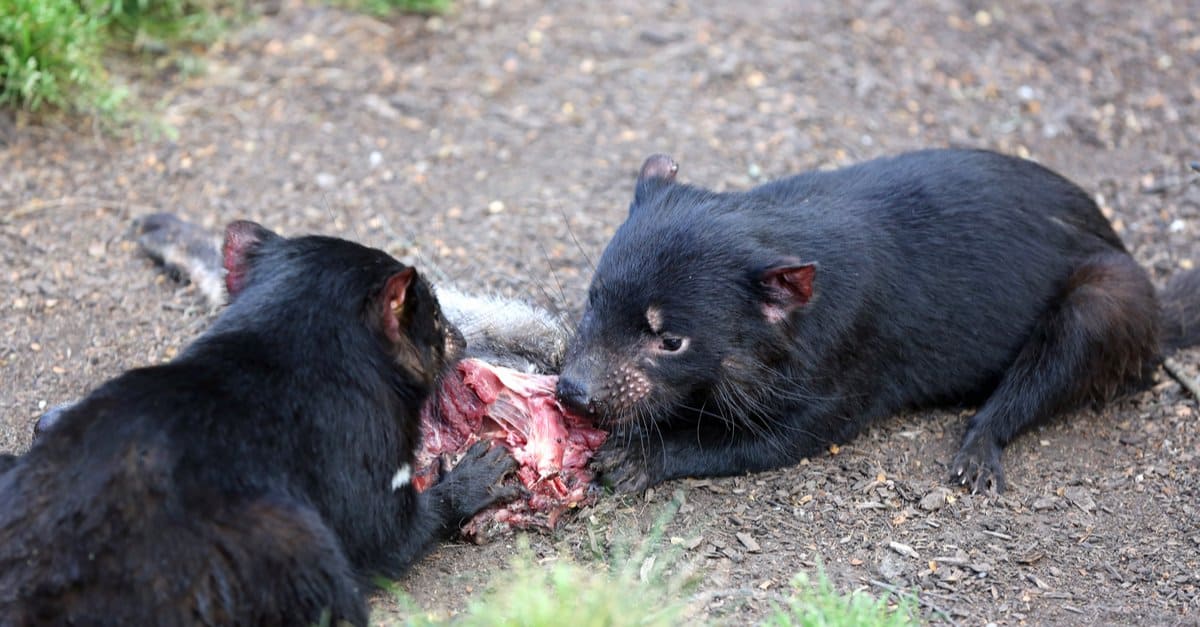
What is the name of this animal?
Tasmanian Devils
500
Compare and contrast a grazer and a browser with an example of each.
Grazer (e.g., cow) mainly eats grass; browser (e.g., deer) eats leaves, twigs, shrubs.
500
Explain how producers move matter and energy through an ecosystem (use the terms matter, energy, and sun).
Producers capture energy from the sun, store it in biomass (matter), and that matter/energy moves to consumers and decomposers through feeding and decomposition.
500
Describe a small experiment a student could do to observe decomposition of a leaf over two weeks (materials, steps, what to measure).
Example experiment: Put identical leaves in three clear jars (open to air, sealed, and with soil), weigh or photograph weekly, note smell/appearance, measure rate of breakdown or mass loss over two weeks.