Ecology 1
Ecology 2
Ecology 3
Ecology 4
Ecology 5
Ecology 6
Ecology 7
100
the variety of species in an ecosystem
Biodiversity
100
An organism that uses sunlight to create its food
What is a producer (autotroph)
100
When collecting data, it is important to collect results before and after. (true or false)
True
100
Give an example of a pioneer species
lichen, mosses, some grasses
100
an organism that hunts, kills, and eats other organisms
What is predator
100
Living part of an ecosystem is called...
What are biotic factors?
100
Where does lost energy go when moving up the trophic pyramid?
It is lost to heat, movement, and metabolic processes.
200
How much energy is in the secondary consumer level of this trophic pyramid?

200kcal (note: the unit you are given whether kcal or something else does not change the number)
200
An organism that feeds on dead and decaying animals
What are decomposers?
200
Plants use this process to turn light into chemical energy
What is photosynthesis?
200
Food chains that are interconnected/overlaps in a particular ecosystem
What is a food web?
200
Process that forms an ecosystem in an area with only barren rock
Primary succession
200
What happens to the energy level as you move up a trophic pyramid? How much energy is transferred?
decreases - only 10% is passed to the next level
200
Air, water, and the Sun are all ......
What is are abiotic factors?
300
the maximum number of individuals of a particular species that an environment can support
carrying capacity
300
Identify the part of the graph labeled d
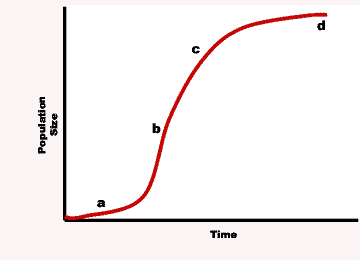
carrying capacity
300
What are some examples of decomposers?
bacteria, fungi, worms, ants, beetles, sow bugs
300
when a population reaches carrying capacity, the graph will show a...
plateau
300
At the bottom of a trophic pyramid, what are those organisms called (the scientific term)
autotrophs, also known as producers
300
Describe a tertiary consumer
organisms that eat secondary consumers
300
something that restricts the number of organisms that can live in an area.
What is a limiting factor?
400
***DAILY DOUBLE***
Describe the water cycle (how does water reach earth and back into the atmosphere)
Back to atmosphere:
Evaporation (from liquid to gas)
Transpiration (plants)
Back to Earth:
Condensation (clouds)
Precipitation (rain, snow, hail)
400
On a trophic pyramid what is the organism that eats the producer
What are primary consumers?
400
As if you were a nitrogen molecule, talk us through the nitrogen cycle, starting in the atmosphere and ending in the biosphere
Answers will vary:
I am in the atmosphere amongst fellow nitrogen molecules and I get passively absorbed by nitrogen fixing bacteria in the soil and through the process of nitrogen fixation, I am converted into ammonia in the geosphere. Then, another, different type of bacteria absorbs me and converts me into nitrates and nitrates through the process of nitrification. I am then released into the soil where plants readily absorb me and can use me to grow, leaving me in the biosphere.
400
the movement of water in a plant from the roots to the leaves, and then evaporation from the leaves
transpiration
400
An animal that eats plants or other animals and does not make its own food (the scientific term)
What is a heterotroph? also known as consumers
400
Name two human activities that affect global systems
Burning fossil fuels, deforestation, monoculture, develepment/urbanization, habitat fragmentation, hunting/fishing, introduction of invasive species, pollution
400
Describe the process of eutrophication
Excess runoff with a high concentration of nutrients enters a body of water, causing algae to grow rapidly, depleting oxygen in the water and leaving everything else in the body of water to die
500
Nitrogen cycle step that includes bacteria
Nitrogen fixation and nitrification
500
As if you are a molecule of Carbon Dioxide, talk us through the carbon cycle, starting and ending in the atmosphere while passing through all other spheres
Answers will vary:
Ex: As a carbon dioxide molecule in the atmosphere, When I come in contact with water, I dissolve into the water, becoming part of the hydrosphere. While dissolved in the water, a marine plant takes the carbon dioxide out of the water that I am in and I am incorporated into the biosphere through photosynthesis. Then, when the plant dies, it settles down in sediment and over hundreds of years, I become part of fossil fuels in the geosphere. Then when those fossil fuels are harvested and used, the combustion of those fuels will release me back into the atmosphere.
500
What happens in the final stage of succession?
Trees are growing. Climax community is reached
500
if an organism uses chemicals to produce energy rather than eating other organisms, it is considered a...
autotroph
500
Organisms in deep areas of ocean would have to adapt to not use this for producing energy
light
500
Difference between primary and secondary succession
Primary succession starts after a disturbance in which no soil or living things are left
Secondary succession starts after a disturbance leaves some soil and maybe some living things
500
***DAILY DOUBLE*** A keystone species is removed from an ecosystem. What will happen to that ecosystem?
It will fundamentally change, as keystone species keep other populations in check or exhibit behaviors that can drastically alter the ecological landscape and therefore populations.