Am I Alive?
Organizing Life
Life in the Biome
Relationships are hard
Population Dynamics
Cycling through life
Oh the Humanity!
Energetic Ecosystems
100
Used to determine if something is alive.
What are The Characteristics of Life
100
The levels in order from smallest to largest
What is organism, population, community, ecosystem, biome, biosphere?
100
A physiological response to a seasonal change
What is migration?
100
This relationship has an organism killing and eating another
What is a predation?
100
A severe drought dries up water holes in a savanna. A herd of 500 wildebeests loses 30% of its population, while a smaller neighboring herd of 50 wildebeests also loses 30% of its population.
This is a _____________ limiting factor
What is density independent?
100
These are 5 places you can find carbon
What is the atmosphere, the ocean, plants, animals, and the ground (fossil fuels/decaying matter)
100
Deforestation, urbanization, mining, and burning of fossil fuels are all considered this
What is a human impact?
100
The arrow within a food web/chain indicates this
What is the flow of energy?
200
An example of an abiotic factor
What is water, air, soil, rock, or dirt?
200
True or False: A population of the forest includes all the deer, oak trees, and birds living together
What is false?
200
These are behavioral adaptations
What are instincts and social interactions?
200
A close physical relationship between two species.
What is symbiosis?
200
Gannets (a type of seabird) aggressively defend a strict 1-meter territory around their nests on sea cliffs, pecking at any neighbor that gets too close.
This population dispersion is known as
What is clustered?
200
When nitrogen is captured from the atmosphere to be used in the soil.
What is nitrogen fixation?
200
The Burmese Python became these once introduced to the Florida Everglades
What is an invasive species?
200
The 10% rule states.
What is only 10% percent of available energy will travel to the next step while 90% is lost to heat and metabolic processes?
300
Populations changing over time
What is evolve?
300

Determine this biome based on the climatogram
What is a Rainforest due to high rainfall and high temperatures?
300
The adaptation that slows down metabolism during scarce food times.
What is hibernation?
300
Two squirrels fighting for the same space in a tree
What is intraspecific competition?
300
An invasive species of fish is introduced to a river with unlimited food and zero predators. For the first five years, its population doubles every month. However, by year six, the river reaches its carrying capacity as shelter runs out and a deadly virus spreads through the crowded fish.
In this example, the growth curve, density dependent & density independent limiting factors are.
What is logistical?
What is the density dependent factors are unlimited food, no predators, & disease, and the density independent factor is no shelter?
300
The role of decomposers in a biogeochemical cycle.
What is recycling nutrients?
300
The primary effect of urbanization
What is habitat loss?
300
A producer starts out with 10,000 J of energy however the secondary consumer will only have this much.
What is 100 J?
400
The proper way to kill bacteria and viruses
What are antibiotics for bacteria, however viruses cannot be killed, only prevented with vaccines
400
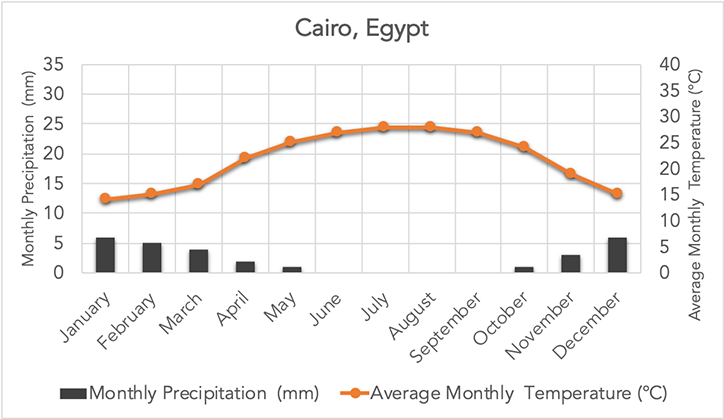
Determine this biome based on the climatogram
What is a desert, due to high temperature and low rainfall.
400
This biome is a roasting-hot, low-lying territory covered in bright white crust and shallow, hypersaline pools (water that contains extremely high amounts of salt, much more than the ocean). Daytime temperatures get dangerously hot, reaching over 45°C. However, because there are no clouds or trees to trap the heat, nights become freezing cold. Rain almost never falls, but every few years, underground water bursts up through the ground and floods the flat ground before evaporating in the heat. The soil and water are packed with minerals that can be toxic to normal plants. The few plants that survive here are short, rubbery, and tough, while millions of insects quickly hatch whenever a sudden flood happens.
These adaptations would be most common in plants, while these would be most common in animals.
What is plants will possess dormancy and hydrotropism, while animals will have long ears and burrowing instincts?
400
An oxpecker bird sits on a rhinoceros, eating disease-carrying ticks off the rhino's skin. However, if the rhino has an open wound, the bird will peck at it to drink the blood, preventing the wound from healing.
What is mutualism and parasitism?
400
This type of succession takes hundreds to thousands of years to complete.
What is Primary Succession?
400
When carbon is converted back to N2 and released into the atmosphere.
Whats is denitrification?
400
Burning fossil fuels results in this phenomenon increasing
What is acid rain?
400
Secondary consumers on the trophic pyramid are often ____________ as they can get their food from both lower levels.
What are omnivores?
500
Bacteria and Viruses differ in one huge way.
What is viruses reproduce using a host cell?
500
This biome has:
Average daily temperatures range between -30°C (-22°F) and 30°C (86°F) with a yearly average of 10°C (50°F). Hot summers and cold winters are typical in this biome.
On average, this biome receives 750 to 1,500 millimeters (30 to 59 inches) of rain per year.
Possess Broadleaf trees (oaks, maples, beeches), shrubs, perennial herbs, and mosses
What is a Temperate Deciduous Forest
500
This biome is a wet, icy northern region built on top of permafrost (a layer of soil deep underground that stays completely frozen all year long). Above the frozen ground sits a thick, soggy layer of peat (decayed, sponge-like plant matter that holds water). Summers are short with 22 hours of sunlight a day, mild temperatures around 20°C, and huge clouds of biting insects. Winters, however, are brutal and dark, lasting eight months with temperatures dropping below -30°C, turning all the water to solid ice. The water here is stagnant and very acidic (containing natural chemical acids that make it harsh for plants to drink). Strong autumn winds sweep across the flat landscape, and the ground constantly shifts between solid ice and thick, sticky mud.
These adaptations would be most common in plants, while these would be most common in animals.
What is plants will possess dormancy and phototropism, and hydrotropism, while animals will have thick fur, short ears, blubber and hibernate?
500
Otter, wolves, and mangrove trees are often pillars in their ecosystem. Providing services and serving in roles that are paramount to a sustainable ecosystems making them.
What is a keystone species?
500
These birds are demonstrating this type of population dispersion
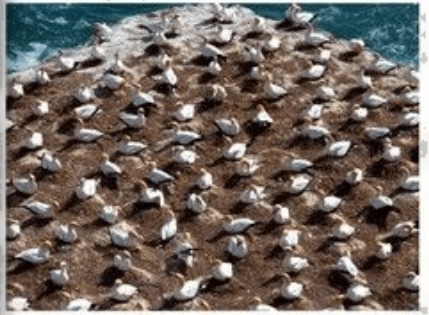
What is uniform?
500
The role of plants in the carbon cycle
Whats is plants absorb carbon during photosynthesis?
500
Excess fertilizer in water runoff will affect this biogeochemical cycle
What is the Nitrogen Cycle?
500
This trophic level possesses the least amount of organisms as the amount of available energy os the smallest
What is the tertiary/quaternary level?