Lessons 1-2
Lessons 3-4
Lessons 5-6
Lessons 7-8
100
Define "ecology."
Ecology: the study of organisms and their interactions with each other and the environment.
100
Write the equation for photosynthesis on the board.

sunlight is the catalyst (driving force), ignore chlorophyll
100
Define "population" (ecology definition).
Population: group of organisms of one species in the same place/time that can reproduce.
100
Define "restoration ecology."
Restoration ecology = renewal of degraded/destroyed ecosystems through active human intervention.
200
Give three examples of abiotic factors from our classroom.
The temperature, the water in water bottles, air
200
Identify the role of producers in an ecosystem's energy flow.
Producers capture sunlight and convert it to chemical energy for all other trophic levels.
200
Calculate total population if:
births = 40, immigration = 10, deaths = 25, emigration = 5.
Total population=(# births+#immigrants)-(#deaths+emigrants).
Total population=(40+10)-(25+5)
Total population=(50)-(30)
Total population=20 members
200
Name two restoration methods described in the materials and give one sentence for each describing how it helps ecosystems.
Reforestation (planting trees to restore forest structure)
Wetlands restoration (return water, soil, plants to improve habitat & water filtration).
300
Explain the difference between habitat and niche (use one short example)
Habitat = where an organism lives (e.g., forest). Niche = role (e.g., nocturnal seed-eater/predator, engages in mutualism etc).
300
Explain the 10% rule in trophic levels and one consequence for food-chain length.
only ~10% of energy transfers to next trophic level
a food chain containing many species results in very minimal energy the further up the food chain (predators)
300
Describe exponential growth and sketch (describe shape) the curve it makes over time on the board.
Exponential growth = accelerating J-shaped curve when resources unlimiting (short-lived in nature).

Curve it makes over time: 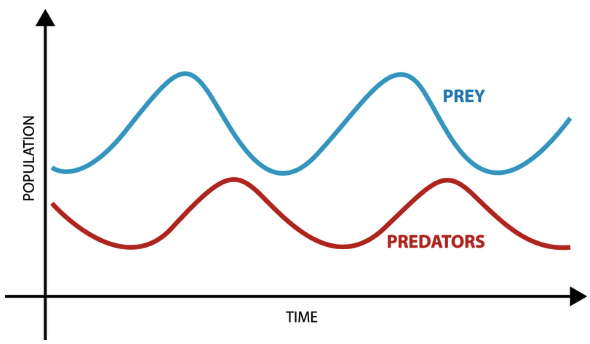
300
What is biocontrol? Give one potential risk of using biocontrol.
Biocontrol = use of one species to control another; risk: introduced control can attack native species (parasitoid fly attacking native moths).
400
List the 6 levels of biological organization in order by writing them on the board.
Individual → Population → Community → Ecosystem → Biome →Biosphere
400
Compare a food chain and a food web — give one strength of using a food web for predictions.
Food chain: single path; food web: many interconnected paths — web predicts effects of species removal better.
400
Define carrying capacity and explain what happens when a population exceeds it.
Carrying capacity = max population sustainable; exceeding leads to resource shortages, die-off, or population crash.
400
Explain and illustrate the difference between bioaccumulation and biomagnification.
Bioaccumulation = buildup of a chemical in one organism over time.
Biomagnification = increasing concentration of that chemical at higher trophic levels.

500
Using the Ruby-throated hummingbird example, explain why some species depend on multiple ecosystems (2–3 sentences).
Hummingbirds migrate and use multiple ecosystems seasonally for feeding, resting, and breeding; stopping in one place for too long reduces survival.
500
Describe how cellular respiration and photosynthesis are related (use the terms reactants and products).
Products of photosynthesis (glucose, oxygen) are reactants for cellular respiration; respiration products (CO2, water) are reactants for photosynthesis.
500
Give two abiotic and two biotic limiting factors that would reduce a fish population in a stream and explain briefly how each limits the population.
Abiotic limiting factors: water availability (drought reduces habitat), temperature (too warm causes stress).
Biotic limiting factors: predators (increase mortality), disease (reduces survival/reproduction).
500
If a dinosaur consumes 20 lions that have consumed 50 zebras each that have consumed 100 shrubs each containing 1 unit of DDT, what amount of pesticide builds up in the osprey?
-100 units (100 shrubs x 1 unit DDT each )
-5,000 units (50 zebras x1 unit DDT x 100 units/zebra)
-100,000 units (20 lions x 1 unit ddt x5 000 units/lion