Reasons for Trade
Advantages and Disadvantages of Trade
Absolute, Comparative & Competitive Advantage
Exchange Rates
Appreciation & depreciation exchange rates
Terms of Trade
Economic Integration
Balance of Payments
100
Which of the following is not a reason nations engage in trade?
A. To access goods they cannot efficiently produce
B. To benefit from lower prices due to global competition
C. To limit consumer choice and protect domestic monopolies
D. To achieve economies of scale through larger markets
C. To limit consumer choice and protect domestic monopolies
Explanation: Trade increases consumer choice and competition. Limiting consumer choice is not a reason nations trade; rather, it is a characteristic of protectionism.
100
What is the most accurate definition of protectionism?
A. Policies that encourage countries to reduce government involvement in trade
B. Government actions designed to restrict imports and protect domestic industries
C. Trade agreements that reduce tariffs between countries
D. The movement of businesses to low‑cost countries
B. Government actions designed to restrict imports and protect domestic industries
100
Define absolute advantage.
Absolute advantage occurs when a country is able to produce a good or service using fewer resources or at a lower cost than another country. This allows the country to produce more output from the same level of resources.
100
Define an exchange rate.
An exchange rate is the value of one country’s currency expressed in terms of the currency of another country.
100
Which of the following events would most likely cause the Australian dollar to appreciate?
A. Australian consumers buy more imported electronics.
B. Foreign tourists increase their travel to Australia.
C. Australian investors buy more overseas shares.
D. Australia imports more oil from overseas.
B. Foreign tourists increase their travel to Australia.
Explanation:
More foreign tourists visiting Australia increases demand for AUD, causing the currency to appreciate.
Options A and D increase supply of AUD (Australians demanding foreign currency), causing depreciation.
Option C also increases supply of AUD, leading to depreciation.
100
Identify which of the following would cause an improvement in the terms of trade is most likely to cause (multiple needed):
A. The country can buy more imports with the same value of exports.
B. Imported machinery becomes cheaper for local businesses.
C. Export prices fall compared to import prices.
D. Higher export prices increase export income.
A. The country can buy more imports with the same value of exports.
B. Imported machinery becomes cheaper for local businesses.
C. Export prices fall compared to import prices. (deterioration)
D. Higher export prices increase export income.
100
Which option best describes a Free Trade Area?
A. Countries adopt a single currency
B. Countries remove tariffs between each other but keep separate external tariffs
C. Countries use the same external tariff for non‑members
D. Countries unify all economic and political policies
B. Countries remove tariffs between each other but keep separate external tariffs
100
Which of the following is recorded in the Financial Account?
A. A foreign company buys shares in an Australian business
B. Australia buys imported machinery
C. A government sends foreign aid to another country
D. Revenue from international tourism
Correct Answer: A
Why? It involves equity investment, part of financial flows.
200
Which of the following best defines factor endowment?
A. The income earned by households for supplying labour to firms
B. The total value of goods and services produced in an economy in a year
C. The quantity and quality of resources (land, labour, capital, enterprise) a nation possesses
D. The level of stability in a country’s balance of payments
C. The quantity and quality of resources (land, labour, capital, enterprise) a nation possesses
Explanation: Factor endowment refers to the supply of the factors of production available within a country.
200
Define international trade.
International trade refers to the exchange of goods and services between countries through exports and imports.
200
Define comparative advantage.
Comparative advantage occurs when a country can produce a good at a lower opportunity cost than another country. This means the country gives up less of another good when producing that product.
200
If 1 AUD = 0.80 USD, calculate how many Australian dollars 1 US dollar is worth. Show your working.
1" AUD"=0.80" USD"
To convert to 1 USD: 1÷0.80=1.25
Therefore: 1 USD=1.25 AUD
200
Draw a demand and supply diagram for a currency in the foreign exchange market to show an appreciation of the currency. Clearly label all axes, curves, and equilibrium exchange rates.
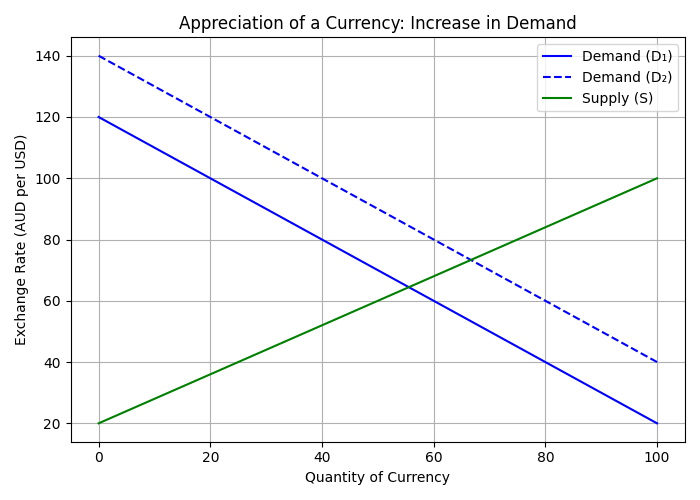
Decrease in supply would also be correct
200
Australia’s ToT rises from 100 to 115. What does this mean?
A rise to 115 means Australia can buy 15% more imports for the same quantity/value of exports compared with the base year. Export prices have risen relative to import prices, improving Australia’s purchasing power.
200
A Customs Union includes which TWO features?
A. A shared currency
B. Free movement of labour
C. No internal trade barriers
D. A common external tariff
C. No internal trade barriers
D. A common external tariff
200
Q: Which is a current transfer in the Current Account?
A. A government grant given to another country after a cyclone
B. Profits repatriated by a foreign company from Australia
C. Sale of a patent to a foreign firm
D. A bank in Japan lends to an Australian company
Answer: A
Why: Secondary income (current transfer)—money given with no good or service in return.
B = Primary income
C = Capital Account (non‑produced, non‑financial asset)
D = Financial Account (borrowing/lending).
300
Explain the difference between an open economy and a closed economy. In your answer, refer to how each system affects the circular flow of income.
A closed economy has no international trade; it only includes households, firms, government, and the financial sector (4-sector model). All income and spending circulate domestically, and no money flows in or out for imports or exports.
In contrast, an open economy includes the foreign sector (5-sector model). This means imports, exports, and foreign investment occur, adding additional injections (exports) and leakages (imports) into the circular flow. These flows impact GDP, employment, and exchange rates.
300
Explain one advantage of international trade for consumers.
International trade increases consumer choice and competition between producers. Greater competition can lead to lower prices and improved product quality, increasing consumer welfare.
300
Using a production possibility frontier (PPF) diagram, explain how opportunity cost influences a country’s decision to specialise.
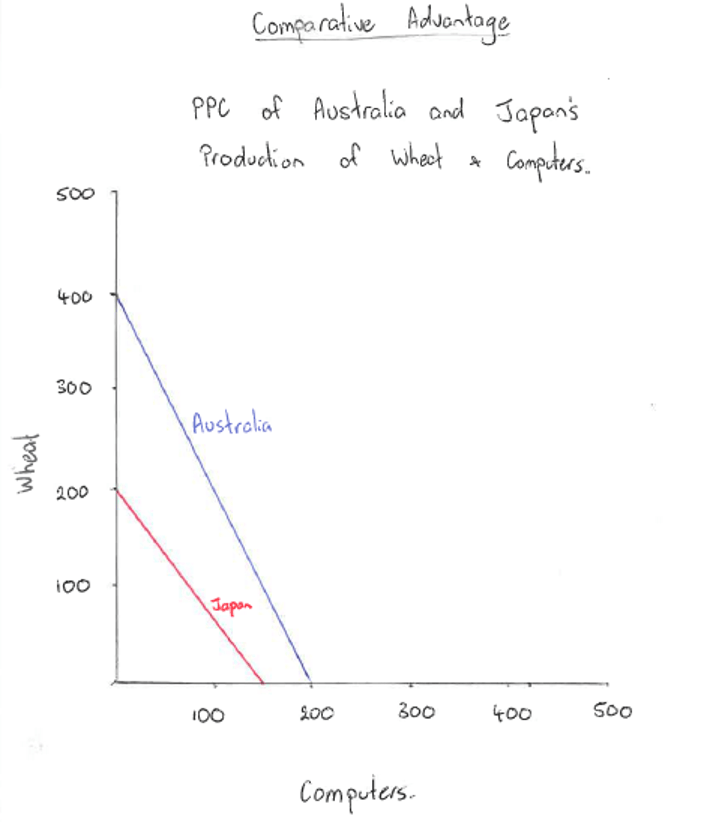
A PPF diagram shows the maximum combinations of two goods that a country can produce using its available resources.
The slope of the PPF represents the opportunity cost of producing one good in terms of another. A country will specialise in producing the good with the lower opportunity cost, as this allows it to maximise production efficiency.
300
Explain the difference between a fixed exchange rate system and a floating exchange rate system.
A fixed exchange rate system is where the value of a currency is pegged to another currency, a basket of currencies or a commodity, and is maintained through government or central bank intervention.
A floating exchange rate system allows the value of a currency to be determined by the forces of supply and demand in the foreign exchange market, with no direct government intervention.
300
Identify two ways a currency can appreciate.
A currency can appreciate if:
1. Demand for the currency increases, for example due to higher foreign demand for exports or increased foreign investment.
2. Supply of the currency decreases, for example if imports fall or there is a reduction in capital outflows.
300
Describe two possible economic effects of an improvement in the ToT.
Higher living standards: Because import prices become relatively cheaper, households and firms can buy more goods and services, increasing consumption.
Lower production costs: Cheaper imported inputs (raw materials, capital goods) reduce firms’ costs of production, making domestic industries more competitive.
300
Define a Preferential Trade Area.
Countries reduce tariffs on selected goods traded between them
300
Explain what a credit is in the Current Account and give one example.
A credit is money coming into the country from overseas.
It increases the Current Account balance.
Example: A foreign tourist spending money in Australia (service export), or overseas companies paying dividends to Australian residents.
400
Define external stability and explain one way trade can influence external stability.
External stability refers to a situation where a country experiences no unwanted movements in foreign reserves and maintains a sustainable balance of payments position.
Trade influences external stability through its impact on the current account. Strong export performance increases export revenue, improving the current account balance and reducing reliance on foreign capital inflows, helping to stabilise foreign reserves.
400
Explain one disadvantage of international trade for domestic producers.
International trade can expose domestic producers to increased foreign competition. If overseas producers have lower costs of production, domestic firms may lose market share, leading to lower profits, reduced production and possible job losses.
400
Using a production possibility frontier (PPF) diagram, explain how absolute advantage influences a country’s decision to specialise.
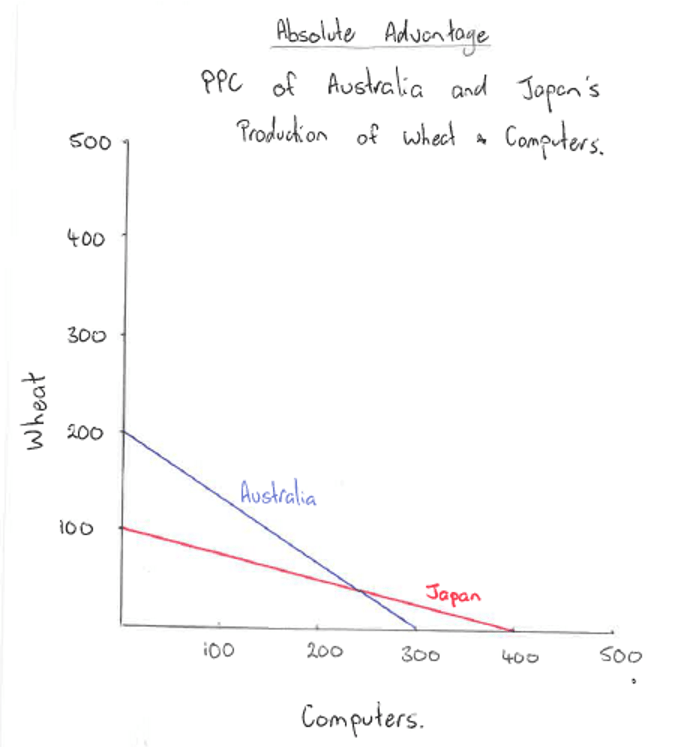
A PPF diagram shows the maximum combinations of two goods that a country can produce using its available resources.
A country has an absolute advantage in the good it can produce in greater quantities using the same level of resources. This is shown on a PPF by the ability to produce more of one good compared to another country.
As a result, a country will choose to specialise in the production of the good in which it has an absolute advantage, as this allows it to increase total output by allocating resources to the most productive use.
400
Explain the difference between an appreciation and a depreciation of a currency.
An appreciation occurs when the value of a floating currency rises relative to other currencies.
A depreciation occurs when the value of a floating currency falls relative to other currencies.
Both terms apply only to floating exchange rate systems and reflect changes driven by market forces.
400
Explain how an increase in imports can lead to a depreciation of a country’s currency. Use a demand and supply diagram in your response.
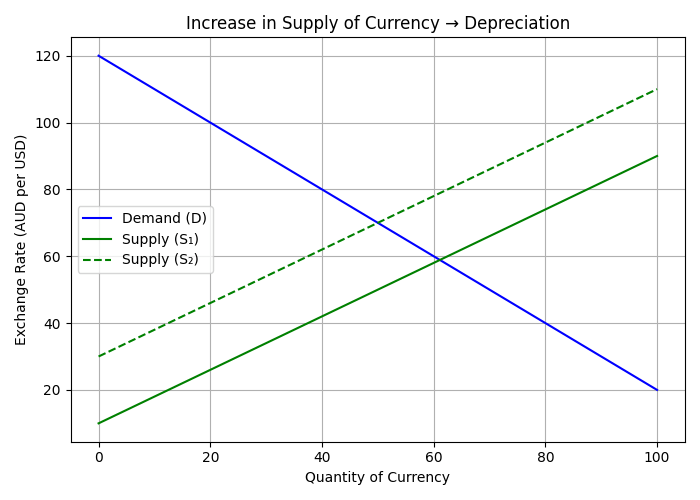
An increase in imports causes domestic consumers to exchange more domestic currency for foreign currencies, increasing the supply of the domestic currency in the foreign exchange market.
400
Explain how investment from U.S. technology companies into Australia’s data‑centre and digital‑services industries could impact Australia’s trade balance.
Investment from U.S. technology companies increases Australia’s capacity to produce digital services, such as cloud computing, data storage, and cyber‑security services. As production expands, Australia can sell more of these services to overseas clients, increasing service exports.
Higher service exports increase credits in the Current Account, improving the trade balance.
Additionally, foreign investment brings new technology and capital into Australia, making the sector more efficient and internationally competitive, which can further boost service exports.
400
Define a Common Market.
A customs union with free movement of labour, capital, and goods between member countries.
400
Define the Current Account and list its four components.
The Current Account records daily transactions between residents and non‑residents. Its four components are:
- Goods
- Services
- Primary income
- Secondary income (current transfers)
500
Define internal stability and explain how an improvement in a country’s trade balance can impact internal stability.
Internal stability refers to a state of the economy where there is full employment and low, stable inflation.
An improvement in a country’s trade balance, such as through increased exports, raises aggregate demand. Higher export demand encourages firms to expand production and hire more workers, reducing unemployment. This increase in economic activity supports growth and improves internal stability, provided inflationary pressures remain controlled.
500
Explain how the use of different currencies can complicate international trade.
International trade involves exchanging different currencies, exposing exporters and importers to exchange rate fluctuations. Changes in exchange rates can make exports more expensive or cheaper and increase uncertainty for businesses. This uncertainty can discourage trade, affect pricing decisions, and reduce profit stability for firms engaged in international trade.
500
Identify and explain one factor of Porters Diamond Model to determine national competitive advantage.
Factor Conditions
Factor conditions refer to a nation’s endowment of production inputs such as labour, natural resources, capital, infrastructure and technological capability. According to Porter, having abundant basic factors (like unskilled labour or raw materials) does not necessarily create a competitive advantage. Instead, it is the presence of advanced and specialised factors—such as highly trained workers, sophisticated research facilities, and modern transport and communication systems—that gives nations an edge. Importantly, Porter argues that these specialised factors are not inherited; they are deliberately created through long‑term investments in education, skills training, innovation and infrastructure. This means a country can strategically build its competitive strength by developing the capabilities most relevant to its key industries.
Demand Conditions
Demand conditions refer to the nature and sophistication of consumers within the domestic market. When local buyers are highly discerning and have evolving needs, they push firms to innovate, improve quality, and anticipate emerging global trends. A strong and demanding home market therefore acts as a testing ground, forcing firms to develop products and services that meet high standards before entering international competition. This early exposure provides businesses with deep insights into consumer behaviour, enabling them to adapt faster and more effectively to overseas markets. Overall, a robust domestic demand becomes a catalyst for international competitiveness by driving firms to continually refine and differentiate their offerings.
Related and Supporting Industries
Competitive advantage is strengthened when a nation possesses clusters of efficient, innovative, and internationally competitive supplier and related industries. These industries support firms by supplying high‑quality inputs, sharing technological developments and collaborating on problem‑solving and innovation. When suppliers are geographically close and competitive themselves, firms benefit from faster communication, reduced costs, and access to cutting‑edge processes or materials. The presence of strong related industries also encourages knowledge spillovers and joint research, fostering an environment where innovation can thrive. Ultimately, these inter‑industry linkages create a network of mutually reinforcing strengths that enhance national competitiveness.
Firm Strategy, Structure and Rivalry
The way firms are created, organised and managed—along with the intensity of domestic rivalry—plays a major role in building national competitive advantage. Porter argues that strong local competition is beneficial because it compels firms to continually innovate, reduce costs and differentiate their products to gain an edge. Nations whose cultural and organisational norms encourage discipline, flexibility, long‑term investment and risk‑taking tend to foster stronger firms. Likewise, business environments that reward efficiency and innovation help companies develop the resilience and capabilities needed to succeed globally. In essence, vigorous domestic rivalry acts as a training ground that prepares firms for the pressures of international markets.
500
Explain how a depreciation of a country’s currency can affect imports and exports.
When a currency depreciates, exports become cheaper for foreign buyers, increasing international competitiveness and export demand. At the same time, imports become more expensive for domestic consumers, which may reduce import volumes. As a result, a depreciation can improve the trade balance by increasing exports and reducing imports.
500
Using demand and supply diagrams, explain two different causes of a currency appreciation.
Cause 1: Increase in demand for exports
• Demand curve shifts right
• Exchange rate rises → appreciation
Cause 2: Decrease in supply of the currency
• Supply curve shifts left
• Exchange rate rises → appreciation
500
Explain how a deterioration in the ToT can create long‑term problems for developing countries.
A deterioration means export prices fall relative to import prices. Developing countries often rely on a small number of commodities (e.g., cocoa, coffee) whose prices are volatile. When these prices fall:
- Export revenue drops, meaning the country must export more just to afford basic imports.
- This often leads to current account deficits and the need to borrow money, increasing external debt.
- To increase export volumes, countries may overuse natural resources, leading to problems such as deforestation, soil degradation, and overfishing.
- The high price volatility of commodities makes it difficult for governments to plan budgets, investment, and development, increasing economic instability.
500
Define a Monetary Union.
Countries share a single currency and a common monetary authority, shared capital and labour
500
Into which account does this transaction belong?
“An Australian software company buys a foreign patent.”
Capital Account
Why? It involves a non‑produced, non‑financial asset (patent).