Populations
Food Webs
Carbon Cycle
Climate Change
Human Impact
100
What term describes the maximum number of individuals an ecosystem can support?
Carrying Capacity
100
Where does all the energy for an ecosystem originate from?
The Sun
100
Is Earth an open or close system for matter and energy? And, what does that mean for carbon?
Closed system for matter. That means carbon can't escape and is only recycled...ie carbon cycle.
100
What has happened to average global temperatures the last 250 years?
Steadily increased
100
Do humans positively, negative, or both impact the environment? Explain your reasoning.
Both
200
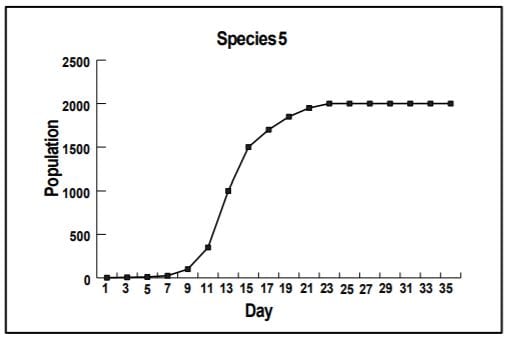 What is the carrying capacity of this population?
2,000
200
How much energy is lost up the food chain?
90%
200
Name all of Earth's spheres.
Atmosphere, biosphere, geosphere, hydrosphere.
200
What do scientists believe to be the cause of change in average global temperatures?
Increasing amounts of CO2 from human activities like burning fossil fuels.
200
What are pesticides and what are they used for? And, what is the problem with using them?
A chemical used to kill and control unwanted insects and can build up the food chain.
300
What are 2 biotic and 2 abiotic limiting factors that control a population's size?
Biotic:
1) Food
2) Predators
Abiotic:
1) Water
2) Space
300
Identify the a food chain with a tertiary consumer.
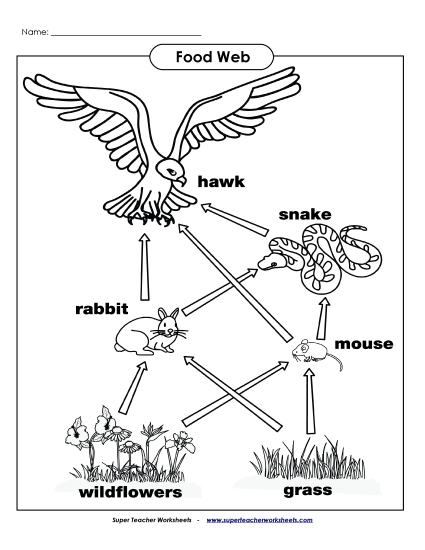
Wildflowers --> mouse --> snake --> hawk
300
What are two ways that carbon is naturally removed from the atmosphere?
photosynthesis and oceanic absorption
300
How has Earth's climate and atmospheric CO2 levels changed throughout Earth's history?
It has going up and down due to natural cycles. For example, when CO2 levels were low Earth experienced an ice age.
300
What are fertilizers? What are the problems with using it?
A chemical that gives nitrogen and phosphorous nutrients to plants to help them grow. Can lead to nutrient pollution.
400
The gray wolf has been almost entirely eliminated from an forest ecosystem due to overhunting. What is the most likely impact on primary consumers and the producers?
Primary Consumers: Likely increase due to no predators
Producers: Likely decrease due to too many Primary Consumers
400
Explain how producers and consumers get their energy.
1) Identify the process.
2) Name the inputs and outputs.
3) Explain why plants are called "producers" while animals are called "consumers".
Plants are producers because they produce their own glucose through photosynthesis. The inputs are CO2, water, and sunlight. The output is glucose and O2. That is then used in cellular respiration to make water, CO2 and energy for the cell.
Animals are consumers because they have to consume glucose to make energy through cellular respiration. The inputs are glucose and oxygen. The outputs are water, CO2, and energy for the cell.
400
Identify the process below for the carbon cycle:
__________ the process of carbon moving from the biosphere to the atmosphere.
__________ the process of carbon moving from the atmosphere to the biosphere.
__________ the process of carbon moving from the biosphere to the lithosphere (soil & top layer of geosphere).
__________________ the process of carbon moving back and forth from the atmosphere and hydrosphere.
5. __________________ the process of carbon being released from the geosphere into the atmosphere through burning.
1. cellular respiration
2. photosynthesis
3. decomposition
4. oceanic absorption
5. combustion
400
What are 3 impacts of climate change? Explain which of Earth's sphere will be affected.
1) Cryosphere- melting glaciers
2) Hydrosphere- rising sea levels
3) Atmosphere - rising air temperatures
400
DDT was a common pesticide used in the 1950-1960's. Explain how DDT and Bald Eagles became an example of bioaccumulation and biomagnification.
Bioaccumulation-DDT built up in organisms
Biomagnificaiton-DDT increased up the food chain and the Eagle had the most
500
A new non-native species of plant is brought into help stabilize a river bank.
1) What is the term for this non-native plant?
2) What is the most likely impact on native plants and animals around the river bank?
1) Invasive species
2) Native plants will lose out due to being outcompeted with.
Animals will lose native food sources and struggle to adapt to new food source (invasive species).
500
If there is a simple food chain of grass, mouse, snake, hawk find out how many calories each would get if there was 152,000 calories in the grass.
Grass = 150,000 calories
Mouse = 15,200 calories
Snake = 1,520 calories
Hawk = 152 calories
500
Explain two ways that humans have altered the carbon cycle and which of Earth's spheres that impacts.
1) Burning fossil fuels. Remove more carbon from geosphere and adds it to atmosphere.
2) Deforestation. Leave more carbon in the atmosphere.
500
If humans don't take any action, what will the future look like in 2100?
And, describe 3 solutions we should take now to fight climate change.
CO2 levels will continue to rise and so too will global temperatures.
Solutions:
1) Use alternative energies
2) Drive electric vehicles
3) Plant more trees
500
Explain how fertilizer leads to eutrophication, nutrient pollution, and dead zones.
See Mr. G