Identify the strip
Treat this
Count that HR
Random
More Random
100
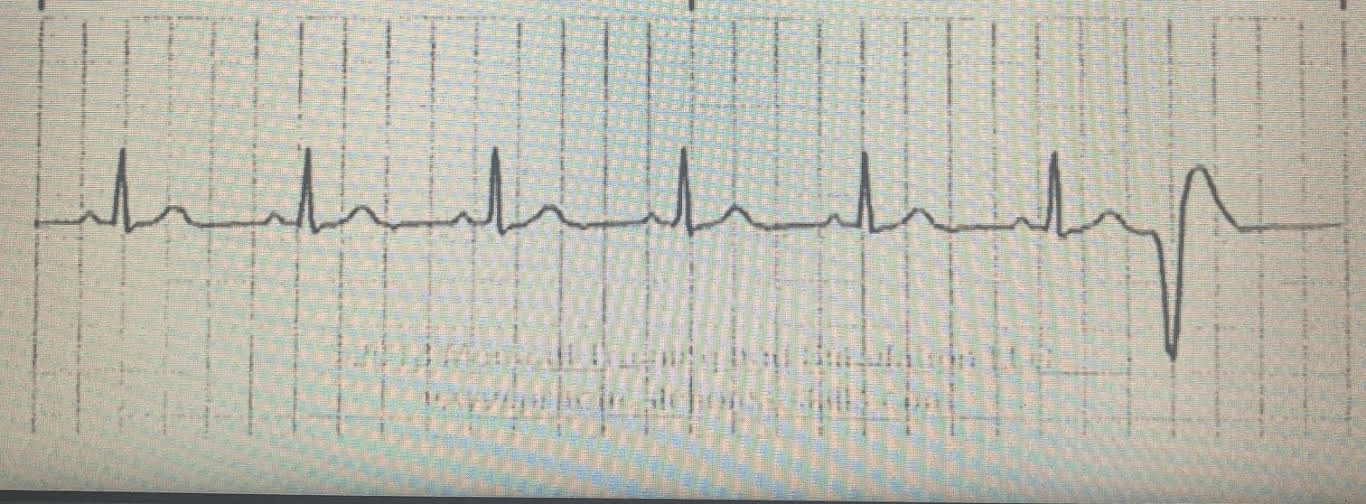
a. Sinus Tachycardia
b. Ventricular Fibrillation
c. Premature Ventricular Tachycardia
d. Atrial Fibrillation
c. Premature Ventricular Tachycardia
A PVC is a premature beat that originates in the ventricles and interrupts the underlying rhythm. Defining characteristics: P Wave is absent in premature beat, the QRS complex is abnormally wide ≥ 0.12 seconds, and the T-wave is generally in the opposite direction as the QRS complex
100
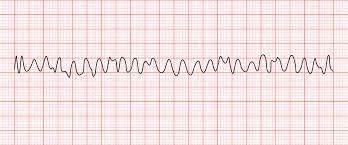
Which medication would be the first-line of treatment for this rhythm?
a. Epinephrine
b. Amiodarone
c. Atropine
d. Diltiazem
a. Epinephrine
This is Vfib.
Epinephrine is used in symptomatic bradycardia and cardiac arrest arrhythmias such as: Ventricular fibrillation (VF) Pulseless ventricular tachycardia (PVT) Asystole.
100
In order to determine an ECG rhythm, which 3 criteria must be analyzed?
a. HR, BP, SPO2
b. HR, SV, BP
c. CO2, HR, BP
d. Regularity, HR, intervals
d. Regularity, HR, intervals
Regularity is determined by measuring the P – P interval and the R – R interval
• If the intervals are irregular, this denotes an arrhythmia
• There should be one P Wave for every QRS Complex
100
A normal PR interval is:
a. 0.12 - 0.20 secs
b. <0.10 seconds
c. 1 - 2 seconds
d. 0.20 - 0.30 seconds
a. 0.12 - 0.20 seconds
Notes from Maria's EKG folder
The PR interval represents the time between atrial depolarization and ventricular depolarization. A very long PR interval may lead to AV dissociation requiring permanent pacing (pacemaker).
100
What is the difference between cardioversion and defibrillation?
a. cardioversion does not have a pulse
b. defibrillation needs to be synchronized
c. cardioversion needs to be synchronized
d. defibrillation is done for ventricular fibrillation
c. cardioversion needs to be synchronized.
Cardioversion is usually done to treat people who have atrial fibrillation or atrial flutter.
Defibrillation - is the treatment for immediately life-threatening arrhythmias with which the patient does not have a pulse, ie ventricular fibrillation (VF) or pulseless ventricular tachycardia (VT)
200
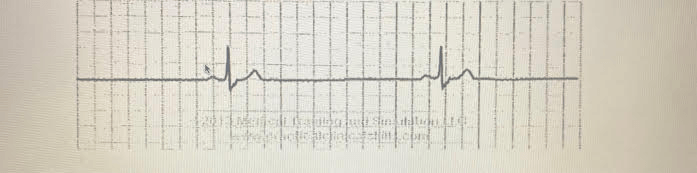
a. Pulseless electrical activity
b. Sinus Bradycardia
c. Asystole
d. PVC
b. Sinus Bradycardia
From Dieter's PDF:
Regularity: P–P and R–R intervals occur at regular intervals. There is one P Wave for every QRS Complex
• Heart Rate: Measures less than 60bpm. Example: 40 bpm
• Intervals: PRInterval:0.12seconds(between0.12-0.20seconds)
• QRS Duration: 0.06 seconds (between 0.06-0.12 seconds) •QT Interval: 0.44 seconds (<0.45 seconds)
200
Your patient has just been administered 0.5 mg of atropine. Which rhythm would you expect to see on the monitor?
a. Sinus rhythm
b. Ventricular tachycardia
c. Sinus bradycardia
d. Atrial flutter
c. Sinus bradycardia
Atropine is useful for treating symptomatic sinus bradycardia and may be beneficial for any type of AV block at the nodal level. The recommended atropine dose for bradycardia is 0.5 mg IV every 3 to 5 minutes to a maximum total dose of 3 mg.
200
Which of the following is the best description of the Six Second Rule?
a. It is the most accurate way to measure HR and is done by counting the number of R waves in a 6 second strip and multiple of 5.
b. It is the least accurate way to measure HR and is done by counting the number of P waves in a 6 second strip and multiple of 10.
c. It is the most accurate way to measure HR and is done by counting the number of QRS intervals in a 6 second strip and a multiple of 10.
d. It is the least accurate way to measure HR and is done by counting the number of R waves and is done by counting the number of R waves in a 6 second strip and a multiple of 10.
d.
Understand that if the rhythm is irregular this method will be even more inaccurate
200
Which of the following best describes what the P Wave represents:
a. Electrical conductivity
b. Ventricular depolarization
c. Atrial depolarization
d. That the heart is pumping effectively
c. Atrial depolarization
The P wave indicates atrial depolarization. The P wave occurs when the sinus node, also known as the SA node, creates an action potential that depolarizes the atria.
200
The ambulance is bringing in a patient in cardiac arrest. When they arrive, the ECG confirms that the patient is in ventricular fibrillation. What is your first priority?
a. Defibrillate
b. Synchronized cardioversion
c. Administer Epinephrine 1 mg IV
d. Perform CPR
A. Defibrillate.
Defibrillation with an AED is the most successful treatment for ventricular fibrillation (VF). A shock is delivered to the heart to uniformly and simultaneously depolarize a critical mass of the excitable myocardium
300
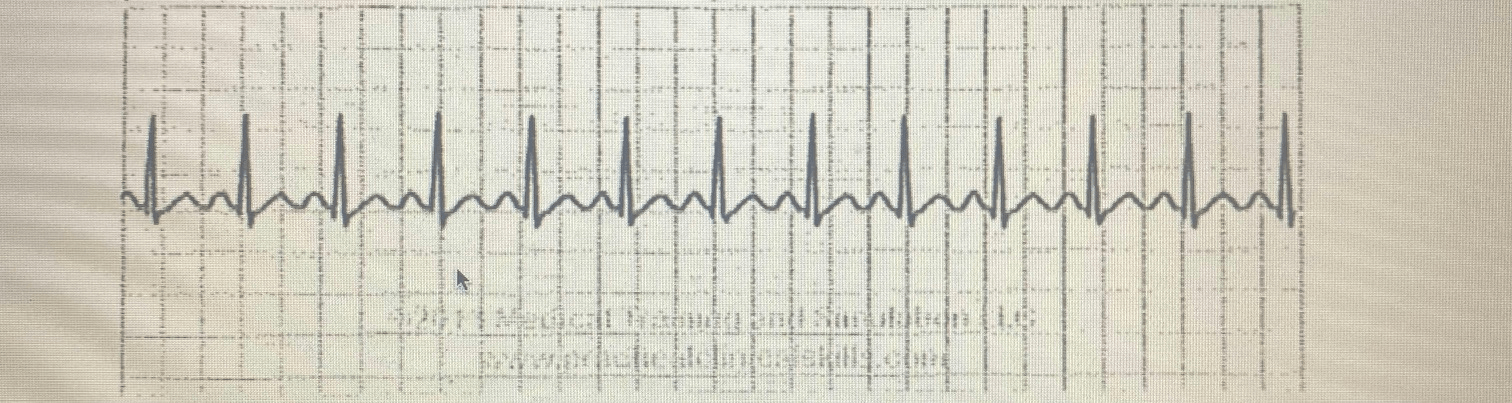
a. Super Ventricular Tachycardia
b. Sinus Tachycardia
c. Atrial Flutter
d. Atrial Fibrillation
b. Sinus Tachycardia
Description:
Regularity: P–P and R–R intervals occur at regular intervals. There is one P Wave for every QRS Complex
• Heart Rate: Measures greater than 100bpm.
PRInterval:0.16seconds(between0.12-0.20seconds)
QRS Duration: 0.08 seconds (between 0.06-0.12 seconds) QT Interval: 0.32 seconds (<0.45 seconds)
Honestly for me, I count the R waves (in this case there are 11) which means the HR is atleast 110. This indicates tachycardia, then identify the P waves (second "hill" before the "spike") before the QRS (idk if thats confusing or not)
300
Your patient in Room 412 has the following rhythm. Which medication should you prepare to administer?
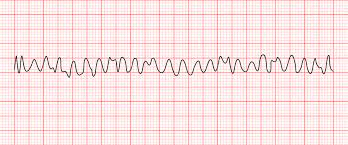
a. Amiodarone
b. Epinephrine
c. Digoxin
d. Diltiazem
a. Amiodarone.
Amiodarone is used to treat certain types of serious (possibly fatal) irregular heartbeat (such as persistent ventricular fibrillation/tachycardia). It is used to restore normal heart rhythm and maintain a regular, steady heartbeat. Amiodarone is known as an anti-arrhythmic drug.
300
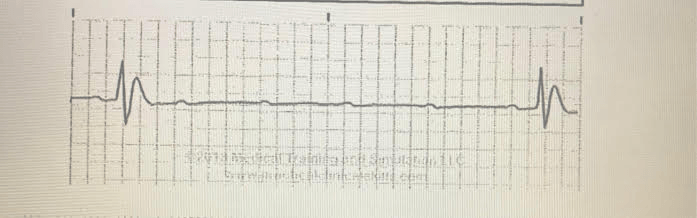
What is the HR for this ECG strip? a. 40
a. 40
b. 60
c. 100
d. 80
b. 60
Count the number of R Waves in a 6 second strip and multiple by 10,
There are 6 R Waves therefore 6 x 10 = 60
300
Which of the following best describes the ST segment?
a. A time in the cardiac cycle when the electrical impulses travel through the Bundle of His to the Bundle Branches
b. A time in the cardiac cycle when the electrical impulses travel through th ventricles via the Bundle Branches through the Purkinje Fibers
c. A time in the cardiac cycle where there is no depolarization, therefore the line is flat.
d. A time in the cardiac cycle where repolarization occurs, otherwise known as the resting state.
c. ST Segment is a time in the cardiac cycle where there is no depolarization, therefore the line is flat
• ST Segment is an indicator of ischemia if the line is above or below the isoelectric line
300
I have an irregular rhythm that varies with respiration.
My rate is normal but may increase during inspiration.
My P Wave is normal.
My PR interval is 0.12 - 0.20 secs
My QRS is 0.06 - 0.10 secs
Lastly, the HR frequently increases with inspiration and decreases with expiration.
What arrhythmia am I?
a. Ventricular tachycardia
b. Sinus arrhythmia
c. Atrial Fibrillation
d. Premature Ventricular tachycardia
b. Sinus arrhythmia
Notes from Maria's PPT:
Variation in heart rate can be related to breathing cycle. The rate increases when the person breaths in and decreases when the person breaths out.
• May occur in association with heart disease in the elderly.
• In general, the presence of sinus arrhythmia is not indicative of the need for further testing and is generally benign.
400
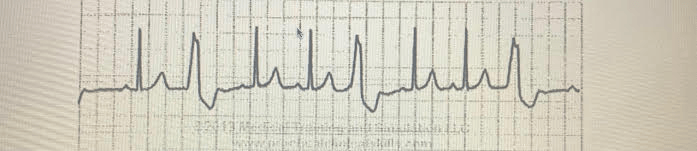
a. Third Degree Block
b. Trigeminy
c. Mobitz I
d. Mobitz II
b. Trigeminy
Description:
Rhythm- irregular
Rate- The underlying rate
P Wave - absent
QRS- Wide (>0.10 secs), bizzare appearance
PVC's occur every 3rd beat
This pattern can be two normal (sinus) beats and one abnormal one. Another trigeminy pattern is two PVCs with one sinus beat.
400
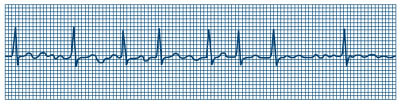
Which calcium channel blocker would be used for this rhythm?
a. Labetolol
b. Diltiazem
c. Digoxin
d. Epinephrine
b. Diltiazem
This rhythm is AFib.
The calcium channel blockers diltiazem (Cardizem) and verapamil (Calan, Isoptin) are effective for initial ventricular rate control in patients with atrial fibrillation.
400
What is the HR for this 6 second strip?
a. 100
b. 120
c. 90
d.160
a.
Count the number of R Waves in a 6 second strip and multiple by 10, therefore 10 x 10 = 100
400
You have a patient with the following rhythm that is not responding to the medication. What would you need to prepare?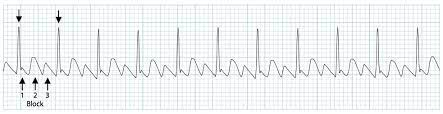
a. defibrillation
b. synchronized cardioversion
c. unsynchronized cardioversion
d. transcutaneous pacing
b.
This patient has atrial flutter.
Cardioversion can correct a heartbeat that's too fast (tachycardia) or irregular (fibrillation). Cardioversion is usually done to treat people who have atrial fibrillation or atrial flutter
400
A 71 year old femal has recieved the maxium dose of atropine and continues to be bradycardic and symptomatic. An external pacemaker is not available. Her BP is 62/40, Pulse 33 and RR 10. Which medication should be attempted next?
a. norepinephrine infusion
b. dopamine infusion
c. lidocaine IV bolus
d. magnesium sulfate IV bolus
b. dopamine infusion
Atropine is the first line of treatment for sinus bradycardia followed by a pacemaker however since this patient has had her maximum dose and a pacemaker is not available, the medication to be considered is Dopamine IV infusion 5 to 20 mcg/kg.
500
a. Second Degree Block (Mobitz I)
b. Third Degree Block
c. Bigeminy
d. Second Degree Block (Mobitz II)
b. Third Degree Block
From Maria's Paper:
Rhythm- Regular, but atrial and ventricular rhythms are independent
Rate- Characterized by atrial rate usually normal and faster than ventricular
P Wave- Normal shape and size, may appear within QRS complexes
PR Interval- Absent: atria and ventricles beat independently
QRS- Normal, but wide if junctional escape focus
From Dieter's PDF:
Regularity: P–P intervals are regular and R–R intervals are regular. There are more P Waves than QRS Complexes. Third Degree AV Block is asynchronous because the atria and ventricles function independently from one another
Atrial rate will usually be normal, between 60-100 bpm. Ventricular rate will be slower If junctional focus takes over, ventricular rate will be 40-60 bpm
If ventricular focus takes over, ventricular rate will be 20-40 bpm
PR Interval: No pattern. P waves have no relationship to QRS complex.
QRS Duration: If junctional focus QRS < 0.12ms, if ventricular focus QRS ≥ 0.12 sec.
QRS Complex: 0.20 seconds QT Interval: 0.52 seconds
500
Which medication would be appropriate to treat this rhythm?
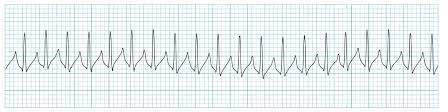
a. Amiodarone
b. Epinephrine
c. Adenosine
d. Digoxin
c. Adenosine
Adenosine is the primary drug used in the treatment of stable narrow-complex SVT (Supraventricular Tachycardia). Adenosine can also be used for regular monomorphic wide-complex tachycardia. When given as a rapid IV bolus, adenosine slows cardiac conduction particularly affecting conduction through the AV node.
500
What is the HR for this 6 second strip?
a. 70
b. 60
c. 40
d. 50
c. 40
Count the number of R Waves in a 6 second strip and multiple by 10
4 x 10 = 40
500
A patient presents to the ED with palpitations, dyspnea, and diaphoresis. The ECG monitor shows supraventricular tachycardia. Her BP is 91/60, HR 172, saturation 90% on RA, RR 24/min. Which intervention would be most appropriate?
a. Vagal maneuvers
b. Atropine 0.5 mg IV
c. Defibrillation
d. Synchronized cardioversion
d. Synchronized cardioversion
Cardioversion can be used to attempt to change the rhythm of the heart. The initial evaluation for cardioversion is by assessing the patient's hemodynamic status. This patient is hypotensive, has palpitations, as well as supraventricular tachycardia, immediate electrical cardioversion should be considered.
500
You have delivered a synchronized monophasic shock with 100 J to an unstable patient with supraventricular tachycardia (SVT). The monitor now shows ventricular fibrillation. The patient is pulseless and apneic. Your best course of action will be to:
a. administer epinephrine, 1 mg IV bolus
b. Administer another synchronized monophasic shock with 100 J
c. Begin CPR, intubate and establish IV access
d. Assure the "synch" control is off and defibrillate with 200 J
d. Assure the "synch" control is off and defibrillate with 200 J
Because the QRS interval is irregular with Vfib, synch should be turned off and another defibrillation should be immediately administed at a higher Joule (up to 200 with Monophasic shocks)