Log. Fallacies I
Log. Fallacies II
Rhetoric General
Rhet. Devices I
Rhet. Devices II
MISC.
100
Personal attack. Attacks person rather than idea/issue.
Ad Hominem
100
Based on the assumption that the opinion of the majority is always valid.
Ad Populum/Bandwagon
100
Considered together, the three rhetorical appeals form what later rhetoricians have called:
Rhetorical Triangle
100
You are very, very, very, very pretty
Repetition
100
The use of words or phrases with strong connotations to elicit an emotional respone.
Loaded Language
100
Explain the difference between denotation and connotation.
Denotation refers to the literal definition of a word.
Connotation refers to the emotions and ideas associated with the word.
200
The string of events leading to a negative end result is caused by the first event.
Slippery Slope/ Bandwagon
200
A diversion tactic that leads people away from the key or real issues.
Red Herring
200
Relies on feelings and emotions to persuade.
Pathos
200
Water is wet. Water is good. Water is life.
Anaphora
200
He fished for trout and compliments all night during our date.
Zeugma
200
Identify and define the three parts discussed that make up tone.
Diction - Word choice
Imagery - figurative language that appeals to the senses (answers vary).
Syntax - Sentence Structure
300
I once got bit by a pit bull, so all pit bulls must be aggressive.
Hasty Generalization
300
Assuming that an incident that precedes another is the cause of the second
Post Hoc
300
Relies on logic, information, and stats to persuade
Logos
300
Literary device that involves repeating a word or phrase at the end of a clause or sentence and at the beginning of the next.
Ex. Fear leads to anger. Anger leads to hate. Hate leads to suffering
Anadiplosis
300
Repetition of a word or expression at the end of successive phrases.
Ex."And I am whatever you say I am. If I wasn't, then why would I say I am? In the paper, the news, everyday I am"
Epistrophe
300
Identify what the acronym S.P.A.C.E.R.A.T. stands for.
Speaker, Purpose, Audience, Context, Rhetorical Device, Appeals, Tone
400
lkaline water is healthy because it results in health benefits, and it has health benefits because it is healthy
Circular Reasoning
400
Lloyd: Can you allow time for more class discussion?
Prof. Schwartz: Oh, obviously you're saying that you and the entire class hasn't studied and now you want to talk to each other to get answers and cheat!
Strawman
400
Relies on a person's credibility, trustworthiness, reliability, and who they may know to persuade.
Ethos
400
A euphemism is a polite or mild way of saying something that might be unpleasant or offensive.
Example: He is in his "golden years" vs. he is "old."
Euphemism
400
Deliberately omits conjunctions between parts of a sentence to create a fast-paced, emphatic, or urgent tone.
Example: You must go up the hill, down the road, through the tunnel, around the corner, past the trees--all before you can get home.
Asyndeton
400
Based on the advertisement, identify and give an example of each of the Rhetorical Choices used.
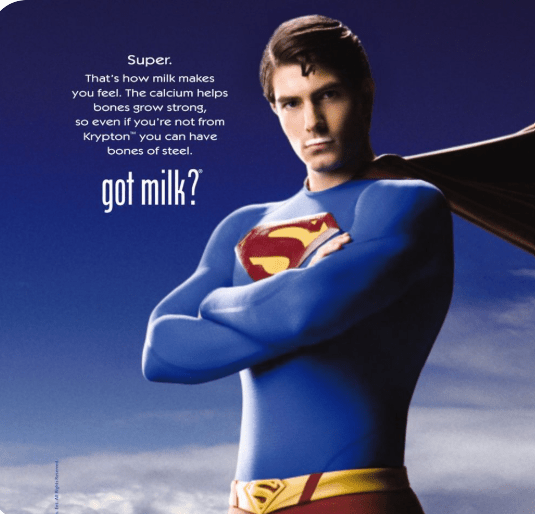
RHETORICAL DEVICES - Rhetorical Question, allusion, etc.
APPEALS - Ethos (the use of Superman--a well known superhero figure to create credibility) Pathos (relates back to the audience as though they can also be a superhero) Logos (explanation of the calcium in bone development)
TONE- Answers vary (must include reasoning)
500
Both apples and strawberries are red. Since they are both red and are fruit, then all fruit must be red.
False Analogy
500
When a key term or phrase in an argument is used in an ambiguous way, with one meaning in one portion of the argument and then another meaning in another portion of the argument/ambiguity of words or the use of zeugma.
Example: A driver who gets pulled over tells the officer that they drank only a few beers when in reality they had a few beers plus two mixed drinks.
Equivocation
500
Rhetoric is defines as elements of ____________________ and _____________________.
argument and persuasion.
500
Involves using conjunctions repeatedly in a sentence.
Example: Neither snow nor rain nor heat nor gloom of night stays these couriers from the swift completion of their appointed rounds".
Polysyndeton
500
Statement or situation that seems to contradict itself or go against common sense.
Example: "You have to spend money to make money"
Paradox
500
Based on the picture, identify and give a thorough examples of the parts of the rhetorical situation.
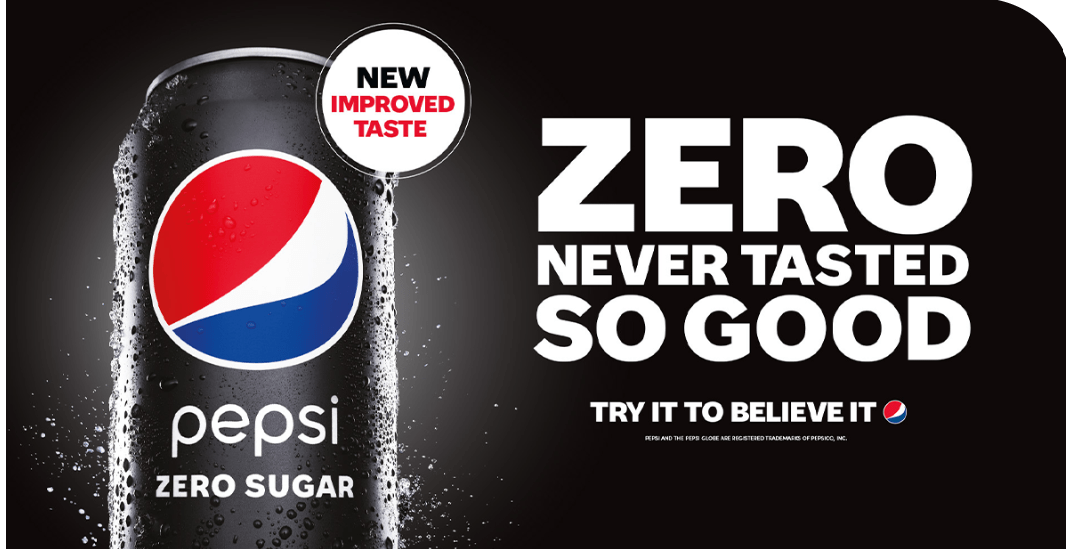
SPEAKER - Pepsi, a popular soda brand
PURPOSE - Advertise the new "improved" Pepsi in order to gain more customers (answers vary- specifically selling/profit).
AUDIENCE - Answers Vary (people who like soda but want to avoid sugar , people who like Pepsi but don't like the taste of Zero sugar, etc.)
CONTEXT - Message: New and improved zero sugar soda that doesn't take like "zero sugar".
Exigence - Catalyst is that Pepsi came up with a zero sugar soda that has an "improved taste" they want to advertise.