Ohm's Law
Electric Circuits
Parallel vs Series
Conductors & Insulators
Standard Units
100
What are the 3 components of Ohm's law?
Voltage, Current, and Resistance
100
How do electrons flow through a circuit: from positive to negative terminal OR negative to positive terminal?
From the positive to negative terminal.
100
Is this a parallel or series circuit?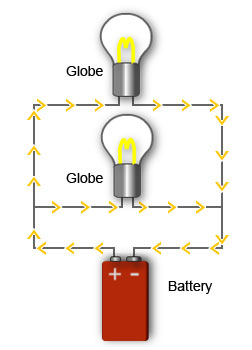
Parallel circuit
100
Is this a good conductor or insulator?
Good conductor
100
What is the standard unit of resistance?
Ohms
200
What is the formula for finding the current in a circuit?
I=V/R
200
What are the 3 essential components to an electric circuit?
1-Load
2-Wires
3-Power supply
200
What is one advantage of a parallel circuit?
Possible answers:
-Each bulb can be turned on individually
-If one bulb blows, the rest keep working
-Extra globes do not affect the brightness of other globes
200
Describe the movement of electrons when they encounter an insulator?
The electrons are stopped from flowing so they are blocked.
200
What is the standard unit of current?
Amperes (A)
300
Can you explain why this triangle helps us remember the formulas for Ohm's law?

Because it shows you when you need to multiply or divide.

300
True or False: An open circuit does not allow electrons to flow.
True. In an open circuit, it is incomplete so electrons cannot flow.
300
If bulb 2 is out, what will happen to bulb 1 and 3? Will they remain lit or turn off?
Bulb 1 and 3 will remain on since they each still have a complete loop.
300
Which has less resistance: conductors or insulators?
Conductors
300
What is the standard unit for voltage?
Volts (V)
400
Use the analogy the water flowing through a pipe to describe the effects of voltage.
The higher voltage in a circuit, the higher the 'push' that the electrons receive.
400
What is disadvantage of a series circuit?
Possible answers:
-Bulbs cannot be individually controlled
-If one bulb is out, then current stops flowing
-The more lights you add, the dimmer they are
400
How much voltage is each bulb getting if there is a 6V battery in this circuit?
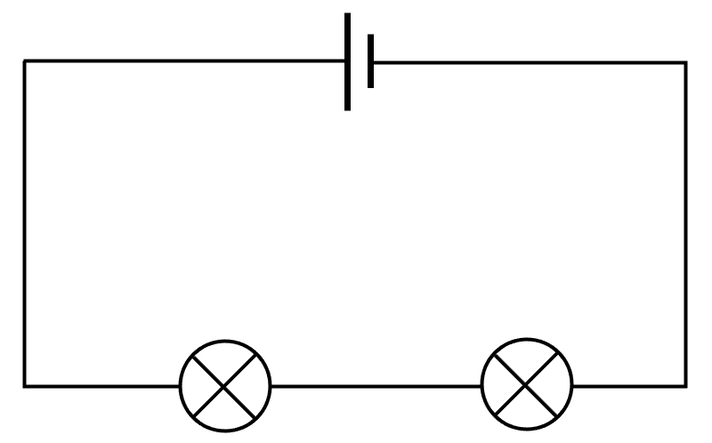
Each bulb would receive half of the total voltage so 3V each.
400
Does this image depict a conductor or insulator? Explain WHY.
Conductor since there are electrons moving freely which allows current to flow effortlessly when voltage is applied.
400
What standard unit is this symbol used for?
Ohms
500
Using the formula for Ohms law (V=IxR) is this statement true or false:
As you increase the voltage of an electric circuit, the current decreases (given that resistance stays the same).
False.
As you increase voltage, the current increases (given the resistance stays the same).
500
What is an example of a power supply other than a battery?
Possible answers: generators, wall outlet etc.
500
How much voltage is each bulb getting if there is a 12V battery in this circuit?
Each bulb would receive 12V.
500
Why can someone be shocked if they touch a bare wire?
Touching a bare wire shocks you because your body acts as a bridge, completing an electrical circuit.
500
How do you convert mV to V?
Divide by 1,000