Reactions
Thermodynamics
ATP
Enzymes
Enzyme regulation
100
This type of reaction is responsible for breaking down large bonds
Catabolic Reactions
100
How many laws are there that govern energy that cells and organisms must follow? What are they called?
2, Laws of Thermodynamics
100
ATP stands for
Adenosine triphosphate
100
An enzyme is an example of what organic molecule
protein
100
What are two ways enzymes can be regulated?
by Inhibitors and Allosterically
200
This reaction is responsible for the building of macromolecules from monomers
Anabolic reactions
200
The law that states that energy cannot be created or destroyed is known as
First law of thermodynamics
200
This form of energy is important to cells because it is
the main form of energy storage and currency
200
In the event that an enzyme is deformed, it is known as
denature
200
The main difference between an Allosteric regulation and Inhibition is that
Inhibitors bind to the active site and inhibit the function
Allosteric regulators bind to the allosteric site, changing the site of the enzyme activating or deactivating it.
300
An _______ reaction is to being endergonic, and a catabolic reaction is to being _________.
Anabolic; Exergonic
300
Organisms often obtain energy and convert it to this form of energy
Chemical energy
300
How does ATP accumulate energy to store for cells?
By picking up the free energy released from exergonic reactions
specifically chemical bonds
300
In order for an enzyme to successfully catalyze a reaction, what is required of the enzyme?
It must first lower the activation energy.
does the lowering of activation energy affect Gibbs free energy?
300
Irreversible inhibitors bind to the active site via ____ bond
Reversible inhibitors bind to the active site via _____ bond
Covalent; Non-covalent
400
A ______ is an organism who's energy source comes directly from the sun.
Producers
400
The measure of disorder in a system is measured by this
Entropy
400
The energy is stored in ATP in
Phosphate bonds
400
During the lowering of activation energy, when the reactants are in their unstable state, what are they called?
Transition state intermediates
400
When the final product acts as an inhibitor for the first enzyme in the pathway, what is this known as?
Feedback inhibition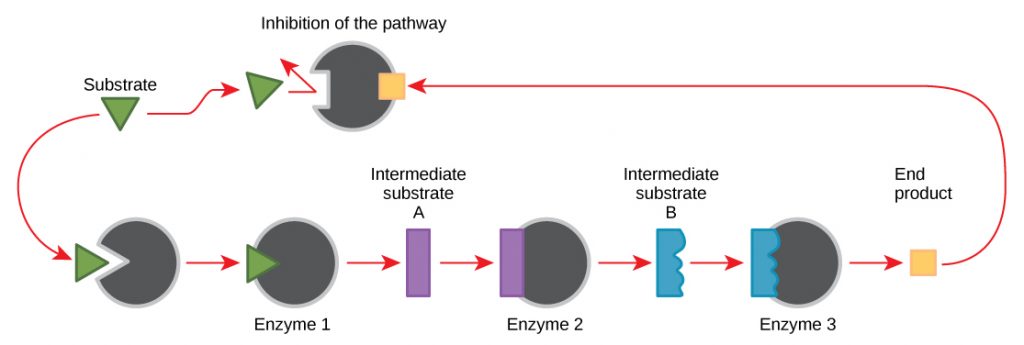
500
The hydrolysis of a molecule is an example of _______ due to the _________ of energy.
Catabolic reaction, release, exergonic
500
Sarah has a lot of stuff going on and begins to become stressed. She feels she is too busy to clean her room, but in reality, she does have time to make her bed.
Each time Sarah renters her room from a long day, she feels out of order, and that disorder increases each day.
How does what Sarah is going through relate to our topic?
It relates to Entropy, in that the degree of disorder naturally increases as no work is done. Sarah neglecting to clean her room, and that disorder she is feeling is an example of that naturally increasing disorder if no work is done.
500
ATP couples exergonic and endergonic reactions, draw a diagram of one
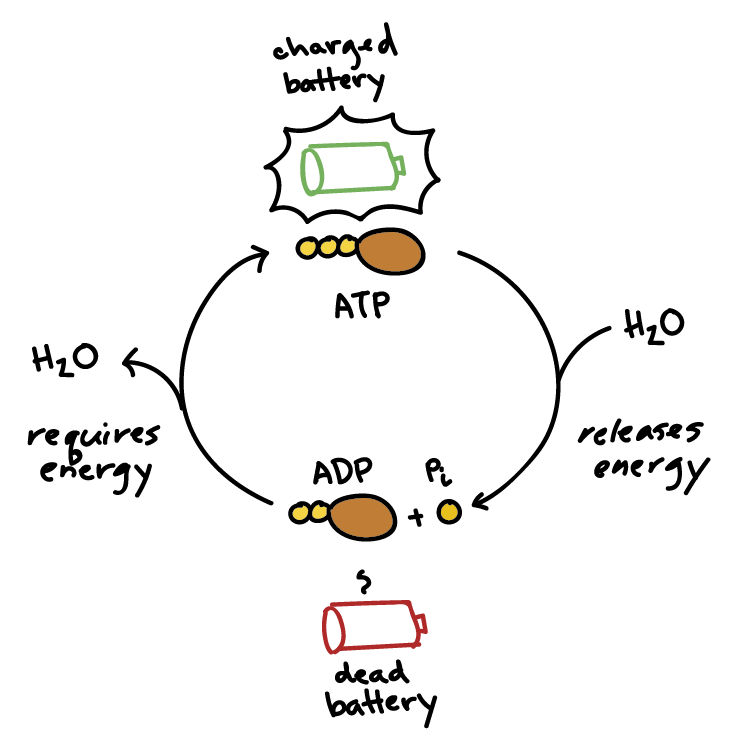
500
What are the three ways that activation energy is lowered?
1. enzymes move substrates into the correct reaction orientation
2. enzymes strain bonds between substrates putting them in an unstable transition state
3. enzymes temporarily adda chemical group to the substrate and destabilizes its bonds.
500
This type of regulation is most prevalent in many metabolic pathways. Why?
Allosteric regulation
because they are able to be specifically controlled by the cell.