Energy Basics
PE and KE
WORK
Energy Conservation Concepts
Random
Final Jeopardy
100
If something has energy, then it has the ability to ___ ____________ or _______ ________.
DO WORK
CAUSE CHANGE
100
1) Energy of motion:
2) Energy due to position, structure, or arrangement:
1) Kinetic
2) Potential
100
What does the "dot" in the Work formula imply?
The "dot" means that you have to use the component force vector that is PARALLEL to the displacement vector when calculating work.
100
The roller coaster is at rest at point A. AFTER point A, it is in motion. Zero-point is at the bottom of the structure. There is no friction.

Where is KE the GREATEST?
D (lowest point on the track)
100
The "quickie" formula for calculating velocity of an object dropped from a specific height.
√2gh
(square root of 2gh)
200
Units of energy (name AND abbreviation)
joules (J)
200
The sum of potential and kinetic energies in a system.
MECHANICAL Energy
200
A mover pushes a 260.-kg piano on wheels up a ramp 7.0 meters long onto a stage 1.75 meters above the auditorium floor. The mover pushes the piano with a force of 680 N. HOW MUCH WORK DOES THE MOVER DO?
W = Fd
W=680*7.0 = 4800J
200
The roller coaster is at rest at point A. AFTER point A, it is in motion. Zero-point is at the bottom of the structure. There is no friction.
At what point(s) does the roller coaster have both P.E. and K.E.?
B, C, D, E
200
A skydiver jumps from a plane. They start with 392,000J of potential energy. (assume no friction or air resistance)
How much K.E. will the skydiver have 3/4 of the way down?
294,000J
(If the skydiver has fallen 3/4 of the way down, then they have lost 3/4 of their P.E. which has transformed into K.E. 3/4 x 392,000J = 294,000J)
300
What type of energy is associated with friction?
THERMAL energy
300
The velocity of a car changes by 3x and it climbs up a 10m mountain.
By how many times does it's KE change by?
9x
300
How much power is developed by an electric motor that moves a 500-N load a distance of 20 meters in 10 seconds?
1000 watts
300
The roller coaster is at rest at point A. AFTER point A, it is in motion. Zero-point is at the bottom of the structure. There IS friction!
If the coaster system has 100,000J of total energy at A, how much total energy does the system have at E?
A) Less than 100,000J
B) 100,000J
C) More than 100,000J
B
300
A human with a mass of 90kg jumps off a diving platform that is 5m above the water.
What is their velocity at the moment of impact?
(Round to the nearest TENTH)
9.90m/s
400
Thermal energy transfer is also called...
HEAT
400
A bird flies from an altitude of 100 to 500 feet.
By how many times does it's Potential Energy change by? (?x)
(Think carefully!)
5x
400
A 800kg car slams on its brakes, stopping in 10m. The magnitude of force from the brakes is 4,000N.
How much work was done?
-40,000J
(remember, NEGATIVE work is done if force is parallel to motion BUT in the opposite direction. Also, if KE decreases, work must be negative)
400
A ball is on top of a 1m shelf. At what height will it have an EQUAL amount of PE and KE once it falls?
0.5m (halfway down!)
400
Describe the energy changes that occur when the spring of a toy car is wound up and released. (Assume the car is already wound up).
Elastic PE to KE
400
FINAL JEOPARDY!
You may wager as little as zero (0) or as much as your current score!
Choose wisely! If you get the question wrong, you will lose the amount that you bet!
LET'S GO! FINAL JEOPARDY!
500
A campfire OUTPUTS what THREE types of energy?
LIGHT
THERMAL
SOUND (a CRACKLING campfire, anyone?)
500
A 2kg model airplane is flying at a height of 3 meters, moving at 5m/s.
How much MECHANICAL energy does it have?
25J of KE, 58.8J of PE
Total Mechanical Energy: 83.8J
500
An adult pulls a child across the ice on a sled. The force on the sled and the child is 26N, and the adult pulls on a rope that joins the sled at an angle of 30 degrees above the horizontal. Ignoring friction, how much work is done pulling the sled 390m?
W = 26 cos 30 * 390 = 8800 J
500
At what point in an object's fall does KE become GREATER than PE?
After the half-way point
500
A system contains 8888 J of kinetic energy, 2222 J of potential energy, 55 J of light energy, and 9292 J of thermal energy.
1) Calculate the mechanical energy in the system.
2) Calculate the total energy in the system.
Mechanical: 11110 J
TOTAL: 20457 J
500
A 60kg skater is atop a 6m hill. What is the maximum amount of work that friction could do for the skater to still make it to the top of the second hill (4m)?
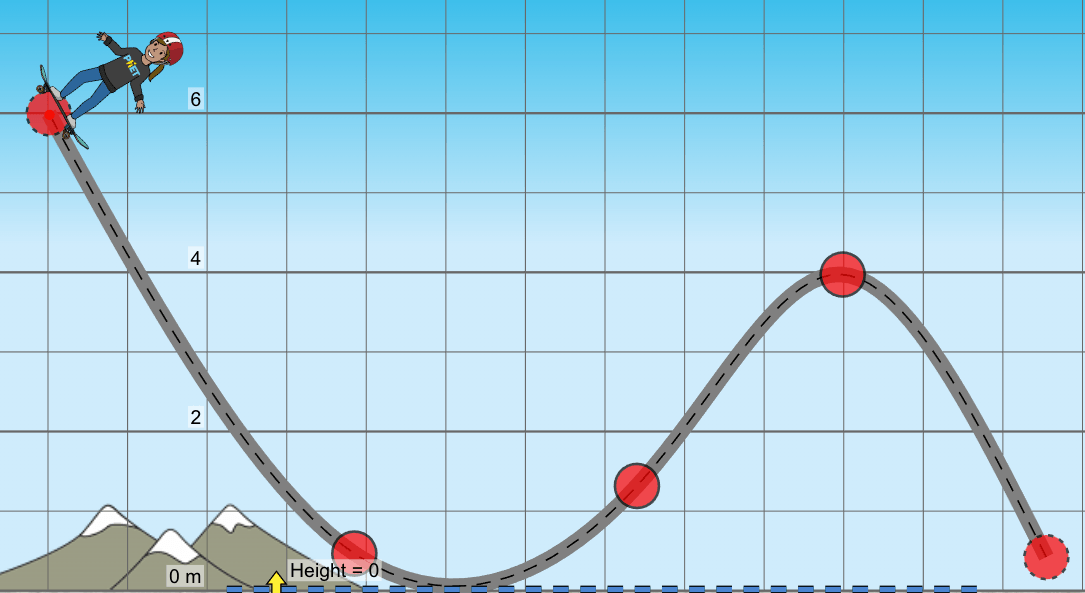
-1,176J of work!
The skater starts with 3,528J at 6m of height. They need 2,352J of kinetic to be able to reach a height of 4m (60kg x 9.8m/s2 x 4m = 2,352J). If they start with 3,528J, and only need 2,352J, then the difference, -1,176J, could be "lost" as thermal energy.