Calculations
Work
Power
Lab Procedure
Energy
100
Determine the Work done on the object below.
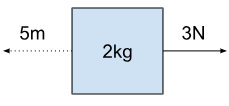
-15J
100
If force is in the same direction as displacement, the work done on the object is ______ (+,-,0)
positive
100
What are the units for Power
Watts
100
What final quantity were we trying to determine in the lab we did at the library stairs?
Power
100
An arrow goes from loaded in a bow, to launched horizontally. Describe the energy transformation (From what to what?)
Spring Potential -> Kinetic
200
Determine the power expended on an object if it gained 30J over the course of 5 seconds.
6W
200
If force is in the opposite direction of motion, the work done on the object is ______ (+,-,0)
negative
200
State two equations that can be used to calculate Power
P=W/t
P=Fv
200
Doing the same amount of work in less time suggests that you have a (higher/lower/same) power.
higher
200
How much gravitational potential energy does an object have if it is 10kg and 5m above the ground?
490J or (depends)
300
Determine the work done on this object
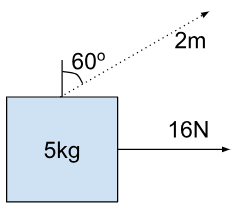
27.7J
300
Determine the work done on this object:
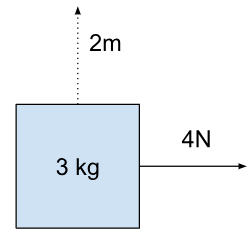
0
300
Two objects are raised to the top of an equally heighted, frictionless platform at a constant velocity in the same amount of time. Which, if either, required more power to accomplish this?
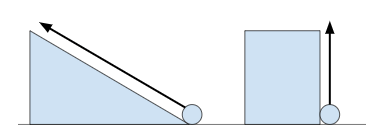
Same amount of Power
300
What equation can be used to determine the work done by a person climbing a staircase at a constant rate?
W=mgh
300
Name Two different charts or graphs that can be used to understand and communicate information related to energy
bar graph, flowchart, scatterplot, line graph, etc.
400
A 10,000kg plane accelerates from 80 m/s to 120 m/s over the course of 5 seconds. Determine the work done on it during this period of time.
40,000,000 J
400
You push a table across the room at a constant speed. Are you doing work on the table. Why or why not?
Yes, you are applying a force and it is displaced in the direction of the force.
400
Two people of equal mass race each other. Both people travel at a constant speed, but one of them is going 7m/s while the other is going 5 m/s. They are both experiencing the same amount of friction. How do their powers compare? (which one has more/equal)
the one going at 7m/s has higher power.
400
Name 2 ways our measurement of power could have been inaccurate in our lab.
Timing errors, Not starting and ending with the same velocity, etc.
400
What is another word for "change of energy of a system"
Work!
500
A 50kg person starting from rest runs up to the top of a 30m tall hill. They arrived at the top of the hill 10 seconds later with a velocity of 8 m/s. What was their average power expended?
1630W
500
A satellite moves in a circular orbit around the Earth. Is the Earth doing work on the satellite? Why or why not.
No, the gravitational force is perpendicular to the displacement of the satellite at all points in the orbit.
500
You push a cart across a room at a constant velocity. The cart is experiencing no net work. Are you expending power into the cart? Explain why or why not.
You are expending power. Friction is doing negative work while we are doing positive work. Both our force and the frictional force are expending power, but they are canceling each other out, resulting in no net power experienced by the cart.
500
A 60kg person climbed a 7.5m tall staircase in 12 seconds. What was their average power expended?
367.5W
500
A 0.1kg arrow is fired from the top of a 20m building. The bow had a spring constant of 200N/m and it was pulled back 0.4m. If the arrow lost 10J of energy to air resistance during its journey, how fast was it moving before it hit the ground?
22.6 m/s