Everything
Energy
Energy
Kinetic energy (KE) + gravitational potential energy (PEg)
What is the Law of Conservation of Energy?
Energy is neither created nor destroyed, it only changes forms.
What is work, according to physics? Explain in words and with an equation.
Work = force across a distance
W = Fd
Give an example of each:
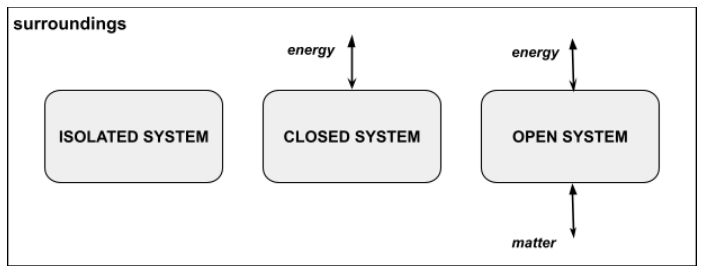
A closed system, an open system, an isolated system
A dog lifts a 0.75 kg bone straight up through a distance of 0.11 m. How much work was done by the dog?
0.81 J
The stored energy of a system based on its height relative to a reference point
Gravitational potential energy
Consider a yo-yo that you release from rest at an angle: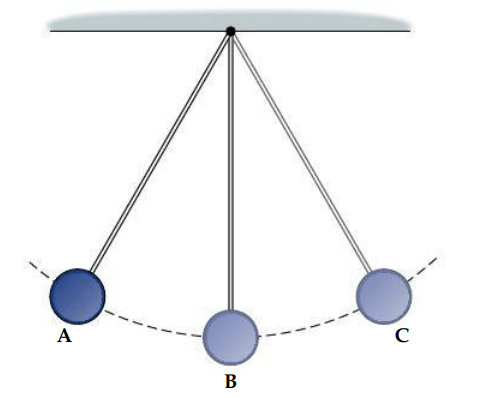
At what point(s) along the path is.... a) the KE the greatest? b) the PEg the greatest?
a) KE is greatest at Point B
b) PEg is greatest at Points A and C
How are work and kinetic energy related?
Work is the change in KE.
W = (KE)final - (KE) initial
The system you are studying + the surroundings = _______?
The universe!
A 0.085 kg arrow is fired from a bow whose string exerts an average force of 105 N on the arrow over a distance of 0.75 m. What is the speed of the arrow as it leaves the bow?
v = 49.7 m/s
The energy of motion
Kinetic Energy
There are two frictionless slides at a pool. Two swimmers slide down each slide simultaneously.
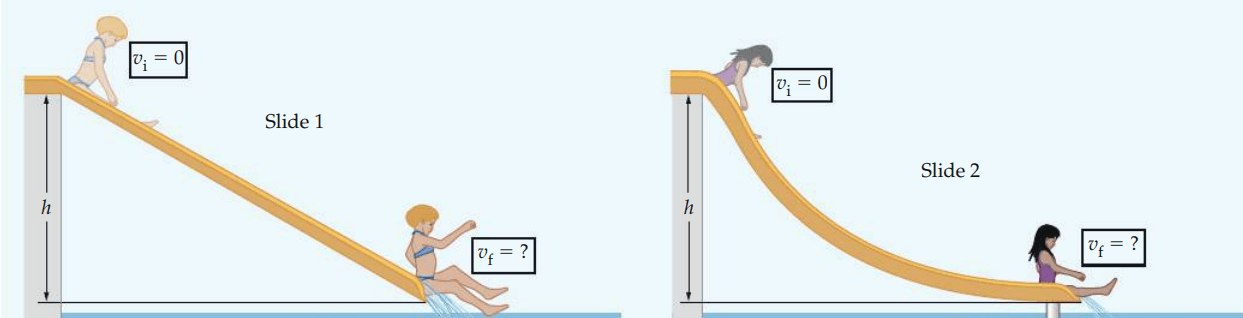
a) Which swimmer reaches the pool the fastest?
b) At the bottom of the slides, is Slide 1’s final speed greater than, less than, or equal to Slide 2’s final speed?
a) Slide 2 is fastest
b) Both Slide 1 and Slide 2 reach the same final velocity.
Describe a situation in which a force is exerted for a long time but does no work. Explain.
Answers may vary :)
Determine whether the following properties are state or path functions:
a) mass
b) distance
c) work
d) time
a) state
b) path
c) path
d) state
How much net work is required to accelerate a 1000 kg car from 20 m/s to 30 m/s?
250,000 J
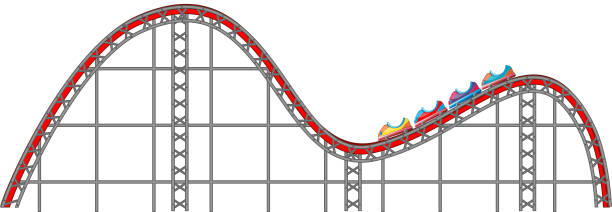
As a roller coaster speeds down a tall hill, its ________ decreases and its ________ increases.
PEg -- decreases
KE -- increases
In 2001, pitcher Randy Johnson exploded a pigeon when the baseball made contact with the poor bird. Draw a simple flowchart that shows how the Law of Conservation of Energy caused the bird to explode.

Motion of baseball (KE) --> Contact with the bird --> All of the KE is turned into PE as it makes contact with the bird --> Bird absorbs the KE as a force --> Bird explodes :(
Why is it important that kinetic energy, potential energy, and work all have the same unit?
We can directly compare these values! For example, we can understand how much energy it takes to push a ball up a hill and connect that back to speed, mass, and stored energy.
Determine whether the following forces are conservative or non-conservative:
a) gravitational force (FG)
b) friction (Ffr)
c) heat
d) air resistance (Fair)
a) conservative
b) non-conservative
c) non-conservative
d) non-conservative
Ms. D. pushes Willow in a basket across the floor (total mass of 28 kg). How much work does Ms. D. do push Willow 8.5 m across the floor with an acceleration of 0.25 m/s2? (Ignore friction).
The unit of energy is the _______.
Force is in Newtons (N).
Energy is in Joules (J).
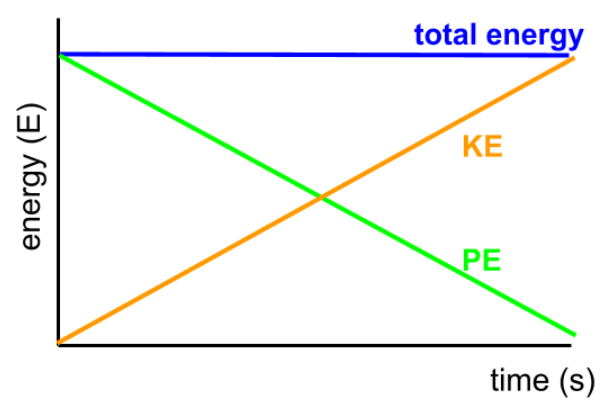
Draw a plot depicting the KE, PEg, and total mechanical energy of a ball rolling down a hill.
Car #1 accelerates from rest to a speed of 20 m/s. Car #2 accelerates from rest to a speed of 40 m/s.
If the cars have the same mass, how much more work much Car #2 put in to reach its final speed?
4x more work (1600 J vs 400 J)
The system you are studying begins with some total energy E. Over time, that energy splits among conservative and non-conservative forces, like kinetic energy and friction. Is energy still conserved?
YES! Total energy is ALWAYS conserved!
In this case: (Total Energy)initial = KEfinal + Friction
A 0.21-kg apple falls from a tree to the ground, 4.0 m below. Ignoring air resistance, determine the apple’s KE, PEg, and the total mechanical energy of the system, E, when the apple’s height above the ground is 3.0 m.
KE = 2.1 J
PEg = 6.2 J
Total E = 8.3 J