1
2
100
1. How were The Spirit of the Laws and Two Treatises on Government similar?
A. Both argued for religious tolerance and freedom of speech.
B. Both claimed that conflict between people was inevitable.
C. Both analyzed the functions and organization of government.
B. Both claimed that conflict between people was inevitable.
100
3. Which Enlightenment thinker produced plays and poems, as well as historical and philosophical essays?
A. Immanuel Kant
B.John LockeC. Montesquieu
D. Voltaire
D. Voltaire
200
2.A common theme among Enlightenment thinkers was:
A. a desire to improve society
B. a belief in the inherent goodness of humanity
C. support for democratic forms of government
A. a desire to improve society
200
The Encyclopedie was published to
A. propose a new plan of government for France
B. inspire peasants to rise up against the ruling class
C. spread Enlightenment ideas as widely as possible
D. improve the study of literature by the middle class
C. spread Enlightenment ideas as widely as possible
300
John Locke's central political value was
A. the protection of individual rights
B. designing governments around biblical teachings
C. ensuring an equal distribution of wealth
D. the empowerment of the majority of people
A. the protection of individual rights
300
The concept of individualism was most central to the political ideas of
A. Thomas Hobbes
B. Immanuel Kant
C. John Locke
D. Montesquieu
C. John Locke
400
Immanuel Kant's main writings centered on which question?
A. How can religious ideas be proven rationally?
B. How should a democratic society be organized?
C. How do humans learn about the way the world works?
D. How do humans react to new technological innovations?
C. How do humans learn about the way the world works?
400
In what way did Enlightenment philosophers reflect the central ideas of both Greek democracy and Roman republicanism?
A. They taught that rule by an elite class of nobles is necessary for running a government.
B. They thought government should represent the will of its citizens.
C. They argued that a merit-based system is the best method for selecting government officials.
D. They felt that rule by a strong central leader is the only way to govern effectively.
B. They thought government should represent the will of its citizens.
500
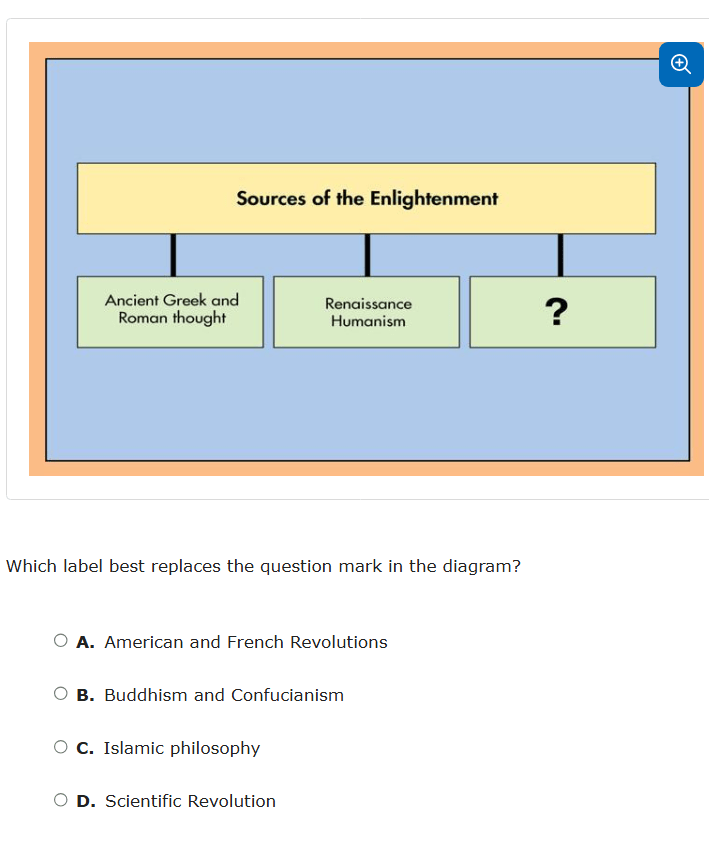
Scientific Revolution