Design Thinking #1
Design Thinking #2
Experimentation #1
Experimenation #2
Prototyping
100
This consulting firm is widely credited with popularizing the modern innovation process known as Design Thinking.
IDEO
100
These questions transform an insight into an optimistic design prompt that opens up many possible solutions.
How Might We
100
While gut feelings might guide early ideas, this approach alone is unreliable—running experiments beats relying on this every time.
Intuition
100
Before designing any study, you need this: a clear, focused inquiry that defines exactly what you're trying to learn.
Research Question
100
This acronym describes the simplest version of a product that can still deliver value to customers—just enough to test your assumptions and start learning.
MVP (Minimum Viable Product)
200
These statements should reveal a new perspective—something that reframes how you see the problem rather than restating what was observed.
Insight Statements
200
Four Reasons Why Brainstorming Fails
•Social Loafing: Reduced effort in groups, leading to fewer individual contributions.
• Lumpy Participation: One person speaking at a time limits the flow of ideas.
• Evaluation Apprehension: Fear of judgment leads to self-censorship and fewer novel ideas.
• Conformity and Groupthink: Desire for consensus stifles unique and unconventional thinking.
200
This educated guess serves as a starting point for investigation—a testable prediction about what you expect to find.
Hypothesis
200
In experiments, one group receives the intervention while the other doesn't—allowing you to compare these two conditions.
Treatment vs Control
200
This term describes how realistic a prototype is—ranging from rough sketches and paper mockups at one end to fully functional models at the other.
Fidelity
300
This defining feature differentiates Design Thinking from other innovation approaches by placing the lived experience and needs of real people at the center.
User-centered Innovation
300
Four Principles of Effective Brainstorming
No Criticism Allowed, Freewheeling is Encouraged, Combination and Improvement, Quantity Over Quality
300
Correlation isn't this. Establishing that X actually produces Y requires ruling out alternative explanations.
Causality
300
This process of assigning participants to groups by chance helps ensure that any differences in outcomes are due to the intervention, not pre-existing differences.
Randomization
300
This type of MVP looks and feels like a real product but only has partial functionality—enough to test key assumptions without building everything.
Semifunctional Test Object
400
This key element of Design Thinking requires the designer to see the world through the eyes of the user, understanding their emotions, motivations, and behaviors.
Empathy
400
A brainstorming technique that helps address uneven communication in groups, promotes idea meritocracy, and reduces dominance issues.
Brainwriting
400
We run experiments specifically to reduce this—transforming "we think this might work" into "we have evidence this works."
Uncertainty
400
This simple experiment pits two versions against each other—say, a blue button versus a green one—to see which performs better.
A/B Test
400
Prototypes help answer three critical questions:
Is there a market for this? Does the product actually work? And what barriers—technical or market—stand in the way of success?
500
These are the three core phases of the Design Thinking process.
1. Inspiration
2. Ideation
3. Implementation
500
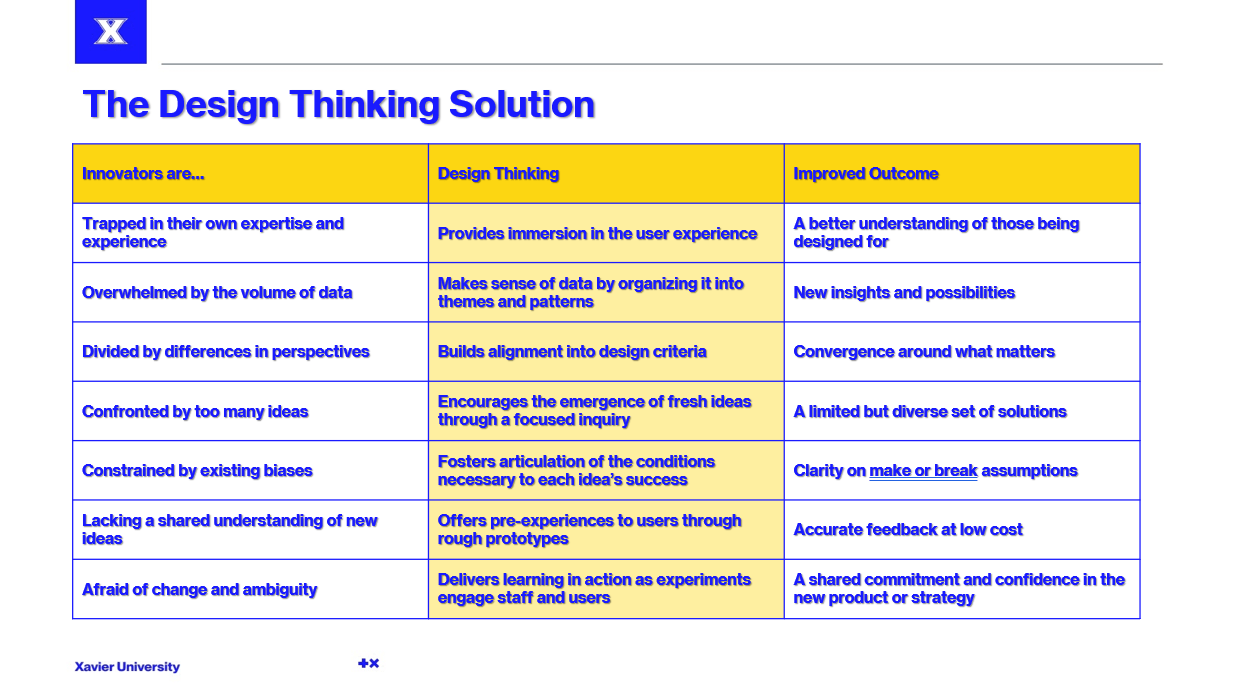
How Design Thinking improves innovation outcomes:
500
An effective hypothesis must be capable of being proven wrong. If no possible evidence could disprove your claim, it fails this essential test.
Falsifiability
500
This travel website runs thousands of simultaneous experiments, creating a virtuous cycle where each test generates learning that fuels the next round of innovation.
500
In Eric Ries' The Lean Startup, this three-step feedback loop describes the core cycle of creating a prototype, gathering data, and using those insights to inform your next move.
Build-Measure-Learn