MC1
MC2
VOCAB
100
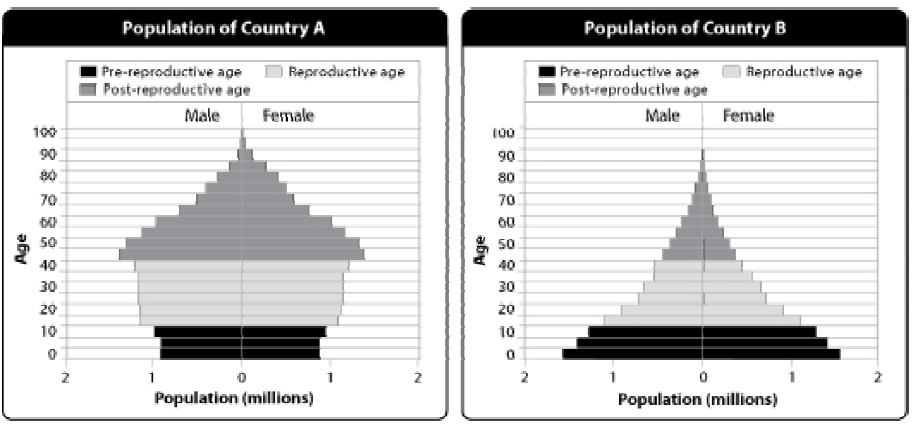
These graphs above are called
A. age structure diagrams.
B. Infant mortality diagrams.
C. life expectancy diagrams.
D. demographic diagrams.
A. Age Structure Diagrams
100
The number of organisms that an environment can support is called the
A. demography.
B. life expectancy.
C. growth rate.
D. carrying capacity.
D. carrying capacity.
100
The pace at which a population grows per unit of time.
Growth rate
200
Which combination of factors will produce the highest rate of population growth?
A. high life expectancy and low infant mortality
B. low life expectancy and low infant mortality
C. high life expectancy and high infant mortality
D. low life expectancy and high infant mortality
A. high life expectancy and low infant mortality
200
Which area would have the lowest population density?
A. tundra in Russia
B. River in China
C. seacoast in Europe
D. suburb in the U.S.A.
A. tundra in Russia
200
The number of babies out of 1000 that die in the first year of life.
Infant mortality
300
The number of babies out of 1,000 that die during their first year of life is called
____________________.
A. Growth rate
B. Life expectancy
C. Infant mortality
D. Population density
C. Infant mortality
300
How a population changes in size during a specific period of time is called the ____________________.
A. Infant mortality
B. life expectancy
C. Population density
D. Growth rate
D. Growth rate
300
The study of human statistics.
Demography
400
In what year did the human population reach 1 billion people?
A. 300
B. 1800
C. 2000
D. 1200
B. 1800
400
The study of human population statistics is called ____________________.
A. Calligraphy
B. Demography
C. Cartography
D. Geography
B. Demography
400
The average lifespan of person in a specific period of time.
Life expectancy
500
What event in the mid-1700s significantly changed human population growth?
A. human settlement began
B. Industrial Revolution
C. development of agriculture
D. bubonic plague
B. Industrial Revolution
500
The number of people living in a given area is described as the population
A. mortality.
B. density.
C. rate.
D. expectancy.
B. density.
500
The transition from a rural to an urban society fueled by fossil fuels.
Industrial Revolution
600
In recent years, the human population has
A. increased slowly.
B. decreased exponentially.
C. increased exponentially.
D. decreased slowly.
C. increased exponentially.
600
The average number of years an individual is predicted to live is called
A. demography.
B. carrying capacity.
C. life expectancy.
D. growth rate.
C. life expectancy.