Vocabulary
Biomes
Human Impact
Biodiversity
Energy Flow
Cycling of Matter/Changing Earth
100
The interaction between humans and their environment.
What is...Environmental Science?
100
Large geographic regions characterized by similar biotic and abiotic features.
What is... Biomes?
100
The time period when humans stopped being hunter-gatherers and began to create cities and shift to farming and domestication of animals.
What is... the Agricultural Revolution?
100
The variety of life on the planet.
What is...Biodiversity?
100
The term for organisms that create their own food through the process of photosynthesis.
What are... Autotrophs or Producers?
100
Volcanoes and earthquakes surround the nickname for the Pacific Plate.
What is... The Ring of Fire?
200
Organisms that are non-native to an ecosystem and cause disruption.
What are.. Invasive Species?
200
Which of the following biomes are similar to one another?
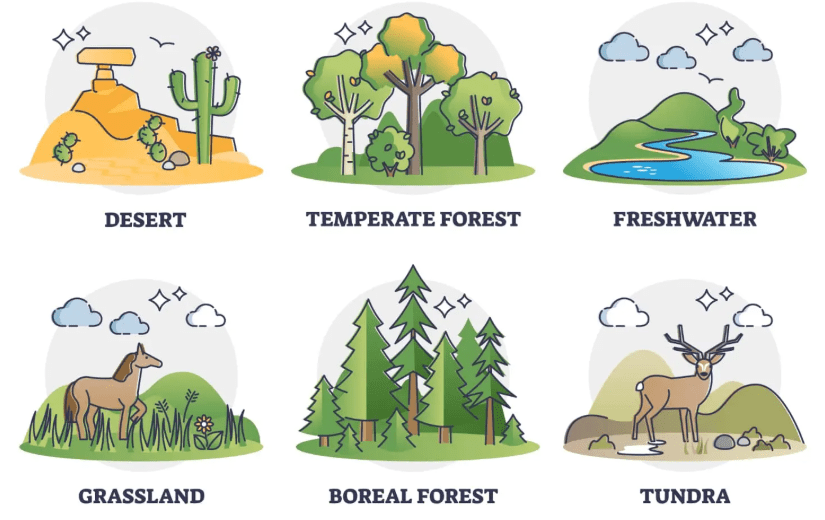
What are.. Temperate Forest and Boreal Forest?
200
The time period when humans started to create factors and shifted to mass fossil fuel consumption.
What is... the Industrial Revolution?
200
What would happen to the fox population in the upcoming year, 30?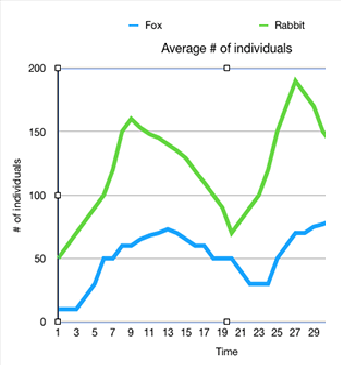
What is... the fox population with begin to decrease as their prey population is starting to decrease.
200
The names of organisms that are in the secondary tier of the energy pyramid.
What are...Primary Consumers?
200
The location where most of the Earth's freshwater resides at.
What are... Icecaps and Glaciers?
300
An organism that helps keep an ecosystem together and functioning.
What is... Keystone Species?
300
The two abiotic factors that make up the y-axis of a climate graph.
What are... Temperature and Precipitation?
300
The term for a long-term shift in Earth's average temperature and weather patterns.
What is... Climate Change?
300
What is the Species Richness of the following ecosystem?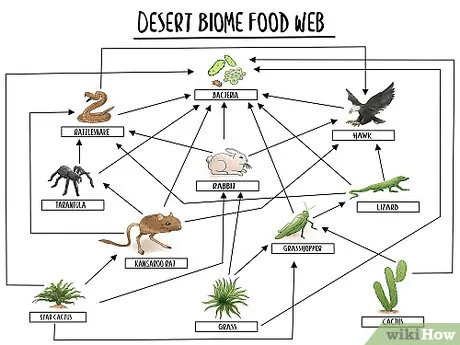
What is... 11?
300
Assume that an ecosystem has 150,000 kcal worth of producers growing at any given time. Approximately how many calories would be available to the secondary consumers?
What is... 1,500 calories?
300
Example of a slow and fast process that changes the Earth's surface.
What are... Slow: Plate tectonics, Climate Change, formation of mountains, erosion.
Fast: Earthquake, volcano, landslide, flood.
400
An environmental factor that causes a population to decrease.
What are... Limiting Factor(s)?
400
From the climate graph, which hemisphere is this area located in?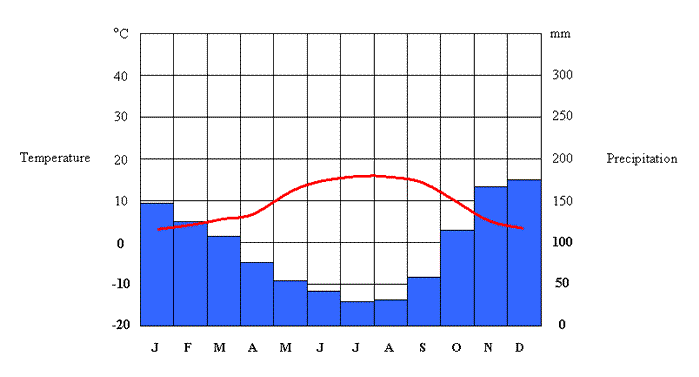
What is... Northern Hemisphere?
400
Explain ecological footprint.
What is...The demands made by one person or group on global natural resources (Carbon footprint).
400
Using the Simpsons Index of Diversity,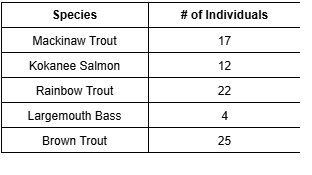 what is the n(n-1) value for Largemouth bass?
What is ... 12?
400
An organism that is classified as a secondary or tertiary consumer that eats both plants and animals.
What is... An Omnivore?
400
The Richter scale takes these measurements during earthquakes.
What is... Magnitude, force, or strength of the earthquake?
500
The largest population an environment can support with its resources.
What is... Carrying Capacity?
500
Explain what type of ecosystem you would be in if you were at a latitude of 80 to 90 degrees, and explain what a climograph of that area would look like.
What is... The ecosystem would be a tundra because those latitudes are at the poles. The climograph would have below-freezing temperatures in the winter months and slightly warmer temperatures in the summer months. Year-round would be low precipitation.
500
List the impacts that humans have had on the environment.
100 points for each correct response.
What are... Deforestation, Global Warming, Invasive Species, Over-Harvesting, Desertification.
500
Calculate the biodiversity using Simpson's Index of Diversity.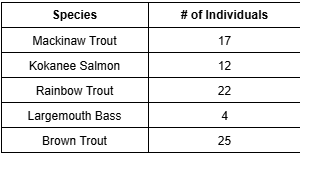
What is... 0.766?
500
From the following food web, create a food chain that has 5 different organisms on it.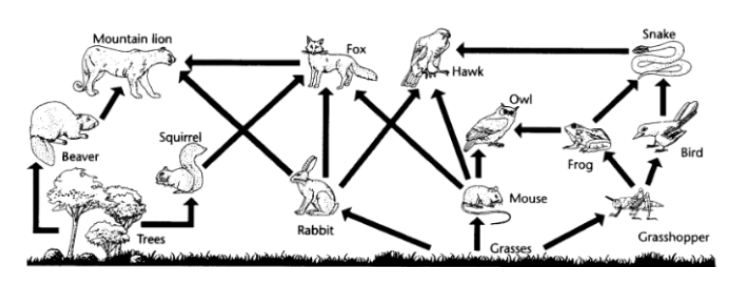
What is...Grasses --> Grasshopper --> Frog --> Snake --> Hawk
Or
Grasses --> Grasshopper--> Frog --> Snake --> Hawk
500
List the properties of water.
100 points for each correct response.
What are... Surface tension, Polarity, High Specific Heat, Density Anomaly, Cohesion, Adhesion.