Macromolecules
Cells (Transport and Organelles)
Photosynthesis
Cellular Respiration
Food Webs
100
These are the four primary types of organic macromolecules found in all living things.
Carbohydrates, Lipids, Proteins and Nucleic Acids
100
This "control center" of the cell contains the genetic material (DNA) in eukaryotes
Nucleus
100
This green pigment is responsible for absorbing sunlight during the light-dependent reactions.
Chlorophyll
100
This is the main energy-carrying molecule (the "currency") of the cell.
ATP
100
This term describes an organism, like a green plant, that can create its own food using sunlight.
Producer/Autotroph
200
This macromolecule is composed of amino acids and serves as the primary building block for tissues and enzymes.
Proteins
200
This type of cell lacks a nucleus and membrane-bound organelles; bacteria are the primary example.
Prokaryotes
200
These are the two primary products of photosynthesis.
Glucose and Oxygen
200
This first step of respiration occurs in the cytoplasm and breaks glucose down into pyruvate.
Glycolysis
200
In a food web where hawks eat snakes, and snakes eat mice, this would happen to the mouse population if the hawks were removed.
It would decrease
300
This is the specific "monomer" or building block of a DNA or RNA molecule
Nucleotide
300
This organelle is the site of protein synthesis and can be found floating freely or attached to the Rough ER.
Ribosomes
300
This specific organelle is where photosynthesis takes place in plant cells.
Chloroplast
300
This process occurs after glycolysis if oxygen is not present
Fermentation
300
This is the maximum number of individuals of a species that an environment can support over a long period.
Carrying Capacity
400
Unlike carbohydrates, these non-polar molecules are used for long-term energy storage and making up the cell membrane.
Lipids
400
This is the movement of water across a semi-permeable membrane from high to low concentration.
osmosis
400
This is the chemical equation for photosynthesis.
6CO2 + 6H2O --> C6H12O6 + 6O2
400
A student sets up an experiment with three flasks containing yeast and warm water.
Flask A: 0g sugar
Flask B: 5g sugar
Flask C: 10g sugar
A balloon is stretched over the top of each flask. After 30 minutes, the balloon on Flask C is the largest.
Explain what gas is filling the balloons and why Flask C showed the most growth.
The gas is Carbon Dioxide CO2. Flask C had the most glucose available for the yeast to perform cellular respiration, resulting in the highest volume of CO2 byproduct.
400
On an island, the moose population (prey) and the wolf population (predator) are closely monitored. In 2024, a harsh winter kills off half of the moose.
Predict what will happen to the wolf population over the next two years.
The wolf population will decrease because their food source (the moose) has declined.
500
This is the process of joining monomers together by removing a water molecule.
dehydration synthesis
500
This type of transport requires ATP because it moves molecules against their concentration gradient.
Active Transport
500
A scientist places a plant in a sealed glass jar with a solution of Bromothymol Blue (an indicator that turns yellow in the presence of CO2 and blue when CO2 is absent). After 24 hours under a bright grow light, the solution is dark blue.
What would happen to the color of the solution if the light was turned off for 24 hours, and why?
The solution would turn yellow. Without light, the plant cannot perform photosynthesis to consume CO2. However, the plant continues Cellular Respiration, which releases CO2 into the solution.
500
A scientist labels the carbon atoms in a glucose molecule with a radioactive tracer and feeds it to a mouse. The mouse is kept in a sealed chamber.
Where will the radioactive carbon atoms most likely be detected 10 minutes later: in the mouse's urine, the mouse's fat stores, or the air in the chamber?
The air in the chamber. During the Krebs Cycle, the carbon atoms from glucose are stripped away and released as Carbon Dioxide (CO2) gas, which the mouse exhales.
500
Predict what would happen to the rabbit population if a disease wiped out the mouse population.
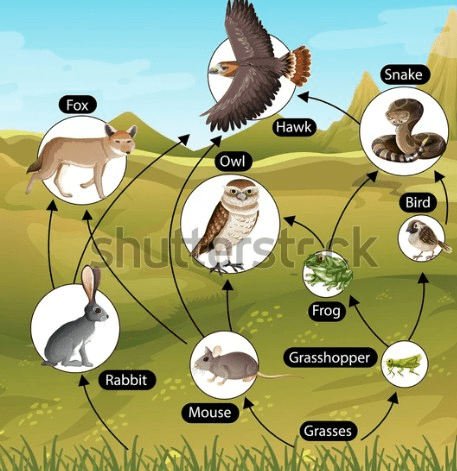
the population would decrease because the fox population and hawk population would lose a food source.