Chemistry
Hydrosphere
Diseases
Earth + Evolution
Pop + Eco
100
The three subatomic particles that make up atoms.
What are protons, neutrons, and electrons?
100
This is the majority of water on earth.
What is salt water? (Non-potable)
100
This is a naturally occurring resource. Humans can use these to create fuel or power.
What is a natural resource?
100
This is defined as change over time.
What is evolution?
100
This is the transfer of energy in an ecosystem.
What is a food web / food chain?
200
This law states that energy cannot be created or destroyed.
What is the law of conservation of energy?
200
An attraction between molecules of different substances. This is the property that allows water to stick to leaves, windows, etc.
What is adhesion?
200
Microorganisms or infectious agents that can cause disease in a host organism.
What are pathogens?
200
This cuts through rock units that are older. Typically caused by tectonic activity.
What are faults?
200
This type of organism produces its own food.
What is an autotroph?
300
This cannot be easily separated and is a pure substance.
What is a molecule?
300
The movement of water from the surface to greater depths.
What is downwelling?
300
A virus requires this to survive and reproduce.
What is a host?
300
This structure is defined as the same structure, different function.
What is a homologous structure?
300
In this type of symbiotic relationship, one organism benefits, while the other is not harmed or benefited.
What is commensalism?
400
These four traits are an indicator of this type of change.
1. Color change
2. Production of a precipitate
3. Formation of a gas
4. Temperature change
What is a chemical change?
400
Openings in the ocean floor that release mineral-rich water. These are very important for chemosynthesis.
What are hydrothermal vents?
400
An organism that carries and transmits the disease-causing pathogen without having symptoms.
What is a vector?
400
Layers of rock were originally formed lying horizontally, so if they are tilted, something disturbed them.
What is the law of original horizontality?
400
This is the product of cellular respiration.
What is carbon dioxide (CO2)?
500
Balance the equation.
__ Al + ___ S8 ---> ___ Al2S3
16 Al + 3 S8 ---> 8 Al2S3
500
A porous rock unit or sediment layer that is trapped between two layers of impermeable rock or clay, which prevents water from easily flowing into or out.
What is a confined aquifer?
500
Proteins produced by the immune system in response to foreign substances.
What are antibodies?
500
Order the sequence from youngest to oldest.
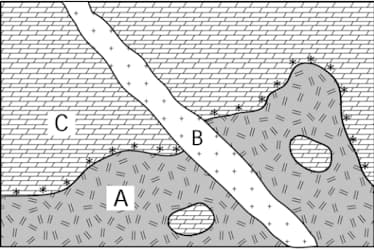
B → A → C
500
These factors can be affected by the size of a population or community.
What is a density-dependent factor?