Alphabet soup
Miscellaneous
Birth & Death
Human Population Qs
Graphs
100
What does PGR stand for and its definition?
Population growth rate
average annual percent change in the population
100
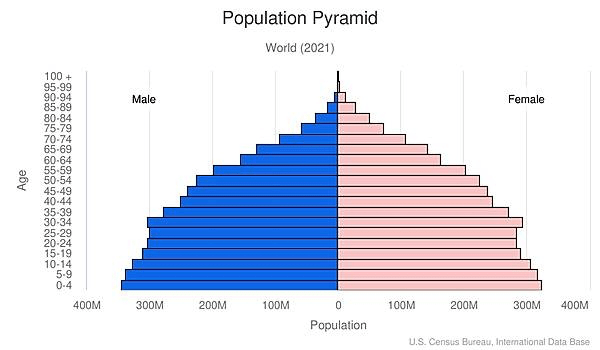
If the world's total fertility rate is equal to the replacement level fertility rate, why would the world's population increase in the next 30 years?
Population momentum.
There are 300 million girls in each of the bottom 3 bars that haven't reached child bearing age that will contribute about 2 billion, at the replacement rate, to the population.
100
What relation does literacy have to population rates?
Increase literacy and the PGR /CBR /TFR rates decrease
100
Some "west"ernized countries have high PGRs but their total fertility rate is low. What's happening?
immigration
100
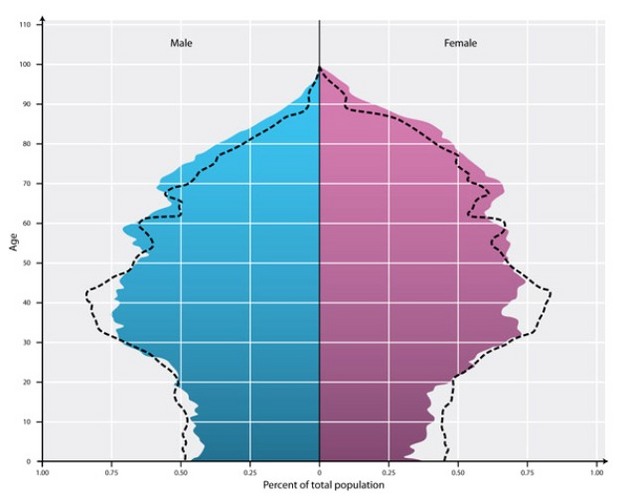
This is a description of the growth rate of the age structure diagram seen above.
(a description of the shape is NOT what I'm looking for)
The population is getting older or
the TFR/ CBR is decreasing
(yes it is an inverted pyramid)
200
What does CDR stand for and its definition?
Crude death rate
number of people per 1000 in a population who die within a given year
200
From the human population lab, what region of the world had the highest PGR?
1. Africa
200
The average number of children born per woman if every woman lived to the end of their childbearing years is the definition of...
TFR - total fertility rate
200
These are 3 factors that contribute to the total fertility rate of a country.
1. opportunities for women;
2. access to family planning; cultural norms; expectation of education for girls/children;
3. economic status of the country ...
200
In a human population undergoing the demographic transition (the graph), this generally decreases first.
What is death rate
300
What does RLF stand for and its definition?
Replacement fertility level
the total fertility rate required to maintain the current population size
300
From the human population lab, the second highest "region" of the world in PGR are disputed because:
1. in one region you have patches of countries with rapid PGR and countries with negative PGR
2. in the other region you have a fairly uniform PGR that is a lower rate than the PGR-winning-region
What regions am I talking about in #1 and #2 above?
1. Asia
2. Latin America
300
If a country has a crude birth rate of 24 per 1,000 and a crude death rate of 8 per 1,000, would you guess it is a developing or developed country?
developing country
(BTW It has a growth rate of 1.6% )
300
What is the effect of the Industrial Revolution & modern medicine on population growth.
They increased it (Increased our carrying capacity)
300
During the transition, industrial, post industrial, or pre-industrial phase does the death rate decline the greatest? (BTW they are not in order)

transition
400
What does IMR stand for and its definition?
infant mortality rate
number of children out of 1000 born alive but then die within the first year
400
The continued population growth after growth reduction measures have been implemented is defined as...
Population momentum
400
Give 3 reasons why CBR and TFR in developing countries is high.
1. Importance of children in the work force
2. Relatively inexpensive to raise children
3. Poor access to family planning services
4. High infant mortality rate
5. Fewer opportunities for women
6. Average age at marriage and first childbirth
7. Lack of retirement plans and pensions
8. Religious and cultural values
400
This is what happens to total fertility rate as a population moves through the demographic transition.
It decreases
400
During this stage of the demographic transition a population experiences an explosion of growth.
What is stage 2?
500
What does NMR stand for and its definition?
Net migration rate:
The difference between immigration and emigration per 1000 people in a year
500
What challenges does a population with this age structure diagram face.
*Labor shortages (hamper economic growth, innovation, entrepreneurship - because more are supporting the elderly)
*Strain on social services (like social security, pensions, medicare)
500
If a country has a crude birth rate of 24 per 1,000 and a crude death rate of 8 per 1,000, what is happening to the population? (increasing/ decreasing/ inverted pyramid, etc...)
It is increasing
500
Phase one of demographic transition graph shows these characteristics
(comment on birth rate, death rate, and infant mortality rate)
What are high birth rates, high death rates, and high infant mortality rates
500
During this/these phase(s) of the demographic transition, population growth is/are zero.

What are I and IV? (First and last)