Layers of the Earth
Seismic Waves
Planetary Differentiation
Recording Seismic Waves
Miscellaneous
100
The continental crust floats on top of the mantle because the crust is
Less dense than the mantle
100
Using seismic waves to determine what the interior of the Earth is made of is and example of what evidence (indirect or direct)
Indirect
100
Deep within Earth’s mantle, some materials sink toward the planet’s center, while others rise toward the surface.
Which property of a material is directly related to whether it will rise or sink?
Density
100
What device is the recording of the amplitude of seismic waves
Seismogram
100
This layer moves to produce the Earth's magnetic field
Outer core
200
Which layer of Earth is thought to be composed primarily of iron and nickel?
The core
200
Surface waves are a combination of which types of waves
P waves and S waves
200
What are the two factors that are important for planetary differention?
Density and Gravity
200
A seismograph station records the arrival of seismic waves from an earthquake. The graph shows a small line wiggle starting at 10:02 AM, followed by much larger wiggles starting at 10:07 AM.
Which statement correctly describes these waves?
A. The waves at 10:02 AM are S-waves, which travel faster than P-waves.
B. The waves at 10:07 AM are P-waves, which carry the most energy.
C. The waves at 10:02 AM are P-waves, and the waves at 10:07 AM are S-waves.
C. The waves at 10:02 AM are P-waves, and the waves at 10:07 AM are S-waves.
D. The waves at 10:07 AM are surface waves, which traveled through the Earth's liquid outer core.
C. The waves at 10:02 AM are P-waves, and the waves at 10:07 AM are S-waves.
200
What was the form of heating during Earth's formation?
Accretional heating
300
When compared to the other layers of Earth, which layer has the lowest density?
The crust
300
If a location receives P waves but not S waves, what can be concluded?
The waves traveled through a liquid layer
300
What is relative density?
Relative density is the comparison of two objects and seeing if one will sink or float
300
What scale do scientists use to describe the magnitude of an earthquake?
Richter Scale
300
What is the reason the inner core is SOLID, even though the outer core is liquid
The pressure is so great, the matter cannot become liquid.
400
Name the three compositional layers in order from least dense to most dense.
Crust, Mantle and Core
400
S waves are these type of waves and move in which way?
Transverse, perpendicular (Up and Down)
400
Earth’s main compositional zones developed early in its history. Silicon and aluminum became more concentrated in the crust, and iron and nickel became more concentrated in the core.
What is the main reason that iron and nickel separated from silicon and aluminum and are now found concentrated in different zones within Earth?
They separated because of their densities
400
What are shadow zones?
Areas on the Earth's surface where seismographs fail to detect direct waves from an earthquake
400
Which statement describes the heat that results from the radioactive decay of elements deep in Earth's Interior?
A. It originally came from our sun.
B. It is the reason the inner core is solid.
C. It drives the convection currents in the mantle.
D. It heats the atmosphere and makes life possible.
C. It drives the convection currents in the mantle
500
Name the 5 mechanical layers of the Earth
Lithosphere, Asthenosphere, Mesosphere, Outer Core, Inner Core
500
Which statment about seismic waves is accurate?
A. Seismic waves only relate to earthquakes.
B. Seismic waves have uniform motion within Earth's layers.
C. Seismic waves change speed when density changes in Earth's layers.
D. Seismic waves determine differences in temperature in Earth's layers.
C. Seismic waves change speed when density changes in Earth's Layers
500
What are three main materials that make up the composition of Earth?
Silicate rock, Nickel and Iron
500
The data table below shows the arrival times of P-waves and S-waves at three different seismic stations:
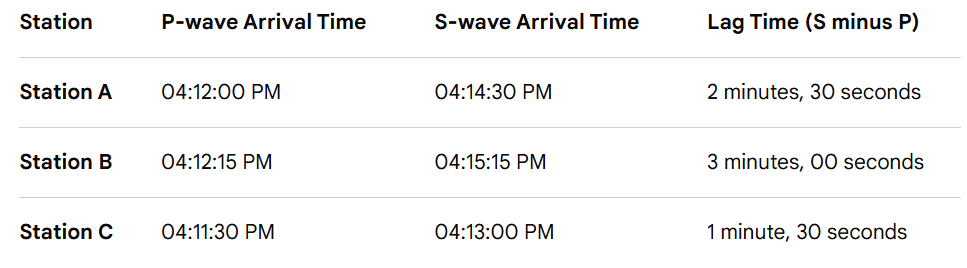
Based on the data table, which station is closest to the epicenter of the earthquake?
Station C
500
What are convection currents and why is Earths internal heat important to them?
Convection currents are loops of continuous heating and cooling in the mantle. Earth's internal heat are important as they drive the currents, as they heat up the lower part of the mantle allowing for it to rise.