Knowledge
Vocabulary
Morphology
Grammar
Miscellaneous
100
Question: How did the Church influence people's lives during the Middle Ages?
A. It controlled all trade between countries.
B. It played an important role in religion, education, and daily life.
C. It trained every person to become a knight.
D. It made all the rules for kings and queens.
Correct Answer: B — The Church influenced religion, education, and daily life. Many people attended church regularly, and monasteries helped preserve books and learning.
100
Question: Which sentence uses the word destined correctly?
A. The knight was destined because he polished his armor.
B. The young prince was destined to become king someday.
C. The farmer destined his crops in the field.
D. The monk was destined when he read a book.
Correct Answer: B — Destined means that something is expected or meant to happen in the future.
100
Question: Which word beginning with the prefix in- best completes the sentence?
The villagers believed the king’s decision was ______ because it treated some people unfairly.
A. invisible
B. incorrect
C. inexpensive
D. inactive
Correct Answer: B — incorrect
Incorrect means not correct. The prefix in- means “not.”
100
Question: Which adverb best completes the sentence?
The knight ______ charged toward the enemy to defend the castle.
A. bravery
B. brave
C. bravely
D. braver
Correct Answer: C — bravely
Bravely is an adverb because it describes how the knight charged toward the enemy.
100
Question: Which two were positive aspects of life in a town during the Middle Ages? Select two answers.
A. People could learn a trade and become skilled craftsmen.
B. Everyone was wealthy and never had to work.
C. People could buy and sell goods at markets.
D. Everyone was free from paying taxes.
Correct Answers: A and C
A: People could learn a trade and develop skills in a craft.
C: Markets gave people opportunities to buy and sell goods.
200
Question: How were serfs and craftsmen similar during the Middle Ages?
A. They both belonged to the highest social class.
B. They both provided goods or services that helped their communities.
C. They both owned large manors and collected taxes.
D. They both served as knights in the king’s army.
Correct Answer: B — Serfs worked on the land, while craftsmen made goods people needed. Both helped their communities survive and function.
200
Question: During the Middle Ages, the papacy was an important part of the Church. What does the word papacy mean?
A. The system of rules used by knights
B. The group of people who worked for a king
C. The office and authority of the pope
D. The land owned by wealthy lords
Correct Answer: C — The papacy refers to the office and authority of the pope, who was the leader of the Catholic Church.
200
Question: Which word beginning with the prefix non- best completes the sentence?
Because the village did not take part in the war, it remained ______ throughout the conflict.
A. nonstop
B. nonviolent
C. nonliving
D. nonfiction
Correct Answer: B — nonviolent
The prefix non- means “not.” Nonviolent means not using or involving violence.
200
Question: Which adjective best completes the sentence?
The knight carried a ______ shield into battle to protect himself from enemy attacks.
A. courageously
B. sturdy
C. defended
D. carefully
Correct Answer: B — sturdy
Sturdy is an adjective because it describes the shield. An adjective describes a noun or pronoun.
200
Question: Which of the following was NOT a negative aspect of living in a town during the Middle Ages?
A. Many towns had dirty streets and unsafe drinking water.
B. Towns offered opportunities for people to find work and sell goods.
C. Diseases could spread quickly because of poor sanitation.
D. Towns were often crowded, with narrow streets.
Correct Answer: B — Towns offered opportunities for work and trade, which was a positive aspect of medieval town life.
300
Question: How did a boy typically train to become a knight during the Middle Ages?
A. He became a monk and studied religious books.
B. He worked as a craftsman and learned to make tools.
C. He trained as a page and then a squire before becoming a knight.
D. He worked as a serf until he owned his own land.
Correct Answer: C — Boys typically began as pages, learning manners and basic skills. Later, they became squires, training to fight and care for a knight’s horses and equipment before they could become knights.
300
Question: During the Middle Ages, the Black Death was a terrible pestilence that spread across Europe. What does the word pestilence mean?
A. A long period of cold weather
B. A serious disease that spreads and affects many people
C. A war between two kingdoms
D. A shortage of food in a village
Correct Answer: B — A pestilence is a serious disease that spreads and affects many people.
300
Question: Which word beginning with the prefix non- best completes the sentence?
The students learned that a story about real events and people is nonfiction, while a story made up by an author is ______.
A. nonessential
B. nonfactual
C. nonstop
D. nonverbal
Correct Answer: B — nonfactual
The prefix non- means “not.” Nonfactual means not based on facts.
300
Question: Which of the following words is a preposition?
A. Quickly
B. Beneath
C. Celebrate
D. Cheerful
orrect Answer: B — Beneath
A preposition shows the relationship between a noun or pronoun and another word in a sentence. For example: The cat hid beneath the table.
300
Question: Which two features helped castles defend people during the Middle Ages? Select two answers.
A. Thick stone walls that made it difficult for enemies to enter.
B. Large gardens where people could grow food.
C. Moats and drawbridges that made it harder for enemies to attack.
D. Marketplaces where merchants could sell goods.
Correct Answers: A and C
A: Thick walls helped protect people inside the castle from enemy attacks.
C: Moats and drawbridges made it harder for enemies to reach the castle.
400
Question: What were the typical steps for a person to become a skilled craftsman during the Middle Ages?
A. Page, squire, knight
B. Apprentice, journeyman, master
C. Serf, freeman, lord
D. Monk, priest, bishop
Correct Answer: B — A person usually started as an apprentice to learn a craft, became a journeyman to gain experience, and could eventually become a master craftsman who owned a workshop and trained apprentices.
400
Question: Which sentence uses the word chivalry correctly when describing the Middle Ages?
A. The knight showed chivalry by being brave, honorable, and respectful to others.
B. The farmer practiced chivalry by planting crops in the spring.
C. The king used chivalry to collect taxes from the villagers.
D. The monk studied chivalry to learn how to build a castle.
Correct Answer: A — Chivalry was a code of behavior for knights that emphasized bravery, honor, and respect for others.
400
Question: Which word beginning with the prefix en- best completes the sentence?
The knight worked to ______ the village by building stronger walls to protect the people from enemy attacks.
A. endanger
B. encourage
C. enclose
D. enrich
Correct Answer: C — enclose
The prefix en- can mean “to put in” or “to cause to be.” Enclose means to surround or close something in.
400
Question: Which of the following is a prepositional phrase?
A. Ran very quickly
B. The brave knight
C. Under the stone bridge
D. Marched into battle
Correct Answer: C — Under the stone bridge
A prepositional phrase begins with a preposition and includes a noun or pronoun that follows it.
400
Question: Which event during the Middle Ages changed history by spreading new ideas, increasing trade, and bringing people from different regions into contact?
A. The building of the first farms
B. The invention of the wheel
C. The Crusades
D. The discovery of electricity
Correct Answer: C — The Crusades
The Crusades were a series of religious wars that brought people from Europe and the Middle East into contact. They affected trade, culture, and relationships between different groups of people.
500
Question: Which two were responsibilities of a lord during the Middle Ages? Select two answers.
A. Protecting the land and people on his manor.
B. Managing the manor and collecting payments from peasants.
C. Serving as the head of the entire Church.
D. Training young boys to become knights.
Correct Answers: A and B
500
Question: After the war, the villagers worked hard to restore the damaged castle to its former condition. Based on this sentence, what does the word restore mean?
A. To destroy something completely
B. To build something for the first time
C. To bring something back to its previous condition
D. To move something to a new location
Correct Answer: C — Restore means to bring something back to its previous condition.
500
Question: Which word beginning with the prefix en- best completes the sentence?
The king hoped to ______ his kingdom by improving trade and helping towns grow.
A. endanger
B. enrich
C. encircle
D. enforce
Correct Answer: B — enrich
Enrich means to improve or make something better or more valuable. The prefix en- helps form a word that means to make something richer.
500
Question: Which word in the sentence is a modal auxiliary verb?
The knight might travel to the castle before sunset.
A. knight
B. travel
C. might
D. sunset
Correct Answer: C — might
A modal auxiliary verb helps the main verb show possibility, ability, permission, or necessity. Examples include can, could, may, might, must, should, and would.
500
Question: How did the Battle of Hastings in 1066 influence history?
A. It ended the feudal system throughout Europe.
B. It caused the Church to lose all its power.
C. It led to William the Conqueror becoming king of England and brought major changes to English culture and government.
D. It united England and France under one king.
Correct Answer: C — William the Conqueror’s victory changed England’s leadership and brought French language and customs that influenced English culture and government.
600
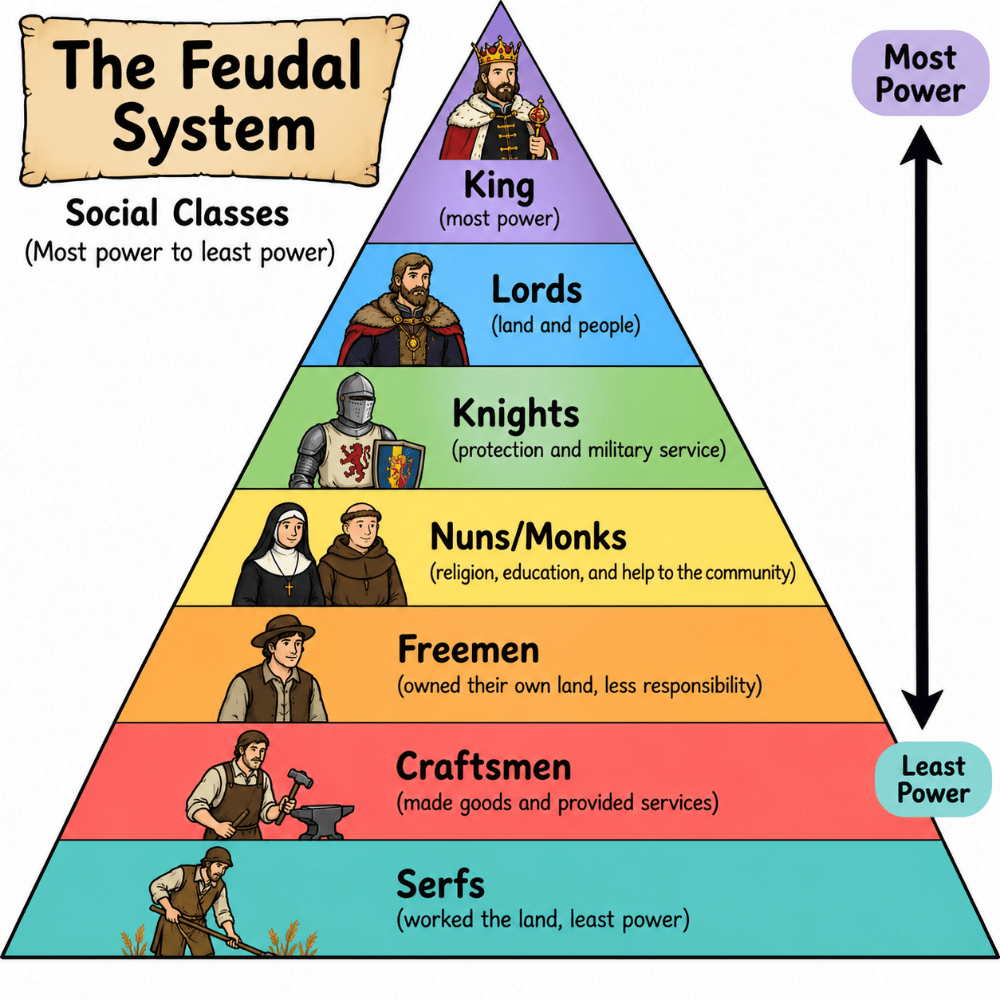
Put the social classes of the feudal system in order from most power to least power.
Knights
Serfs
King
Craftsmen
Lords
Freemen
Nuns/Monks
600
Question: During the Middle Ages, Thomas worked with a skilled blacksmith who taught him how to make tools and weapons. Based on this sentence, what is an apprentice?
A. A person who teaches others a skilled trade.
B. A person who is learning a skilled trade from an experienced worker.
C. A person who sells goods at a market.
D. A person who owns a large manor.
Correct Answer: B — An apprentice is someone who learns a skilled trade by working with an experienced person.
600
Question: Which word containing the root arch best completes the sentence?
The king’s most feared ______ had spent years trying to overthrow him and seize control of the kingdom.
A. architect B. archenemy C. monarch D. archer
Correct Answer: B. archenemy
Explanation: An archenemy is a person’s chief or greatest enemy.
600
Question: Which of the following is a complex sentence?
A. The knight rode his horse, and the squire carried his shield.
B. The castle stood on a hill above the village.
C. Although the battle was difficult, the knights continued to fight.
D. The king entered the hall and greeted his guests.
Correct Answer: C — Although the battle was difficult, the knights continued to fight.
A complex sentence contains an independent clause and a dependent clause. The word although introduces the dependent clause.
600
Question: Which two events or problems helped lead to the creation of the Magna Carta in 1215? Select two answers.
A. King John demanded high taxes from his people.
B. The nobles were unhappy with the king’s use of power.
C. The king wanted all peasants to become knights.
D. The Church wanted to end all trade in England.
Correct Answers: A and B
A: King John demanded high taxes to pay for wars and other expenses.
B: The nobles were angry about the king’s actions and forced him to agree to the Magna Carta, which limited some of his power.
700
Put these years in order from oldest to newest.
450 BCE
120 CE
300 BCE
800 CE
Correct Answer:
450 BCE
300 BCE
120 CE
800 CE
700
Question: Which word best completes the sentence?
As trade routes expanded during the Middle Ages, new towns ________ near busy rivers and crossroads, attracting merchants and skilled workers.
A. fueled
B. declined
C. emerged
D. scattered
Correct Answer: C — emerged
Emerged means appeared or developed. In this sentence, new towns developed in places where trade was growing.
700
Question: Which word containing the root arch best completes the sentence?
The medieval ruler strengthened his authority over the kingdom, making it clear that he was the supreme ______ whose decisions affected every social class.
A. architect B. monarch C. archer D. archive
Correct Answer: B. monarch
700
Question: In the sentence below, which part is the dependent clause?
Although the battle was difficult, the knights continued to fight.
A. The knights continued
B. Although the battle was difficult
C. The knights continued to fight
D. The battle was difficult, the knights continued
Correct Answer: B — Although the battle was difficult
A dependent clause has a subject and a verb, but it does not express a complete thought on its own. The word although makes this clause dependent on the rest of the sentence.
700
Question: Put these kings in order from the earliest to rule to the latest to rule.
Richard the Lion-Hearted
William the Conqueror
King John
Henry I
Correct Order:
William the Conqueror (1066–1087)
Henry I (1100–1135)
Richard the Lion-Hearted (1189–1199)
King John (1199–1216)