Natural Selection
Comparative Anatomy
Fossils
Embryology
Evolutionary Relationships
100
An adaptation _____.
A. is an inherited trait
B. increases a species’ chances of surviving
C. increases a species’ chances of reproducing
D. all of the above
What is all of the above?
100
The more homologous structures two species have, the ____________ closely related they may be.
What is more?
100
Species go ___________ when they cannot adapt to environmental changes.
What is extinct?
100
______________is the study of embryos to see how their similarities and differences indicate an evolutionary relationship.
What is Embryology?
100
What type of organisms do scientist usually agree that birds are descended from?
A. reptiles
B. fish
C. amphibians
D. mammals
What is reptiles?
200
Small changes in traits that cause variation are frequently caused by _____.
A. natural selection
B. competition
C. mutations
D. migration
What is mutations?
200
These are homologous structures because their origins are different, but they look and act the same.
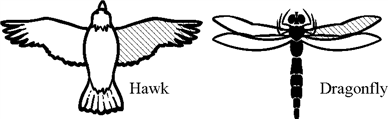
True or false
What is true?
200
A sequence of layers of sedimentary rock, the oldest layer is at the base, and that the layers are progressively younger as the sequence ascends to the top layer.
What is Law of Superposition?
200
Pharyngeal pouches are found in all ________________embryos.
What is vertebrate?
200
Scientists can date most fossils directly.
True or False?
What is false?
300
Which of the following could be illustrated by the bird eating the white moth?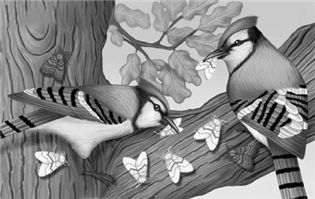
A. reproduction
B. differentiation
C. competition
D. selection
What is the competition?
300
Which of the following is evidence of the evolution of living species?
a. homologous structures
b. analogous structures
c. vestigial structures
d. all of the above
What is all of the above?
300
Which best describes the relationship between rock layers and index fossils?
A. Different rock layers can be determined to be the same RELATIVE age if they contain the same index fossils
B. Different rock layers contain only specific species of index fossils.
C. Different rock layers can be compared to determine the EXACT age of index fossils.
D. Different rock layers can be determined to be the same EXACT age if they contain the same index fossils
What is A or What is different rock layers can be determined to be the same RELATIVE age if they contain the same index fossils?
300
In the the third embryonic stage (bottom row), mammal embryos _____

A. have more characteristics in common with each other than with reptiles or birds.
B. are still hard to tell from reptiles and birds.
C.have the same features as fish, reptiles, and birds.
D. do not have tails.
What is have more characteristics in common with each other than with reptiles or birds?
300
Which of the following is NOT a fossil?
A. outline of a fern found in a rock
B. petrified wood in the desert
C. baby mammoth found in a glacier
D. old stone tools found in a cave
What is old stone tools found in a cave
400
What does this sequence illustrate?
A. how variation results in an adaptation
B. how camouflage results in variation
C. how selective breeding results in an adaptation
D. how mimicry results in variation

What is how variation results in adaptation?
400
These are analogous structures because they look different but their origin is similar.
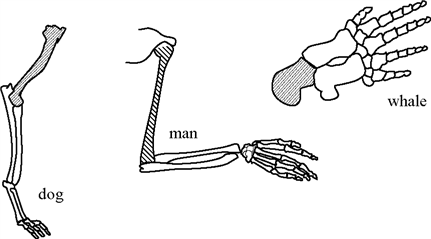
True or False?
What is false?
400
Which answer has the correct order of events from oldest to youngest?

A. BACDE
B. ABCDE
C. BAECD
D. BACED
What is BAECD?
400
These drawings show three embryos at the same early stage of embryonic development.

Which comparison of these drawings provides the best evidence that pigs, chickens, and cows are related?
A. The embryos are similar in size.
B. The embryos are curled from head to tail.
C. The embryos have developed from a single cell.
D. The embryos have similar structures and shapes.
What is embryos have similar structures and shapes.
400
B is a mold of A.
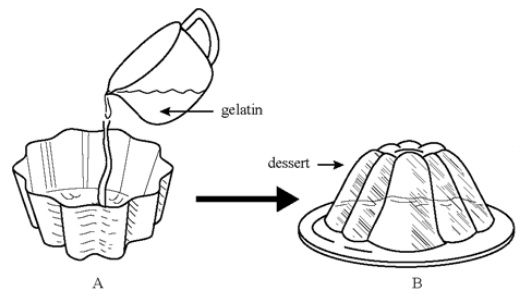
True or False?
What is true?
500
Although Darwin did not know about genes, he could see that animals of the same species who had slight variations that helped them to survive longer could produce more offspring than animals who were not as well equipped. Which of the following could be an example of a variation that would help a group of animals survive?
A. black bears in a region that was always covered with snow
B. turtles with long necks on an island where the food source was elevated
C. choosing a cat to take home from an animal shelter
D. planting a certain kind of flower to attract butterflies
What is turtles with long necks on an island where the food source was elevated?
500
Based on the image of forelimbs below, what evolutionary relationships can you infer?

A) Humans, dogs, birds, and whales likely do not have a common ancestor, since their forelimbs are analogous structures that have similar functions but different structures.
B) Humans, dogs, birds, and whales likely have a common ancestor, evidenced by the homologous bone structure of their limbs.
C)Humans, dogs, birds, and whales likely evolved from one another in a linear pattern, as evidenced by the similarities in their limb structure.
D) Humans, dogs, birds, and whales likely evolved from different ancestors, since the function of their limbs is different.
What is humans, dogs, birds, and whales likely have a common ancestor, evidenced by the homologous bone structure of their limbs?
500
What statement is true about the rock layers below?

A. Only the older rocks contain fossils of complex life forms.
B. Only the younger rocks contain simple life forms.
C. Both older and younger rocks contain more complex life forms.
D. Only the younger rocks contain fossils of complex life forms.
What is the younger rocks contain fossils of complex life forms?
500
The diagrams show the developing embryos and the adult forms of various types of animals with backbones.

What statement is best supported by comparing the development of those four animals with backbones?
A. The differences noted in all adult forms show that they do not share a common ancestor.
B. The shape of each adult form is clearly seen in the early stages of embryonic development.
C. The similarities noted in the early embryo stages are strong evidence of the existence of a common ancestor.
D. The embryos of all animals with backbones share an identical pattern of development into adult form.
What is the similarities noted in the early embryo stages are strong evidence of the existence of a common ancestor?
500
The changes over time in the inherited traits of a type of organism are __.
A. Artificial Selection
B. Biogenesis
C. spontaneous generation
D. evolution
What is evolution?