The American Bison
Limb Development...
Some Moths...
Are We Related?
A Change from Water to Land
100
BONUS
Which characteristic would give one species the greatest advantage over other species?
higher number of surviving offspring
lower number of matings
lower adaptation to the environment
higher rate of disease
(1) higher number of surviving offspring
100
Whales and alligators both have pelvic and hind leg bones as part of their skeletal structure. In alligators, these bones are large and connected to powerful back legs that help the animal walk, swim, and move on land. The hind legs are important for support, movement, and hunting.
In whales, pelvic and hind leg bones are still present, but they are much smaller and no longer attached to functional legs. Modern whales use their tails and flippers for movement through the water, so these bones do not play a major role in locomotion. Scientists study these structures to better understand how body parts can change in size and function over long periods of time as organisms adapt to different environments.
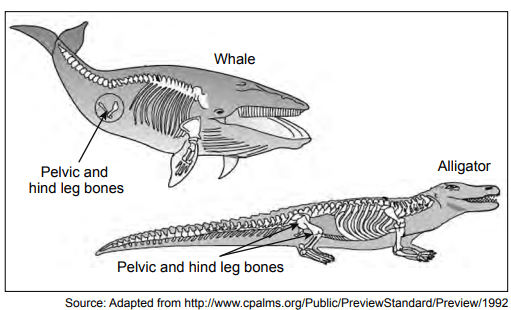
This similarity between whales and alligators supports the idea that
whales evolved from alligators
alligators evolved from whales
alligators and whales share a common ancestor
alligators and whales share the same genetic mutations
(3) alligators and whales share a common ancestor
100
The cabbage tree emperor moth does not have ears that might alert them to approaching predators, such as bats. Instead, they all have wings with scales and hair-like structures called fur, suited to absorbing the ultrasonic sound frequencies used by bats hunting for food. This absorption reduces the echoes that bounce back to the bats, allowing these moths to avoid detection. Since they are not detected, they don’t need to quickly fly away and use more energy. Scientists have observed that other moth species have developed different defense mechanisms. Some moth species have ears and can hear their predators approaching and quickly swerve out of the way. Other moth species fly in a slow zigzag pattern that imitates bees and wasps, which are not desirable prey to bats.
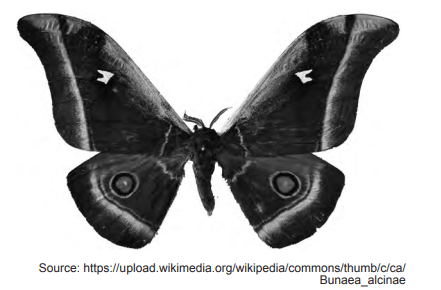
Identify an event that most likely caused the first moth to have sound-absorbing fur and scales
a mutation
100
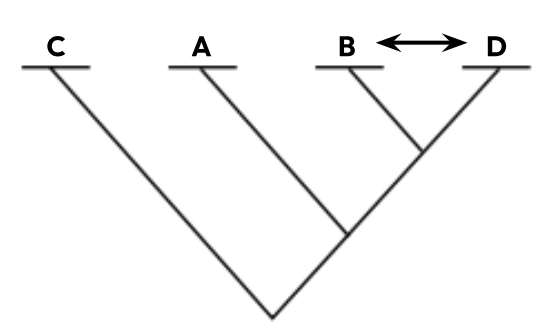
Gel electrophoresis is used to separate DNA by size. Smaller fragments are able to move quickly and much farther down the gel, while longer fragments move slower and remain stuck towards the top. DNA samples were taken from four different species of animals labeled A, B, C, and D. The diagram below represents the results of a procedure that separated DNA fragments of each species using gel electrophoresis.
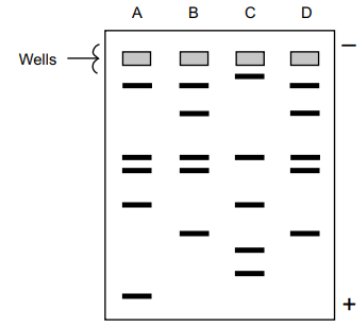
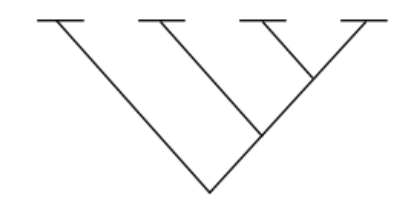
Based on these banding patterns, label the branching tree diagram below using the letters A, B, C, and D to represent their possible evolutionary relationships.
100
The diagram illustrates the evolution of tetrapods. A tetrapod is a four-footed animal.
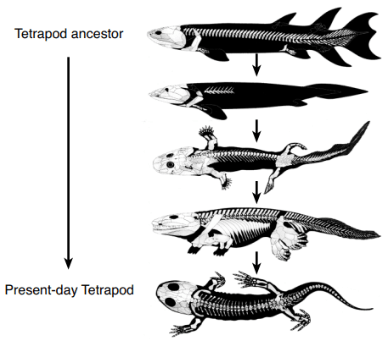
Which statement below identifies the evolutionary relationships presented in the diagram?
Present-day tetrapods are unrelated to early aquatic organisms and evolved independently.
Fish evolved directly from modern tetrapods and later returned to water.
Present-day tetrapods evolved from a common aquatic ancestor through a series of gradual changes.
All organisms in the diagram existed at the same time but lived in different environments.
(3) Present-day tetrapods evolved from a common aquatic ancestor through a series of gradual changes.
200
American bison are herding mammals found on the plains of North America. When predators, such as wolves or mountain lions, threaten the calves, the adults form a double ring around the calves. The adult female bison make an inner circle around the calves while the male adult bison form an outer circle around the females.
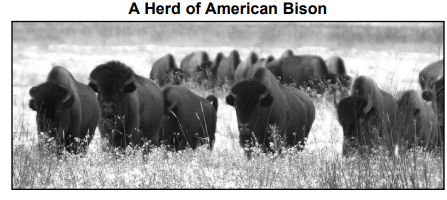
Explain how the process of evolution has led to the development of this behavior in bison populations.
This behavior allowed the bison to survive and reproduce, passing it on to future generations.
200
Whales and alligators both have pelvic and hind leg bones as part of their skeletal structure. In alligators, these bones are large and connected to powerful back legs that help the animal walk, swim, and move on land. The hind legs are important for support, movement, and hunting.
In whales, pelvic and hind leg bones are still present, but they are much smaller and no longer attached to functional legs. Modern whales use their tails and flippers for movement through the water, so these bones do not play a major role in locomotion. Scientists study these structures to better understand how body parts can change in size and function over long periods of time as organisms adapt to different environments.
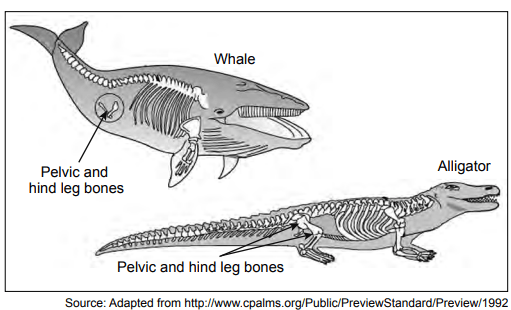
Construct an explanation, based on evidence, that the evolution of limb development can be the result of environmental factors.
When the environment changes, those organisms that are better able to survive will reproduce and pass their genes on to the next generation. Over time this would lead to limb development that is well suited to the new environment.
200
The cabbage tree emperor moth does not have ears that might alert them to approaching predators, such as bats. Instead, they all have wings with scales and hair-like structures called fur, suited to absorbing the ultrasonic sound frequencies used by bats hunting for food. This absorption reduces the echoes that bounce back to the bats, allowing these moths to avoid detection. Since they are not detected, they don’t need to quickly fly away and use more energy. Scientists have observed that other moth species have developed different defense mechanisms. Some moth species have ears and can hear their predators approaching and quickly swerve out of the way. Other moth species fly in a slow zigzag pattern that imitates bees and wasps, which are not desirable prey to bats.
Describe one advantage of having sound-absorbing fur and scales compared to a different defense mechanism.
Other defense mechanisms use more energy
200
Gel electrophoresis is used to separate DNA by size. Smaller fragments are able to move quickly and much farther down the gel, while longer fragments move slower and remain stuck towards the top. DNA samples were taken from four different species of animals labeled A, B, C, and D. The diagram below represents the results of a procedure that separated DNA fragments of each species using gel electrophoresis.

Which two DNA samples are most closely related?
A and D
A and B
B and C
B and D
(4) B and D
200
Describe one way scientists can determine the correct sequence of fossils that represents the ancestry of an organism such as a tetrapod.
deeper = older
300
BONUS
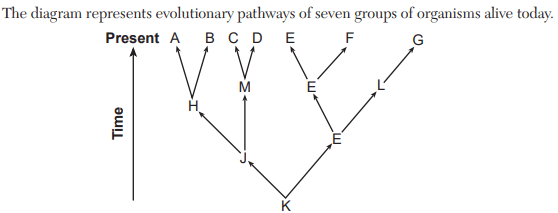
Which species appears to have been well adapted to its environment for a long period of time?
E
F
C
D
(1) E
300
Many species of whales live in social groups called pods. These pods can include a few individuals or sometimes dozens of members. Whales in pods often work together when searching for food, sometimes surrounding schools of fish or taking turns during a hunt. They also communicate using a variety of sounds, which allows them to stay connected even across long distances.
Within a pod, adult whales often remain close to younger whales. Calves can be seen swimming near older group members, and in some cases, several adults stay nearby when a young whale is present. Young whales also spend time observing others in the group, repeating certain behaviors they see.
Because of these interactions, whales in pods tend to stay close together and rely on one another in different situations. The graph below shows some information about pod size in whales.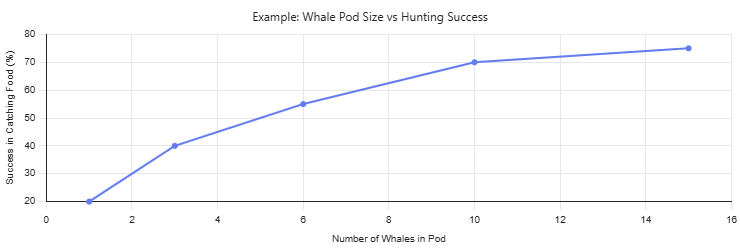
Describe evidence from the graph that supports the claim that hunting in pods increases the whales chance to survive and reproduce.
As number of whales in a pod increases, the success in catching food % increases
300
The cabbage tree emperor moth does not have ears that might alert them to approaching predators, such as bats. Instead, they all have wings with scales and hair-like structures called fur, suited to absorbing the ultrasonic sound frequencies used by bats hunting for food. This absorption reduces the echoes that bounce back to the bats, allowing these moths to avoid detection. Since they are not detected, they don’t need to quickly fly away and use more energy. Scientists have observed that other moth species have developed different defense mechanisms. Some moth species have ears and can hear their predators approaching and quickly swerve out of the way. Other moth species fly in a slow zigzag pattern that imitates bees and wasps, which are not desirable prey to bats.
Predict how the frequency of the trait for sound-absorbing wings might be expected to change over time. Support your answer.
The sound-absorbing wings trait would increase over time, as it helps the butterfly survive and reproduce
300
The diagram [gel electrophoresis] was based on DNA evidence. Describe other forms of evidence that would help support the accuracy of the evolutionary pathways represented in the diagram.
fossils, homologous structures, embryology
300
Studying fossils provides evidence for evolution because fossils
take a long time to form
can show patterns of biological change over time
always contain complete DNA sequences
found in the same area are usually closely related to each other
(2) can show patterns of biological change over time
400
In the 1800s, unregulated hunting reduced bison herds from tens of millions of individuals to fewer than 1,000. How might the DNA of the modern bison populations compare with the DNA of ancestral populations prior to the 1800s?
Modern bison have more genetic diversity than their ancestors as a result of an increase in available mates.
Modern bison have less genetic diversity than the population before the 1800s did as a result of increased random mutations.
The DNA of the modern bison is identical to that of bison living before the 1800s because they all evolved from the same common ancestor.
The DNA of modern bison shows less genetic diversity compared to their ancestors due to the limited genetic variation remaining in their population
(4) The DNA of modern bison shows less genetic diversity compared to their ancestors due to the limited genetic variation remaining in their population
400
Many species of whales live in social groups called pods. These pods can include a few individuals or sometimes dozens of members. Whales in pods often work together when searching for food, sometimes surrounding schools of fish or taking turns during a hunt. They also communicate using a variety of sounds, which allows them to stay connected even across long distances.
Within a pod, adult whales often remain close to younger whales. Calves can be seen swimming near older group members, and in some cases, several adults stay nearby when a young whale is present. Young whales also spend time observing others in the group, repeating certain behaviors they see.
Because of these interactions, whales in pods tend to stay close together and rely on one another in different situations. The graph below shows some information about pod size in whales.
What statement provides evidence that explains how an environmental factor could cause a change in gene frequency for the likelihood of social behaviors in whales?
Whale social behavior is caused only by learned habits and does not relate to genetic differences
Whales sometimes swim alone in areas where food is always abundant and easy to catch
In regions where food is difficult to find, whales that cooperate in groups obtain more food and are more likely to have offspring that also cooperate
All whales, regardless of environment, behave in the same way and form pods
(3) In regions where food is difficult to find, whales that cooperate in groups obtain more food and are more likely to have offspring that also cooperate
400
When the frequency of a gene in a population changes, the most likely result would be
ecological succession
species extinction
biological evolution
genetic mutation
(3) biological evolution
400
BONUS: The amino acid sequence of four species, Bc, X, Y, and Z, were compared to determine their evolutionary relationship. Based on the amino acid sequence below, identify the evolutionary tree that best represents the relationship between the species.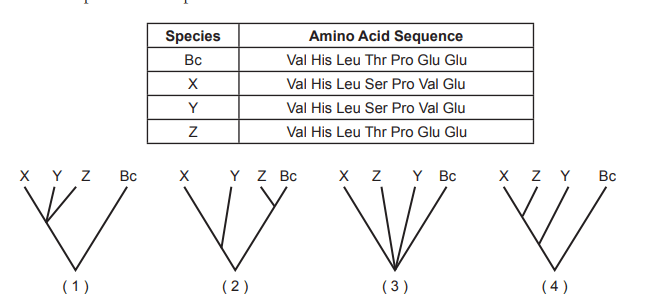
(2)
400
The changes observed over time occurred as the organisms
needed to change the habitat where they lived from land to water
needed to change the habitat where they lived from water to land
developed variations that made it possible for them to move from land to water
developed variations that made it possible for them to move from water to land
(4) developed variations that made it possible for them to move from water to land