Introduction
Cells
Innate 1
Innate 2
Case Studies
100
When you give someone an attenuated pathogen to prevent disease.
What is vaccination?
100
Matures to an antibody secreting plasma cell.
What are B cells?
100
First line of defense against a pathogen.
Give three examples.
Skin: Barrier
Mechanical: flow of tears, mucus, air
Chemical: sebum, stomach acid, lysozyme (tears and nasal secretions)
Microbiological: normal flora
100
When complement proteins C5-C9 form a pore in the membrane of a pathogen.
What is the membrane attack complex?
100
Filters the blood and removes pathogens and eliminates old RBC's
What is the spleen?
200
The immune system protects you from these four types of pathogens.
What are bacteria, viruses, fungi, and parasites (worms and protozoa).
200
Matures to be a helper or regulatory or cytotoxic cell.
What are T- cells? Or T-lymphocytes
200
Fixation of complement.
What is attaching C3b to the pathogens surface?
The goal of all three pathways!
200
Role of C3a, C5a and C2b?
Anaphylatoxins: they increase vascular permeability leading to inflammation.
Chemoattractant for neutrophils, increases expression of complement receptors, increase phagocytosis.
200
Form a hypothesis to test the theory that exposure to parasites decreases allergies in adults.
If a population is exposed to parasites then they will have a decreased allergic response to local allergens such as pollen.
If a population has a high incidence of allergy then infecting them with parasites will shift the immune response to the parasite.
300
Primary lymphoid tissue
What are the bone marrow and thymus?
300
Cells of innate immunity that need to overcome inhibitory signals to kill virally infected cells?
What are natural killer cells?
300
Results of complement fixation?
Increased inflammatory cells
Opsonization of pathogen leading to phagocytosis
Perforation of pathogen cell membrane
Then DEATH of PATHOGEN
300
A group of receptors present as dimers that bind to pathogen associated molecules such as lipopolysaccharide, and double stranded RNA. They activate transcription factors to release cytokines and adhesion molecules.
What are Toll-like receptors?
FYI: TLR are found on monocytes, macrophages, dendritic cells, neutrophils, B cells, T cells, fibroblasts, endothelial cells, and epithelial cells.
300
Why are encapsulated bacteria hard for the innate immune system to kill?
Polysaccharide capsule: Difficult for cells to phagocytosis them because they do not activate complement well.
Immunity is dependent on generating antibodies.
Children under 2 make a poor antibody response to polysaccharide antigens.
400
A type of endocytosis performed by specialized cells such as macrophages and neutrophils.
What is phagocytosis?
400
Star shaped cells that take up pathogen and travel to secondary lymphoid tissue (lymph nodes) to activate T-cells.
What are dendritic cells?
400
C3b2Bb
What is its purpose?
What is C5 convertase?
To form the membrane attack complex.
400
Role of TNF-alpha: local vs systemic?
Local: Increased inflammation, phagocytosis of bacteria and local vessel closure.
Systemic: Overall swelling (edema), causes a decrease in blood volume, collapse of blood vessels, coagulation in blood vessel leading to multiple organ failure and septic shock.
400
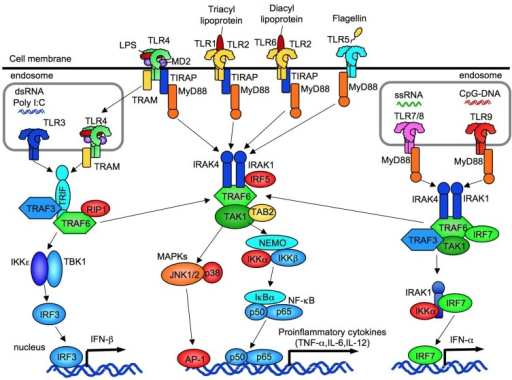
Which TLR are on the cell membrane? Which TLR are in the endosome? Which one binds directly to its TLR? What is the role of NFkappaB?
Cell membrane: 4, 1&2, 6&2, 5
Endosome: 7&8, 9
Directly: 5
NFkappaB: transcription factor that produces the cytokines: TNF-alpha, IL-12 & Il-6.
500
A commensal organism breaches the gut epithelium and cause disease.
What is an opportunistic infection?
500
Precursor cells that gives rise to all other cells in the bone marrow.
What is the hematopoietic stem cell?
500
What molecules facilitate inflammation?
Name two and give their function
Cytokines:
CXCL8: recruits neutrophils and NK cells,IL-1: vasodilation, TNF-alpha: increases permeability of blood vessels, IL-6: fever, IFN-alpa and beta: help fight off a viral infection,
500
Effector functions leading to elimination of pathogen.
(Name them)
What are: phagocytosis, apoptosis, and cell lysis
500
Interferon response
Elimination of a viral infection by the production of IL-1 alpha and beta.
Increases production of endonucleases, warns neighboring cells to increase production of proteins that inhibit viral replication, increases expression of ligands for NK cells, activates NK cells.