Introduction to Community Health
Optimizing Population Health
Health Disparities & Social Determinants of Health
Health & Vulnerable Populations
100
You are teaching a new nurse on ways to develop her cultural competency. Which of the following interventions would you recommend for the nurse? Select all that apply.
a. Use the internet to find resources that can help you gain more knowledge about different cultures.
b. Ask patients questions about their cultural traditions and beliefs if you are unfamiliar with that culture.
c. Provide the same type of care and delivery to every patient so you do not project any bias.
d. Be approachable and have an open mind about learning different health beliefs and traditions.
e. Learn common health beliefs about the different cultures and assume everyone of that culture follows those health beliefs.
a. Use the internet to find resources that can help you gain more knowledge about different cultures.
b. Ask patients questions about their cultural traditions and beliefs if you are unfamiliar with that culture.
d. Be approachable and have an open mind about learning different health beliefs and traditions.
100
You are a community health nurse working at the public health department. You are tasked with starting a free exercise class at the recreation center to encourage & motivate residents to work out and lose weight. This program is using what concept to improve community health?
a. Risk reduction
b. Health protection
c. Health promotion
d. Health motivation
e. Risk management
c. Health promotion.
Health promotion is defined as the process of enabling people to increase control over, and to improve, their health. It moves beyond a focus on individual behavior towards a wide range of social and environmental interventions. Examples would be related to helping patients make lifestyle changes such as increasing exercise.
100
Social determinants of health are the social and environmental conditions in which people are born, live, learn, work, play, worship, and age. There are 5 major categories for social determinants of health. Which category is missing from this list?
-education access and quality
-neighborhood & built environment
-social & community context
-economic stability
-
healthcare access and quality
100
You are a home health nurse providing education to a family living with a grandmother who has early onset Alzheimer’s. Which of the following is the priority education that should be provided to the family?
a. You should obtain a caretaker for your grandmother to ensure she can be watched at all times.
b. You should notify your neighbors of your grandmother's condition in case of possible elopement.
c. You should modify the home environment, such as removing rugs in high traffic areas, to prevent injury.
d. You should work on mental stimulation activities with your grandmother to promote brain health.
e. You should give your grandmother something to do with her hands, like folding towels, when she becomes anxious or agitated.
c. You should modify the home environment, such as removing rugs in high traffic areas, to prevent injury.
Modifying the home environment is priority due to the high risk of falls and injuries during early onset Alzheimer's. 24/7 caretaker and elopement are options that may need to be addressed in later stages of Alzheimer's.
200
Fill in the blank:
1. _______ refers to having shared geographic origin, language/dialect, religious faith, folklore, food preferences, and culture.
2. _______ categorizes groups of people based on superficial criteria such as physical characteristics.
1. Ethnicity refers to having shared geographic origin, language/dialect, religious faith, folklore, food preferences, and culture.
2. Race categorizes groups of people based on superficial criteria such as physical characteristics.
200
James is a PHN that has been assigned to work with the local health department to find ways to reduce obesity rates. They come up with a plan to set up a marathon and include incentives for all participants. According to the intervention wheel, what level is James practicing at? *refer to image below
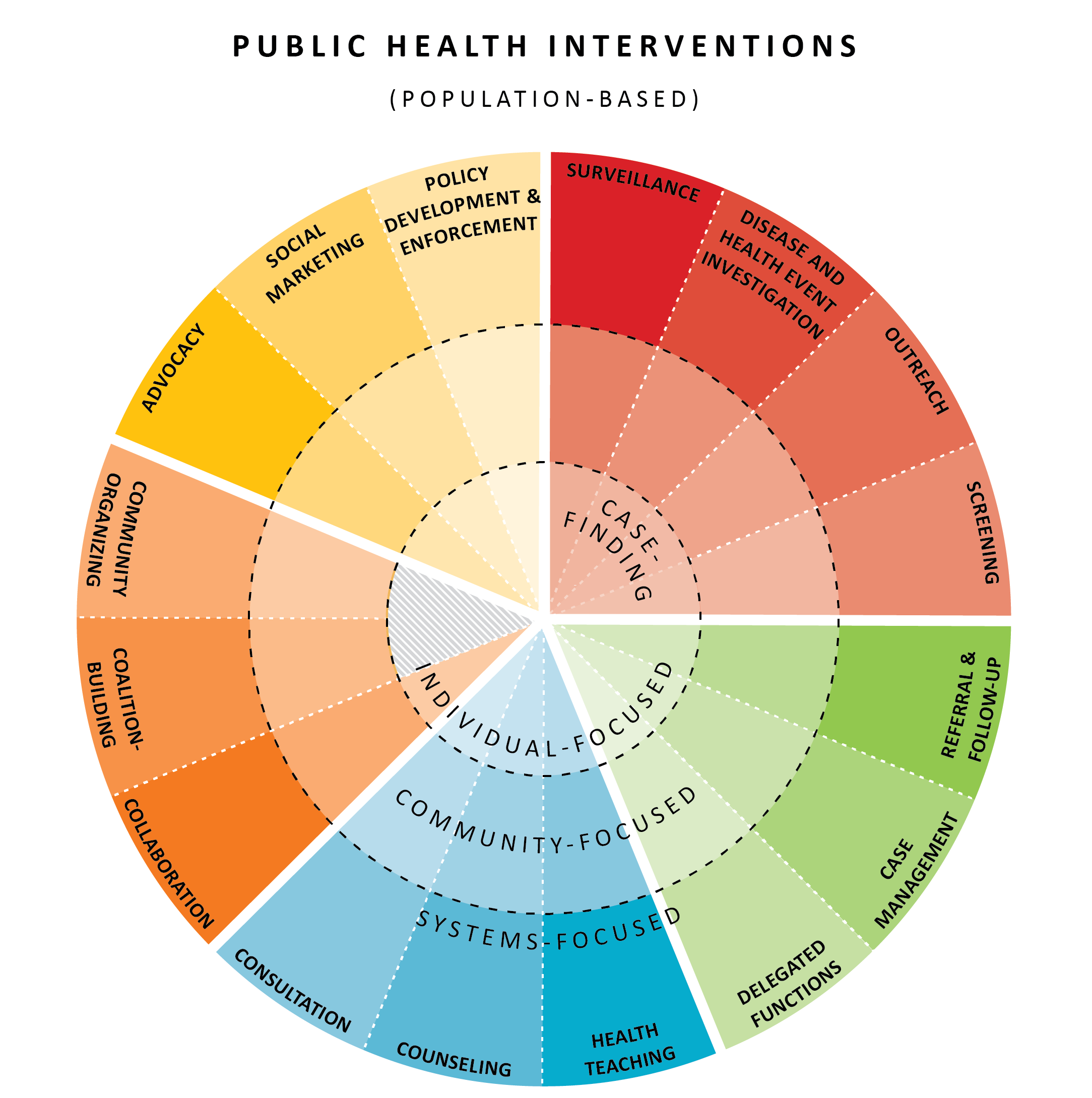
John is practicing at a community-focused level. The intervention he is performing is focused on improving the health of a community.
200
In class, we learned about the difference between equity versus equality. Which of the following examples demonstrates equity?
a. Costco offers influenza vaccines for $15 for all members.
b. The federal governments gives 2 at home COVID self-testing kits to each household.
c. A church opens their door as a shelter to residents during a major flood.
d. The local health department offers sliding scale payment (payment based on income) to their patients who do not have private health insurance.
e. The federal government gives PPP loans to businesses during an outbreak quarantine to keep their workforce employed.
d. The local health department offers sliding scale payment to their patients who do not have private health insurance.
200
You are a nurse working at a primary care clinic. You are treating a patient who tells you she moved to the U.S two months ago. She had to flee her home country after marrying her husband and converting to Islam. Her status in the US has not yet been definitively determined. How would you classify this patient?
a. Primary homelessness
b. Migrant
c. Asylee
d. Refugee
e. Day laborer
c. Asylee
A person asking to receive refugee status is outside the United States and seeking to enter, whereas an asylee is a person already residing in the United States when applying for asylum.
300
Sarah, a BSN nursing student, asks her community health teacher what the difference is between public health nurse and other nurses. What statements accurately reflect the role of a PHN? Select all that apply.
a. Public health nursing is a recognized nursing specialty.
b. PHNs work in various settings including schools, infection control, and health departments.
c. A PHN's main role is to provide health education to patients.
d. PHNs are focused on health promotion and disease prevention for the community.
e. PHNs primarily work with diverse patients in the acute care setting.
a. Public health nursing is a recognized nursing specialty.
b. PHNs work in various settings including schools, infection control, and health departments.
d. PHNs are focused on health promotion and disease prevention for the community.
300
Prevalence pot is a way of depicting the total number of cases of the disease in the population and takes into account issues related to duration of the disease and the incidence of the disease. List the 3 ways you can leave the prevalence pot.
The three ways to leave the prevalence pot:
Cure, disability, or death.
300
Provide an example of how marginalization can lead to discrimination and adverse health outcomes.
examples:
homeless individuals are not offered care, such as pain medication, with the same frequency as nonmarginalized patients.
provider discrimination against LGBTQ population prevents LGBTQ individuals from seeking care.
300
LGBTQ+ individuals are considered a vulnerable population because they are at an increased risk of experiencing adverse health outcomes due to discrimination and social isolation. What health disparities are common in this vulnerable population? Select all that apply.
a. Substance use disorders
b. Noncommunicable diseases
c. Suicide
d. HIV/AIDs
e. Injuries from violence
f. Bipolar disorder
g. Homelessness
a. Substance use disorders
c. Suicide
d. HIV/AIDs
e. Injuries from violence
g. Homelessness
400
The public health nurse is responsible for the six standards of practice to provide competent level of care using the nursing process. What are the 6 standards?
1. Assessment
2. Diagnosis
3. Outcome identification
4. Planning
5. Implementation
6. Evaluation
400
An overweight 52-year-old male patient comes to a primary care clinic for a routine check-up. He has a history of hypertension. He also recently developed a venous ulcer above his L ankle. He has been a tobacco smoker for 25 years and smokes ~1 pack/day. He does not drink alcohol. He has a family history of type 2 diabetes.
Which of the following are tertiary prevention nursing interventions for this client? SATA.
a. Perform wound care for his venous ulcer.
b. Educate the client to limit his sodium intake.
c. Draw client's blood and test his A1C level.
d. Administer influenza vaccine since it is flu season.
e. Provide smoking cessation education.
f. Teach the client about DASH diet.
a. Provide wound care to his L ankle.
b. Educate the client to limit his sodium intake.
e. Provide smoking cessation education.
f. Teach the client about DASH diet.
400
Linda, a PHN, is performing a community assessment to better understand the underlying factors associated with the noted increase in childhood obesity in the community. What social determinants of health should Linda include in the assessment? Select all that apply.
a. Location of primary health providers
b. Nutrition and physical education classes in the public schools
c. Access to fresh produce
d. Presence of sidewalks and green space within the community
e. Housing security
a. Location of primary health providers
b. Nutrition and physical education classes in the public schools
c. Access to fresh produce
d. Presence of sidewalks and green space within the community
400
You are an emergency room nurse admitting a new patient. While performing your admission, you find out the patient does not have a permanent residence. He has been moving across the U.S and crashes at different friends and family’ member's houses every couple months. What type of homelessness would this patient be considered?
a. Primary
b. Secondary
c. Tertiary
d. The patient is not considered homeless because they are sheltered throughout the night.
b. Secondary- includes those who are staying in a temporary form of housing because they have nowhere else to go—those living with friends or family, or in shelters.
500
The World Health Organization (WHO) is focused on improving the health of global populations. What are the major functions of the WHO? Select all that apply.
a. Conduct biomedical research
b. Conduct disease surveillance
c. Responder to manmade and natural disasters
d. Oversee various nursing boards
e. Establish evidence-based policies
f. Control public health departments
a. Conduct biomedical research
b. Conduct disease surveillance
c. Responder to manmade and natural disasters
e. Establish evidence-based policies
The WHO is focused on global health, the collaborative transnational research and action for promoting health for all. Their duties include all of the above. They do not oversee nursing boards.
500
Heather is a school nurse who works at a high school located in community with limited funds and resources. The principal of the school informs her several students were caught drinking alcohol in the bathroom last week. The principal wants Heather to work with the students and have them complete a continuing drug and alcohol education class. According to the newer IOM framework, which prevention intervention is the principal suggesting?
A. Universal prevention intervention
B. Selective prevention intervention
C. Indicated prevention intervention
D. Secondary prevention intervention
E. Tertiary prevention intervention
C. Indicated prevention intervention
500
Priscilla is a new PHN studying the different factors and principles that impact communities. She learns about social capital and understands that it influences communities by doing what? Select all that apply.
a. it helps increase the number of trusted relationships within their community
b. it influences civic engagement and voting patterns
c. it increases individuals' hostility and distrust in healthcare providers/medical professionals
d. it increases the number and strength of ties to the neighborhood and community organizations
e. it can influence social determinants of health such as education & employment
f. it forces people to understand what services are available to them in the community
a. it can help people or groups increase the number of trusted relationships within their community
b. it can influence civic engagement and voting patterns
d. it can increase the number and strength of ties to the neighborhood and community organizations
e. it can influence social determinants of health such as education & employment
500
Migrants are a vulnerable population and are at an increased risk for poorer health outcomes. Which of the following interventions could assist this specific population? Select all that apply.
a. Increase the amount of health care providers in rural areas.
b. Advocate for policies that mandate businesses provide healthcare insurance for seasonal workers.
c. Increase affordable housing in agricultural towns.
d. Work with local contractors to build a new state of the art gym.
e. Provide transportation in rural towns with limited access to healthcare services.
f. Provide mobile HIV/AIDs screenings.
g. Provide human trafficking awareness & education training to healthcare professionals in agricultural towns.
a. Increase the amount of health care providers in rural areas.
b. Advocate for policies that mandate businesses provide healthcare insurance for seasonal workers.
c. Increase affordable housing in agricultural towns.
e. Provide transportation in agricultural towns with limited access to healthcare services.
g. Provide human trafficking awareness & education training to healthcare professionals in agricultural towns.