Experiments
DNA Structure and Replication
Transcription and Translation
Protein Structure and Function
Mendelian Genetics
100
What were the positive and negative controls in the Griffith experiment?
a.) Positive control: heat-treated S cells; Negative control: live R cells
b.) Positive control: live S cells; Negative control: live R cells
c.) Positive control: live R cells; Negative control: live S cells
d.) Positive control: heat-treated S cells and live R cells; Negative control: live S cells
b.) Positive control: live S cells; Negative control: live R cells
Positive control = a condition that produces a known result, negative control = produces no result/nothing happens
Griffith experiment: monitoring whether the mice die or not, so anything where we know the mice will die is the positive control and anything where we know the mice will stay alive is the negative control
100
Which of the following is correct about base pairings? Choose all that apply.
a.) A pairs with T
b.) G pairs with T
c.) T pairs with C
d.) C pairs with G
a.) A pairs with T, d.) C pairs with G
These are the base pairs in DNA
Keep in mind, there will be equal amounts for each base pair (ex: if DNA is 15% adenine, then it is also 15% thymine)
100
What is the correct order of the central dogma of biology?
a.) DNA -> RNA -> protein
b.) RNA -> DNA -> protein
c.) protein -> RNA -> DNA
d.) protein -> DNA -> RNA
a.) DNA -> RNA -> protein
DNA replicates, transcription makes mRNA copies, translation makes protein
100
What type of bond is used to combine amino acids to make a protein? (aka a peptide bond)
a.) Ionic
b.) Covalent
c.) Hydrogen
d.) Hydrophobic interactions
b.) Covalent
A peptide bond is just a covalent bond that joins amino acids together to form a protein
You need a strong bond to join amino acids together so that the resulting protein has a strong structure
100
In pea plants, purple flowers (P) are dominant to white flowers (p). What color will a pea plant with the genotype Pp be?
a.) Purple
b.) White
a.) Purple
If P is dominant and expresses purple flowers, then even one copy of P will overpower the p (white flowers)
Dominant phenotype will always be expressed (at least for this class) if there is at least one copy of the dominant allele
Heterozygotes will express dominant trait
200
Which tube produced only live R cells in the Avery experiment?
a.) S filtrate only
b.) S filtrate treated with protease
c.) S filtrate treated with DNase
d.) S filtrate treated with RNase
c.) S filtrate treated with DNase
S filtrate includes what is needed for the heritable material to be shared and to transform R cells into S cells.
We now know that the heritable material is DNA -> DNase is an enzyme that destroys DNA
No DNA = no transformation from R cells to S cells
200
What type of bond holds the sugar and phosphate together in DNA? What type of bond holds the bases together in DNA? (Two answers total.)
a.) Ionic
b.) Covalent
c.) Hydrogen
d.) Hydrophobic interactions
b.) Covalent
sugar and phosphate are held together by covalent bonds -> need a strong backbone to keep DNA's structure -> covalent bonds are strongest
c.) Hydrogen
need weaker bonds between the bases because we need to be able to unwind the double helix so that transcription/translation can take place -> hydrogen bonds are one of the weaker bonds
200
Which direction does RNA polymerase read the template strand?
a.) 3' - 5'
b.) 5' - 3'
a.) 3' - 5'
RNA polymerase binds to the template strand and reads from 3' - 5'
DNA is therefore synthesized in the opposite direction 5' - 3'
Why? Because DNA is antiparallel, meaning the strands run in opposite directions!
200
What is the unique part of every amino acid that determines its various characteristics?
a.) Carboxyl group
b.) Amino group
c.) Alpha carbon
d.) R group/side chain
d.) R group/side chain
The R group/side chain is the only part of an amino acid that is different/unique
All amino acids have the same alpha carbon, carboxyl group, and amino group
200
In pea plants, purple flowers (P) are dominant to white flowers (p). If you have a cross between to heterozygous plants, what ratio of plants will have purple flowers?
a.) 1/4
b.) 1/2
c.) 3/4
d.) All plant will have purple flowers
c.) 3/4
Punnett square:

Probability:
300
If a mutation caused DNA to have 5 possible types of base pairs instead of 4, how many different sequences could be made from 4 base pairs?
a.) 44
b.) 45
c.) 54
d.) 55
c.) 54
We are told DNA now has 5 types of base pairs instead of 4, and we are given 4 individual base pairs
There are 5 choices for each of the 4 positions.
# of possible sequences = number of types of base pairs ^ given base pairs
300
In the Meselson-Stahl experiment, when they performed density gradient centrifugation, ______ was heavier and therefore was _____ in the gradient.
a.) 14N, lower
b.) 14N, higher
c.) 15N, lower
d.) 15N, higher
c.) 15N, lower
The number represents the atomic weight -> larger number = heavier and more dense
Heavier and denser materials will be lower in the gradient
14N would be lighter and higher in the gradient
300
Where does RNA polymerase bind on an operon? Where does the repressor protein bind?
a.) Repressor
b.) Promoter
c.) Operator
d.) Activator
b.) Promoter
The promoter only acts as a site where RNA polymerase can bind and begin transcription -> promotes transcription by allowing RNA polymerase to bind
c.) Operator
The operator only acts as a location for the repressor protein to bind and stop transcription
300
How many unique tRNAs does the following amino acid sequence have:
Met–Leu–Ser–Gly–Met–Pro–Ser–Leu–Gly–stop
a.) 5
b.) 6
c.) 8
d.) 10
a.) 5
Unique tRNA essentially means the unique amino acid attached -> stop codon does not count
Repeats of amino acids do not count either -> you only count each unique amino acid one time
300
The starting genotype for your plant is BbHh. Write the potential gametes that could be produced by this plant, using commas between each gamete. This one is NOT multiple choice!
BH, Bh, bH, bh
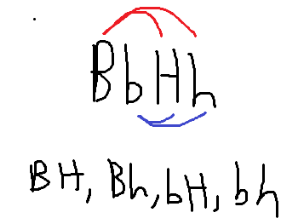
Gametes are just the different possible combinations between the different traits
400
In the Hershey-Chase experiment, which biomolecule was primarily found outside the bacterial cells, in the supernatant?
a.) Protein
b.) DNA
a.) Protein
Heritable material is injected into the cell by bacteriophages, and everything else will stay outside of the cell and end up in the supernatant
The heritable material was expected to be inside of the cell -> we now know it is DNA, so we would expect nearly all of it to be inside in the nucleus
Protein would be the opposite, since the bacteriophage protein was not injected into the cell
400
 After two rounds of replication, which of the following models does this image represent? Pink = new DNA (or 14N) and black = old DNA (or 15N).
a.) Conservative
b.) Semi-conservative
c.) Moasic/dispersive
b.) Semi-conservative
Only semi-conservative will have DNA with one strand old DNA and one strand new DNA (50/50)
Since only new DNA (14N) is available, future generations will be all new/all 14N since that is all they are able to replicate with
Mosaic is very distinctive (would be small blocks in each strand) and conservative would have DNA that is either all old (15N) or all new (14N)
400
If there is plenty of lactose available and LacI is nonfunctional, what would happen to protein production (production of B-galactosidase and permease)?
a.) There would be little to no production of lac operon proteins
b.) There would be lots of production of the lac operon proteins as long as lactose is available
c.) There would be lots of production of the lac operon proteins even after lactose is used up
d.) None of the above
c.) There would be lots of production of the lac operon proteins even after lactose is used up
LacI encodes for a repressor protein -> when LacI is functional, repressor protein is functional
If LacI is nonfunctional, then there is no repressor protein -> even with no lactose available, transcription won't be able to be stopped/repressed
400
 Identify the amino group, carboxyl group, and R group relative to the central carbon
a.) Amino to the left, carboxyl to the right, R group below
b.) Amino to the right, carboxyl to the left, R group below
c.) Amino below, carboxyl to the right, R group to the left
d.) Amino to the left, carboxyl below, R group to the right
a.) Amino to the left, carboxyl to the right, R group below
Amino group = NH2, in this case it is NH3+
Carboxyl group = COOH, in this case it is COO-
If you get questions like this, all you need to do is look for an NH for amino, and COO or a double-bonded O for carboxyl
More likely than not, you'll get a simple question though! I'm just not sure...
400
Huntington’s disease is dominant. If one parent is Hh and the other is hh, what is the probability that their child will inherit the disease?
a.) 0%
b.) 25%
c.) 50%
d.) 100%
c.) 50%
Punnett Square:
Probability:
500
How were DNA and protein labeled in the Hershey-Chase experiment?
a.) DNA was labeled with sulfur-35, and protein was labeled with phosphorus-32.
b.) DNA was labeled with nitrogen-15, and protein was labeled with carbon-14.
c.) DNA was labeled with oxygen-18, and protein was labeled with sulfur-35.
d.) DNA was labeled with phosphorus-32, and protein was labeled with sulfur-35.
d.) DNA was labeled with phosphorus-32, and protein was labeled with sulfur-35.
DNA has a phosphate backbone, while protein does not contain any phosphorus (or very little)
Protein contains sulfur, while DNA does not contain any sulfur
500

After two rounds of replication, which model does the following image represent?
a.) Conservative
b.) Semi-conservative
c.) Mosaic/dispersive
a.) Conservative
Conservative is the only model of replication that will not have any DNA in the middle (50/50). DNA will be either all old (15N) or all new (14N)
Both semi-conservative and mosaic will always have a band in the middle!!
500
Given the following coding strand, what is the mRNA sequence? 5′ – ATG CCA TTT GGA – 3′
a.) 5′ – AUG CCA UUU GGA – 3′
b.) 3′ – AUG CCA UUU GGA – 5′
c.) 5′ – UAC GGU AAA CCU – 3′
d.) 3′ – AGG UUU ACC GTA – 5′
a.) 5′ – AUG CCA UUU GGA – 3′
The template strand is what RNA polymerase binds to and creates the mRNA strand from -> template strand is in the 3' - 5' direction
The coding strand is the same as the mRNA, except the coding strand has T and the mRNA has U -> both will be in the 5' - 3' direction
500

Is the following amino acid hydrophilic or hydrophobic?
a.) Hydrophilic
b.) Hydrophobic
b.) Hydrophobic
Hydrophobic amino acids only have carbon and hydrogen in their R group/side chain
Any location where two lines intersect is a carbon; they just don't explicitly say that
Hydrophilic amino acids either have a charge (- or +) shown on their R group, or they have a NOPS element (nitrogen, oxygen, phosphorus, sulfur) SPECIFICALLY in their side chain -> amino and carboxyl groups do not affect this as all!!
Not sure if you'll get a question quite like this, but have a general idea of how to tell just in case!
500
In pea plants, purple flowers (P) are dominant to white flowers (p), and tall plants (T) and dominant to short plants (t). If you have two parents that are heterozygous for both traits, what fraction of the offspring will be recessive for both traits?
a.) 1/2
b.) 1/4
c.) 1/8
d.) 1/16
d.) 1/16
Punnett square:
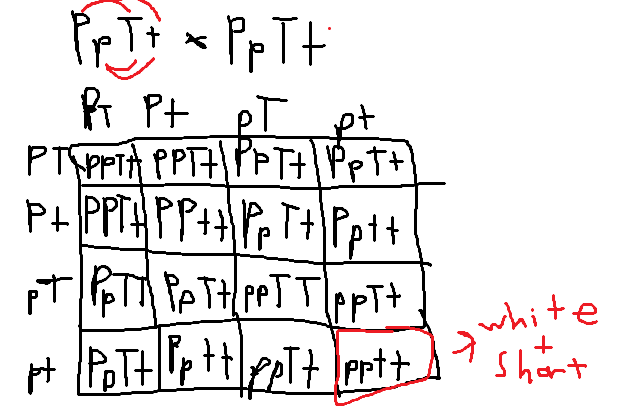
Probability: