Nervous System
Sensory Systems
Muscles
Immune System
Skeletal System
100
What stimulates vesicles containing neurotransmitters to release the neurotransmitters from an axon terminal?
CALCIUM
100
What are the two photoreceptors and their roles? Where are they located?
Rods → sensitive to light
Cones → color vision
Both located in the back of the retina
100
Which band is defined by the presence of myosin but no actin?
a. Z line
b. M line
c. A band
d. H zone
e. I band
d. H zone
100
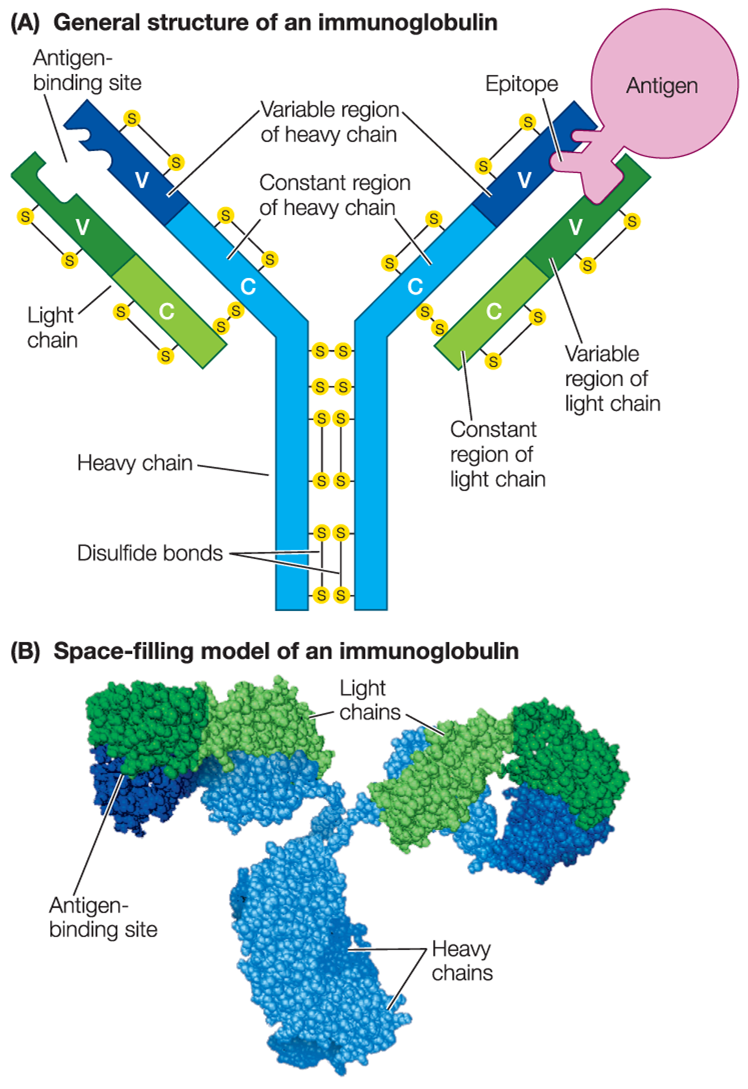
These are sites on the antigen that the immune system recognizes. This is the part of an antigen molecule to which an antibody’s variable region attaches itself.
Antigenic determinants/epitopes
vs
Antibody’s variable region = antigen binding site = paratope
100
An osteon is composed of…
a. Collection of osteoblasts
b. Layers of bone lamellae surrounding a central canal
c. Collection of osteoclasts
d. Cartilage
b. Layers of bone lamellae surrounding a central canal
T/F: Osteons are located within spongy bone?
FALSE, osteons are located within compact bone. Unlike compact bone, spongy bone already has so many holes and crevices (lots of surface area) that blood vessels and nerves can pass through and interact with bone tissue.
200
The opening of voltage gated potassium and sodium channels on an axon by a stimulus that exceeds threshold initially results in a strong depolarization because:
A) the potassium channels open faster and potassium ions flow inward.
B) the potassium channels open faster and potassium ions flow outward.
C) the sodium channels open faster and sodium ions flow inward.
D) the sodium channels open faster and sodium ions flow outward.
E) both channels open at the same times and both ions flow inward.
c. the sodium channels open faster and sodium ions flow inward.

200
Which of the following statements about ommatidia is FALSE?
a. Lenses are found next to photoreceptors
b. Brain compiles and integrates lots of images
c. They creates a mosaic image, much like the pixels on a digital screen.
d. Ommatidia are the optical units of arthropods
e. Each ommatidium has its own lens
f. None of the above
None of the above
200
These are invaginations of the muscle cell membrane that carry the action potential deeper into the muscle fiber, ensuring that the signal reaches the sarcoplasmic reticulum for calcium release and muscle contraction.
A) neuromuscular junctions
B) fascicles
C) myofilaments
D) T tubules
E) sarcomeres
T tubules - know the processes of excitation and contraction in sequence!

200
What’s the key difference between B-cell receptors and T-cell receptors?
T-cell receptors
can only bind to antigens bound to MHC proteins on APCs
cannot recognize free antigens
need antigen presentation
Classes correspond to which T cells?
Vs
B-cell receptors (aka antibodies aka immunoglobulins)
can recognize and bind to free antigens
does not need to utilize MHC proteins for antigen presentation
200
Which of the following materials makes up mollusc exoskeletons?
A) Calcium phosphate
B) Chitin
C) Calcium carbonate
D) Wax
E) Epithelial cells
C) Calcium carbonate
300
What does membrane potential represent?
A. The amount of ATP inside a cell
B. The difference in electrical potential created by separated charges
C. The speed at which ions move through a membrane
D. The amount of neurotransmitter released by a neuron
B. The difference in electrical potential created by separated charges
300
Which statement is correctly characterizes ionotropic receptors?
a. Activate a G protein which allows ions to depolarize the cell
b. Have an ion channel with a ligand binding site
c. Cause only excitatory potentials
d. Utilize second messenger molecules
e. None of the above
b. Have an ion channel with a ligand binding site
300
In the first 10 seconds of exercise, which of the following is providing your body the majority of energy?
a. Glycolysis
b. Creatine phosphate
c. Lactic acid
d. Citric Acid Cycle
e. Electron transport chain
Creatine phosphate pathway - creatine phosphate floating in cytoplasm; the phosphate binds to ADP to quickly make ATP
An example of an immediate ATP-making pathway
Allows for immediate ATP, but is quickly exhausted
300
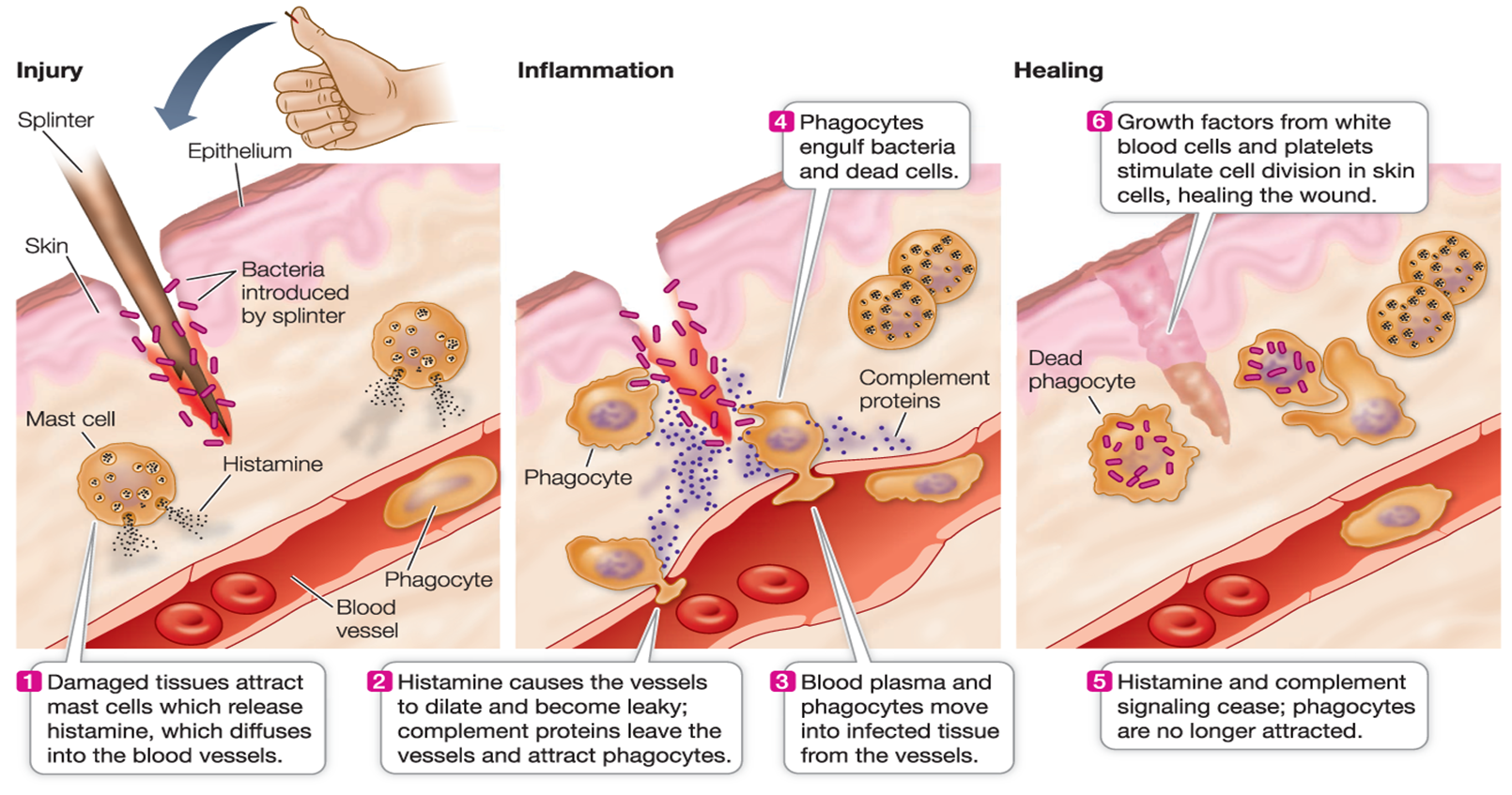
When histamine is released from a mast cell, what will be the next event in the inflammatory response?
a) Histamine will target the phagocytes and stimulate apoptosis.
b) Histamine will lyse the bacteria in the wound.
c) Histamine will bind to bacterial antigens.
d) Histamine will cause the blood vessel in the area to dilate and become leaky.
e) Histamine will stimulate Tc cells.
d) Histamine will cause the blood vessel in the area to dilate and become leaky.
300
Which of the following is incorrect?
a) Osteoblasts - deposits new bone matrix
b) Osteoclasts - release calcium into ECF
c) Osteocytes - surrounded by bone matrix
d) Osteoclasts - dissolve bone matrix
e) Osteoblasts - withdraws calcium from bone bank
f) Osteoclasts - responsible for reabsorption of bone
e) Osteoblasts - withdraws calcium from bone bank
Osteoblasts add to / “deposit” calcium into bone bank.
400
What is the primary effect of myelin on an axon?
A. It increases Na⁺ leakage
B. It prevents ionic movement across the entire neuron
C. It prevents Na⁺ from leaking and increases conduction velocity
D. It prevents action potentials from occurring
C. It prevents Na⁺ from leaking and increases conduction velocity
400
Which statement is correctly characterizes ionotropic receptors?
a. Activate a G protein which allows ions to depolarize the cell
b. Have an ion channel with a ligand binding site
c. Cause only excitatory potentials
d. Utilize second messenger molecules
e. None of the above
b. Have an ion channel with a ligand binding site
400
What causes the power stroke during the cross-bridge cycle?
ADP + P being released from the myosin head
400
Which of the following statements about innate immune systems is false?
A) found in all animals.
B) always on or are quickly activated.
C) activate the adaptive immune responses.
D) generally non-specific so they do not contain any receptors for foreign molecules.
E) lack memory and fail to improve with more exposures to a pathogen
D) generally non-specific so they do not contain any receptors for foreign molecules.
400
Little Timmy didn't get enough Vitamin D as a child and has developed bowed legs. Doctors determine that Little Timmy has a skeletal disease called Rickets. A symptom Little Timmy experiences is ________ which is caused by _________.
A) Brittle bones; collagen deficiency
B) Brittle bones; calcium phosphate deficiency
C) Flexible bones; collagen deficiency
D) Flexible bones; calcium phosphate deficiency
D) Flexible bones; calcium phosphate deficiency
500
If voltage-gated Na⁺ channels opened during an action potential but voltage-gated K⁺ channels failed to open, which phase would be most directly affected?
Depolarization
500
In a visual system, light is absorbed by a light-sensitive pigment protein called rhodopsin, which causes what?
a. a change of shape in neurons
b. depolarization of the rhodopsin molecule
c. a change in shape of the opsin protein.
d. an increase in the number of rod cells.
c. a change in shape of the opsin protein (11-cis → all-trans)
500
Which of the following statements about sarcomere molecules is/are TRUE? (MULTIPLE SELECT)
A) Titin anchors actin to the Z line
B) Tropomysoin blocks myosin binding sites
C) Troponin has one subunit that binds myosin
D) Myosin shortens in length as the sarcomere contracts
E) Myosin heads bind calcium
B is the only true statement
- A: Titin anchors MYSOSIN to the Z line
- C: Troponin has 3 subunits that bind to: tropomyosin, actin, and calcium - NOT MYOSIN
- D: Myosin and actin stay the same length during contraction. The sarcomere itself shortens as the filaments slide across each other.
- E: TROPONIN binds calcium (myosin does not).
500
What characterizes a secondary immune response?
a. Antibody and T cell production increased
b. Memory cells create a “memory” of antigen/attack
c. Slow response
d. What occurs when a vaccination is first administered
e. Infection from a previously-encountered pathogen
e. Infection from a previously-encountered pathogen
500
A tiger cub consumes a lot of its mother’s calcium-rich milk. Which of the following are most active?
A. B cells
B. Osteoclasts
C. Osteons
D. Haversian cells
E. Osteoblasts
E. Osteoblasts
More calcium consumption → rise in blood calcium levels → build more bone (deposit excess calcium into our “bone banks”)
Example of what feedback mechanism?