Carbohydrates and Lipids
Cell Membrane and transport
Cell Structure and Function
Energetics and Enzymes
Respiration
100
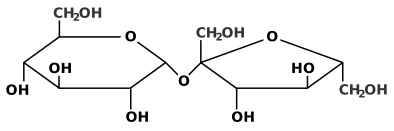
What kind of carbohydrate is this?
A disaccharide, because it contains two subunits (rings).
100
Does diffusion require an input of energy?
No, it is passive.
100
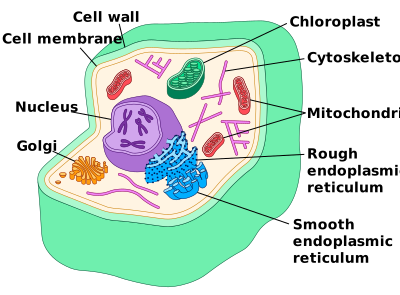
Can this plant cell carry out respiration?
Yes, it has mitochondria!
100
Which has more potential energy: electrons in C-H bond or C-O bond?
C-H hond!
100
In the ETC do you get an output of energy in any form?
No, you put it in (losing the proton) to form the gradient for ATP Synthase.
200
Name one function of lipids.
Form boundaries of cells, store energy.
200
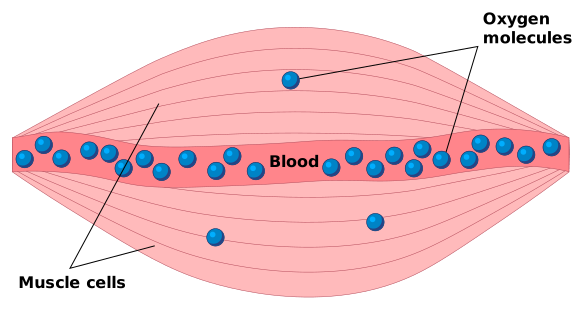
What will happen to the oxygen molecules in this diagram?
Oxygen will move from the blood into the muscle by diffusing directly through cell membranes.
200
Which type of cell is most likely to be affected by a drug that blocks production of the cell wall?
A plant cell
200
What is released from a spontaneous reaction?
Free energy.
200
If a cell runs out of O2 during exercise, what process may occur?
Fermentation
300
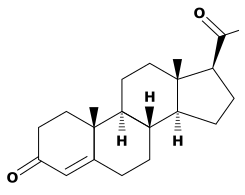
What is this?
A steroid
300
Carrier, Channel, or both?: Changes shape when functioning
Carriers only
300
Name two structures only found in eukaryotic cells
Nucleus, and mitochondria
300
True or false?: Enzymes require an energy input to catalyze chemical reactions
False!
300
At what point during cellular respiration does the type of energy stored in glucose first get transformed to a different type of energy?
When the ETC creates the H+ gradient.
400
Why are some fats liquid or solid at room temperature?
Saturated vs. Unsaturated. Unsaturated has at least one carbon double bond, which prevents it from packing tightly together.
400
Glucose moves from high concentrations outside the cell to lower concentrations inside the cell through GLUT4. What type of membrane transport occurs as glucose moves through the GLUT4 transmembrane protein?
Passive transport, because glucose is moving down its concentration gradient.
400
Certain types of animal cells, such as immune cells and smooth muscle cells, have a large amount of endoplasmic reticulum. Based on this information, which statement describes the most likely function of these cells?
Cells produce proteins and lipids
400
Why might the breakdown of ADP be less useful than ATP when coupled to a nonspontaneous reaction?
ATP has three negative charges while ADP only has two, so ADP has less potential energy.
400
Multiple rounds of cellular respiration have to occur to produce the same amount of ATP as one round of fermentation. Fix this statement.
Multiple rounds of fermentation have to occur to produce the same amount of ATP as one round of cellular respiration.
500
A lipid has both polar and non-polar components and a fatty acid chain with a carbon-carbon double bond. Name one true thing about this lipid.
It could be a phospholipid, and it has hydrophobic and hydrophilic regions.
500
Your IV will typically contain saline (0.9% salt in sterile water) or another similar solution of sterile water and ions. What would happen to your blood cells if you received an IV of pure water instead?
Your cells would swell because the concentration of molecules in solution would now be higher inside the cell than outside the cell and water would diffuse through the membrane into your cells.
500
Name at least three cell parts that are present in both animals and plants.
Cell membrane, cytoskeleton, endoplasmic reticulum, nucleus, mitochondria, and vacuoles.
500
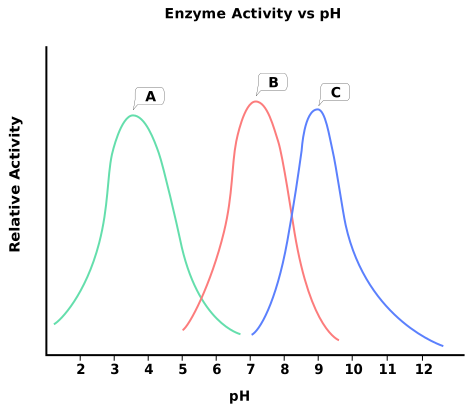
Trypsin, a digestive enzyme works best in pH of 8-9, where does it fit on the Graph?
C
500
During fermentation what is the different output? When is this produced?
Lactic acid, Glycolysis and Pyruvation