Electron Configuration
Orbital Diagrams
Properties of the Periodic Table
Periodic Trends
Strong and Weak Electrolytes, Acids, and Bases
100
This is the condensed electron configuration of a ground-state chlorine atom.
[Ne] 3s23p5
100
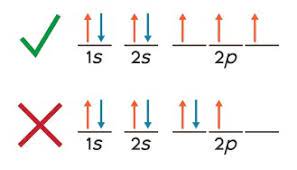 This rule is being violated in these 2 electron orbital diagrams
Hund's Rule
Same spinning electrons fill each orbital sublevel before filling an orbital twice
100
This is the name for the group 6A elements
chalcogens
(the oxygen group is also acceptable)
100
These 2 directions describe how the metallic character of an element decreases, or how the nonmetallic character increases
Up and to the right
100
This adjective can be used to describe hydrochloric acid as an acid and an electrolyte
strong
200
This atom is given by the electron configuration:
1s2 2s2 2p6 3s2 3p6 4s2
Calcium (Ca)
200
This rule is being violated in the orbital diagrams above
Pauli exclusion principle
2 electrons that occupy the same orbital must have opposite spin
200
This group of elements is notoriously unreactive
Noble gases
200
These 2 directions describe how the atomic radii of elements increase
Down and to the left
200
This adjective describes how strontium hydroxide will act as an electrolyte
Strong
300
This is the condensed electron configuration for ground-state copper.
[Ar] 4s1 3d10
300
This rule states that electrons will occupy the lowest energy orbitals first.
Aufbau principle
300
This adjective can describe how hydrogen, nitrogen, oxygen, fluorine, chlorine, bromine, and iodine are all found in their natural, gaseous form
Diatomic
300
These directions generally describe the decrease in ionization energy
down and to the left
Chapter 7 Part 1 Slides 21-22
300
This adjective describes how silver chloride will function as an electrolyte
Weak
400
The condensed lanthanum electron configuration
[Xe] 6s2 5d1
400

The diagram above is the orbital diagram for this element
Sulfur
400
This group of elements is highly reactive with water
Alkali metals
400
The correct order of these elements from largest to smallest:
F, As, Ca, Sr, S
Sr > Ca > As > S > F
400
These 2 substances, which only differ by a single oxygen atom (1 of the substances has 1 more oxygen atom than the other), are both considered strong electrolytes and strong acids
(name or formula will be a sufficient response)
Chloric Acid (HClO3)
Perchloric Acid (HClO4)
500
The FULL electron configuration for seaborgium (Sg)
1s2 2s2 2p6 3s2 3p6 4s2 3d10 4p6 5s2 4d10 5p6 6s2 4f14 5d10 6p6 7s2 5f14 6d4
500

The diagram above is the orbital diagram for this element
Copper
500
Metal oxides will react with this substance to form salts and water
acids
500
The correct order of these elements from least to most electronegative:
Cs, F, Ru, Al, P
Cs < Ru < Al < P < F
500
2,3-dimethylpentane will act as this type of electrolyte
nonelectrolyte