HEY LADIES
stylin'
Praise be!
vocab
breaking traditions
100
Though she did not consider herself a Surrealist, this painter was known for the surrealist elements in her many self-portraits
Frida Kahlo
100
Hanna Höch's photomontage falls into this art movement
Dada
100
This artist painted the Sistine Chapel ceiling, Vatican City, Rome, 1508-1512. He included imagery that clearly referenced human anatomy even though the Pope had banned artists from studying cadavers.
Michelangelo
100
The type of paint used in Northern Europe in the 15th c. that allowed for smoother blending, softer shadows, and more realistic paintings
Oil paint
100
The inventor of Action Painting, this American artist was known for his unconventional way of painting in the 1950s
Jackson Pollock
200
This painting of a nude reclining woman breaks many traditions by using bright unrealistic colors, harsh lines, and distorted proportions
Matisse's Blue Nude
Henri Matisse, Blue Nude: Memory of Biskra, 1907
200
Translating as wild beasts, this movement uses bright colors, loose brushwork, and flattened or distorted perspectives.
Fauvism or Fauvists
200
A religious movement of the 16th century that began as an attempt to reform the Roman Catholic Church and resulted in the creation of Protestant churches.
The Protestant Reformation
200
Creating the illusion of depth of space by fading colors and eliminating detail in objects that are further away.
Atmospheric perspective
200
Identify this artwork that portrays five prostitutes gazing out at the viewer.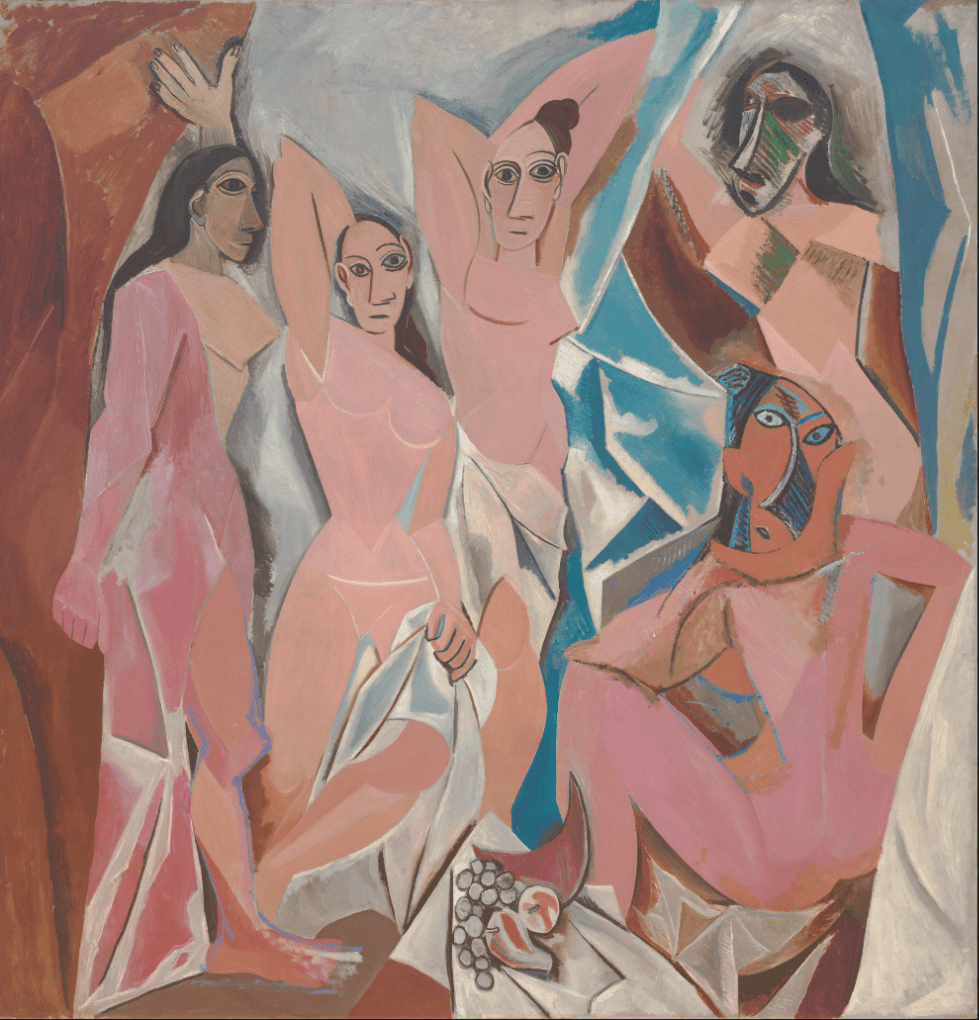
Pablo Picasso, Les Demoiselles d’Avignon, Cubism, 1907, Oil on canvas
300
This famous American artist constructed to Vietnam Memorial to have a shiny black surface so that viewers would see their own reflection when looking at the memorial
Maya Lin
300
an artistic style that replaced baroque in France the 1730s. It was highly secular, emphasized grace & charm. Like baroque it was still very elaborate and ornate.
Rococo
300
The reaction of the Roman Catholic Church to the Protestant Reformation reaffirming the veneration of saints and the authority of the Pope
The Counter Reformation
300
Pioneered by Picasso this early 20th-century style depicts objects by breaking them down into geometric shapes and presenting them from multiple viewpoints simultaneously
Cubism
300
Wanting to subvert the idea of mass production and the idea of objects "Made in China" this artist worked with 1,600 Jingdezhen craftsmen to create 100 million hand painted porcelain sunflower seeds
Ai Weiwei
400
This frenchman made frequent trips to Tahiti, a colony of France. He painted many artworks that depicted life in Tahiti and Tahitian girls
Paul Gauguin
400
Architect Frank Lloyd Wright was known for this style that is most common in the Midwestern United States
Prairie style
400
Bernini's Ecstasy of Saint Teresa shows a saint in a dramatic moment. It uses golden rays to symbolize the light of god. These characteristics align with this religious movement
Counter Reformation
400
abstract way of painting in which the artist drips or splatters paint onto a surface like a canvas
Action painting
400
This painting by Eugéne Delacroix was considered so politically charged the King had it removed from public display shortly after its purchase in 1831 for fear it would incite voilence
Liberty Leading the People
500
This artist painted Marie Antoinette and her Children, 1787, oil on canvas. She was known for painting the royal family and is part of the Rococo art movement
Élisabeth Vigée-Lebrun
500
This Neoclassical artist painted Oath of the Horatii, 1784, oil on canvas
Jacques-Louis David
500
The content of this artwork is an interpretation of a visions of God, which the subject wrote about in her diaries. This one in particular sculpture recounts a recurring vision where an angel descends from Heaven and stabs her with an arrow in her heart that consumes her with a love for God
Bernini, The Ecstasy of St. Teresa, Cornaro Chapel, Santa Maria della Vittoria, Rome, 1645-1652, Baroque, marble, gilded metal, fresco.
500
Depictions of nature in a way that shows grandeur, beauty, and power
Sublime
500
Identify one characteristic of the The Burghers of Calais by Rodin that is atypical of how heroes are typically portrayed in art
Low pedestal, gaunt faces, dressed in rags, non-idealized bodies, sorrowful expressions