Fungi
Virus For Random
Covid
HIV
Influenza
100
Hyphae grow and branch out, forming a network called
Mycelium
100
Reassortment can only occur in what types of genome?
segmented ssRNA genomes
100
The envelope of Covid Consists of?
Spike proteins
100
What are the receptors utilized by HIV for cellular entry?
CD4 or CCR5
100
Influenza uses the following receptors to invade the cell
HA& NA
200
What is the function of ergosterol
Maintaining structural membrane and fluidity
200
What Two conditions Must be met in order for a virus to infect a Virus? and what to do they mean?
Susceptible: When a cell is described as susceptible to a virus, it means the virus can enter the cell. This doesn't necessarily mean the virus can replicate inside the cell, but it has the potential to do so.
Permissive: When a cell is described as permissive to a virus, it means the virus can not only enter the cell but also successfully replicate inside it. The permissive cell provides the necessary machinery and resources for the virus to produce new copies of itself.
200
The receptor utilized by the SARS-CoV-2 virus, responsible for COVID-19, is known as the
angiotensin-converting enzyme 2 (ACE2) receptor.
200
What are the enzyme in use for HIV and what do they do?
Reverse Transcriptase – Special enzyme that
makes DNA copies of RNA
Integrase – enzyme that integrates the newly
formed virus DNA into the host chromosome
- After HIV infects a cell, its viral RNA genome is converted into double-stranded DNA by another viral enzyme, reverse transcriptase. This viral DNA needs to integrate into the host cell's chromosomal DNA for the virus to replicate and produce new HIV particles.
- Integrase acts like a molecular matchmaker, precisely cutting and joining the viral DNA with the host DNA. This allows the viral DNA to become part of the host's genetic code.
200
What is the Function of RNA Dependent of Polymerase
is an enzyme that catalyzes the replication of RNA from an RNA template. It plays a crucial role in the replication of RNA viruses, as these viruses use RNA as their genetic material and lack the enzyme necessary for replicating RNA directly from a DNA template
300
Single Celled Fungi Are Called
Yeast
300
Describe the steps of the lytic phase
1) Attachment 2) Entry 3) Release of genetic material + replication 4) Transcriptions & Translation of viral genes 5) Release of new virus particles (Lysing of the Cell)
300
Covid 19 has the ability to affect what other areas in your body?
- kidney
- gall bladder
- testis
- heart
300
HIV is consider what type of Virus?
Retro virus
300
All the Characteristics of Influenza
Group V
-sRNA genome
Enveloped
• Hemagglutinin (HA)
• Neuraminidase (NA)
RNA Dependent RNA
Polymerase
• Capable of Reassortment
400
Cell Walls of Fungi Are made up of?
Cellulose, Chitin, Glucans
400
What is a Viroid?
Particles which are in itself infectious mRNA.
Do not possess capsid head & mostly infect plants
400
SARS-CoV-2 exhibits
all characteristics of
Air Born Transmission
-Particle size
-Distance
-Environment
400
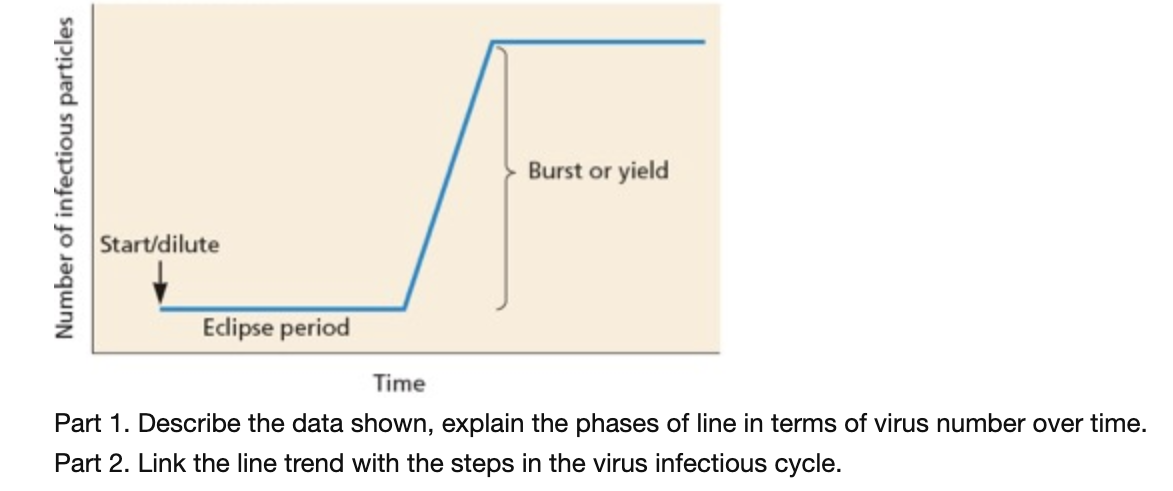 Explain what is occurring in this image? Disregard Pat 1 and 2 from the image.
Start/Dilute: In viral replication, the "start" or initiation phase refers to the beginning of the viral replication cycle within a host cell. This phase begins when the virus attaches to the host cell surface, enters the cell, and releases its genetic material (genome) into the host cell's cytoplasm or nucleus, depending on the virus type.
The eclipse phase is a stage of the viral replication cycle during which newly produced viral particles are not yet detectable within the host cell or in the surrounding medium. During this phase, viral components are actively synthesized, assembled, and packaged into new virions.
Burst or Yield:the stage of the viral replication cycle during which newly assembled virions are released from the infected host cell, leading to cell lysis and the release of infectious virus particles into the surrounding environment.
400
Difference between Antigenic shift and drift
antigenic shift involves major changes in viral particles resulting from reassortment events, while antigenic drift involves minor changes due to accumulation of mutations through time.
500
Explain How Fungi can reproduce
Asexually or sexually
Asexually- Dividing Cells through mitosis
Sexually- Spore and a fungs
500
Describe the Lysogenic Phase and how it differs from the lytic Phase
The lysogenic phase is one of two main ways viruses reproduce within a host cell. Unlike the lytic cycle, which results in the death of the host cell, the lysogenic phase allows the virus to integrate its genetic material into the host cell's DNA and integrate its genome. This creates a symbiotic relationship where the virus can lie dormant for extended periods. Lysogenic phase is not making new particles while lytic phase is doing so.
500
List all the Characteristics of covid?
* Envelope w/ spike proteins
• +sRNA
• RNA Dependent RNA Polymerase
* Group ACE receptor
500
List all the Characteristics of HIV?
Retrovirus
- RNA Genome (Ssrna +)
- Use of Reverse Transcriptase
- Binds to CD4 Receptors
- Conical-isohedral capsid
- Envelope
Spike Proteins
group VI
Enzyme
Reverse Transcriptase
Integrase
500
Imagine an individual who is simultaneously infected with two different strains of influenza virus, strain A and strain B. These two strains have different combinations of genetic segments in their viral genomes, Co-Infection in the Same Host Cell in the individual's respiratory tract are co-infected with both strain A and strain B viruses and shuffling of genes occur?
Reassortment