Trig. sum and difference
Verifying trig. identities
Inverse Trig. Functions
Tangent functions/
coterminal angles
coterminal angles
Any :)
100
True or false: sin(75°)=sin(50°)cos(25°)-cos(50°)sin(25°)
False- In order to get sin(75°), we would have to add 25 and 75 if those were our chosen degree values.
So, our formula would be sin(a+b)=sin(a)cos(b)+cos(a)sin(b), not minus
100
Verify the identity:
cos x + sin x tan x = sec x
Let's start with the left-hand side:
cos x +sinx tan x
=cosx + sinx(sinx/cosx)
=cosx + sin2x/cosx
now, let's make the denominators match so that we can add these two fractions:
=cosx(cosx/cosx) + sin2x/cosx
=cos2x/cosx + sin2x/cosx
=(cos2x + sin2x)/cosx
as we know through our trig identities,
cos2x + sin2x=1, so...
=1/cosx
=sec x (verified)
100
Find the exact value for y=sin-1(√2/2).
sin(y)= (√2/2)
So now, you are basically looking for where on your unit circle the y-coordinate is (√2/2). As you can see, there are two points where this holds true: π/4 and 3π/4. However, to determine which one of these is our answer, we use our arcsin range of -π/2 ≤ arcsinx ≤ π/2. We now can see that our answer is π/4.
100
What are the zeros of a tangent function on a graph? How could you determine this?
Since tanΘ= sinΘ/cosΘ, we are looking for whenever the numerator is zero (the denominator being zero would lead to an undefined function (where your asymptotes would be)) so when sinΘ=0, there will be a zero for tanget.
Answer(s): 0, π, 2π, 3π...
100
Which two trigonometric functions are even functions? What does this mean?
Cosine and secant are both even functions, while the rest are odd. This means that f(-x)=f(x).
200
Write the expression as tangent of a single angle"
(tan19+tan47) /(1-tan19tan47)
As we can see, this problem follows the format
tan(a+b)=(tan a+ tan b) /(1-(tan a *tan b))
So, we would simply add tan(a) and tan(b)
19+47=66
answer: tan(66°)
200
Verify the identity:
(𝐭𝐚𝐧 𝒕 − 𝐜𝐨𝐭 𝒕)/ (𝐬𝐢𝐧𝒕*𝐜𝐨𝐬 𝒕) = 𝐬𝐞𝐜2 𝒕 − 𝐜𝐬𝐜2 t
Let's start with the left hand side.
(𝐭𝐚𝐧 𝒕 − 𝐜𝐨𝐭 𝒕)/ (𝐬𝐢𝐧𝒕*𝐜𝐨𝐬 𝒕)
= (tan 𝑡/ (sin 𝑡 *cos 𝑡) − (cot t/ (sin 𝑡 * cos 𝑡)
= (tan 𝑡)(1/sin 𝑡* cos 𝑡) − (cot𝑡)(1/sin 𝑡 *cos 𝑡)
= (sin t /cos t)(1/ (sin 𝑡* cos )− (cos 𝑡 /sin t)(1 /(sin 𝑡 *cos 𝑡)
= (1 /cos2 t)− (1 /sin2t)
= 𝐬𝐞𝐜 2 𝒕 − 𝐜𝐬𝐜 2 t (verified)
200
Find the exact value for y=arctan(-1).
tan(y)=-1
So, we now look for where tan=-1 on our unit circle. Since your chart does not show where tangent is in the fourth quadrant, you can look for where tan=1 to start. As you can see, and using our range -π/2 < arctanx < π/2, tan=1 is π/4, so our answer would be -π/4. To make this a positive value, you can simply do 2π-π/4 to get 7π/4 which falls in the fourth quadrant (good with our range and is our answer!
200
State if the given angles are coterminal. If they aren't, correct the second angle to make it so that they are:
185°, -545°
These angles are NOT coterminal. Examples of angles that would be coterminal with 185° are -535°,-175°, or POSITIVE 545°.
200
Find the reference angle for 5π/3.
This angle falls in the fourth quadrant, so you would use the format 2π-5π/3 which means your answer would be π/3.
300
Use the sum or difference identity to find the exact value of cos(255°).
You could solve this several ways, but I chose to solve it with
cos(a-b)=cos(a)cos(b)+sin(a)sin(b)
cos(300°-45°)=cos(300°)cos(45°)+sin(300°)sin(45°)
=(1/2)(√2/2)+(-√3/2)(√2/2)
=(√2/4)+(-√6/4)
answer:(√2 - √6) / 4
300
Verify the identity:
(1+sinx)/cosx + cosx/(1+ sinx)= 2secx
Let's start with the left hand side:
(1+sinx)/cosx + cosx/(1+ sinx)
First, lets make our bases match.
((1+sinx)/cosx)*(1+sinx)/(1+sinx) +cosx/(1+sinx)*(cosx/cosx)
=(1+sin2x)/(cosx(1+sinx)) + cos2x/(cosx(1+sinx))
=(1+2sinx+sin2x+cos2x)/ (cosx(1+sinx))
as we know, sin2x+cos2x=1, so...
(1+2sinx+1)/(cosx(1+sinx))
=(2+2sinx)/(cosx(1+sinx)
we can factor out a 2 from the numerator now
(2(1+sinx)/ (cosx(1+sinx)
we can now cancel the "(1+sinx)" as it is in both the numerator and denominator, leaving
2/cosx
=2secx (verified)
300
Find the exact value of y=sin(arcsin(√2/5)).
Then, find the exact value of an equation with the opposite circumstance: y=arccos(cos(11π/6))
For inverse functions, if the regular trig function (sine in this case) is outside of the inverse function, then the two cancel out and your answer is simply the x value. Mathmatically, this can be represented as sin(arcsin(x)=x, so our answer would just be √2/5.
Because of our range 0 ≤ arccosx ≤ π, the answer cannot be just 11π/6 because it is not in our range. So, we evaluate from the inside out. Start with cos(11π/6)=√3/2. Now, we can simply do y=arccos(√3/2). cos(y)=√3/2, and using our chart and based on our range, our answer will be π/6.
300
Find a singular angle value that is determined by the sum equation of
(tan180-tan45)/(1+tan180tan45)
Then, find a coterminal angle for the angle in part a.
Since this is based off of our property tan(a-b), we would simply do 180-45=135 to get our answer.
An example of coterminal angle to this would be -225°.
300
Find the amplitude, period, vertical shift and phase shift for the following equation:
2 sin(4(x − 0.5)) + 3
We can follow the model below as a guide:
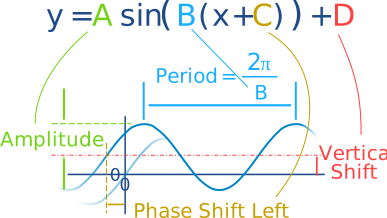
Let's start with our amplitude. As we can see from the model, the amplitude is the number that falls in front of our trig. sign, making our amplitude or "A: 2.
Now, let's look at our period. The period is determined by dividing 2π/B, located in the parenthesis but before x here.
So, we would do 2π/4=π/2 for our period.
Now, we can move onto horizontal shift. This value is found after x but still IN THE PARENTHESIS, as shown by our model. Here, our horizontal shift would be -0.5, meaning it is shifted 0.5 to the right.
Lastly, our vertical shift is found outside of the parenthesis and is separated by a plus or minus sign, unlike our amplitude which is connected through multiplication. Our vertical shift would be 3, telling you it is going in the upward direction on the graph.
400
Use sin(a+b) to solve, given that:
sin(a)=4/5, where a is in quadrant 1
cos(b)=-24/25, where b is in quadrant 3.
First, we must find both cos(a) and sin(b) to do the problem. We can use our identity sin2x+cos2x=1 to do this, and use the quadrant to determine the sign.
Let's start with cos(b):
(4/5)2+cos2x=1
=16/25+cos2x=1
=cos2x=9/25
=3/5 (our answer is positive since cosine is positive in quadrant 1)
Now, let's find sin(b):
(-24/25)2+sin2x=1
=576/625+sin2x=1
=sin2x=49/625
=sinx=-7/25 (answer would be negative bc sine is negative in quadrant 3)
Now, we can finally solve the problem!!
sin(a+b)=sin(a)cos(b)+cos(a)sin(b)
=(4/5)(-24/25)+(3/5)(-7/25)
answer: -117/125
400
Verify the identity:
sec(x)+tan(x)=cos(x)/(1-sin(x))
For this problem, I am going to start with the right side:
cos(x)/(1-sin(x))
I am then going to multiply the value with the opposite sign to the denominator, but I must do this to the numerator too to make sure I am multiplying by "1".
(cosx/(1-sinx)) * (1+sinx)/(1+sinx)
=(cosx*(1+sinx))/(1-sin2x)
From our properties, we know that cos2x+sin2x=1, but we can rearrange this to get cos2x=1-sin2x. We can now replace our denominator with this value
(cosx*(1+sinx))/cos2x
we can cancel out one cosine from the numerator and denominator now
(1+sinx)/cosx
We can separate this fraction into two parts:
(1/cosx) + (sinx/cosx)
from our identities, this gives us
sec(x)+tan(x) (verified)
400
Find the exact value of y=cos(arcsin(3/5)).
Currently, we have two clashing trig functions and we want to make it so that we either have only sine or only cosine. We can use cos2x+sin2x=1 and rearrange to get cosx=√(1-sin2x). Since our "x" is arcsin(3/5), we can plug that in to get √(1-sin(arcsin(3/5)2). Any time we have sin on the outside and its inverse on the inside, we can cancel them out. So now, we are left with √(1-(3/5)2)= √(1-9/25)=√(16/25), making our answer 4/5.
400
Given that Θ=30°, and a line passes through the point P(4,2) from the origin, find the equation of the line in slope-intercept form.
Since slope=(y-0)/(x-0)=y/x, your slope will be equal to your tangent(30)= 1/√3. Then, we can plug in points
y-2= 1/√3(x-4)
y-2=x/√3-4/√3
Answer: y= x/√3 - 4/√3 + 2
400
If your family was having a pie at thanksgiving, and your dad ate a large slice that was bounded by a 70 degree angle, and the whole pie had a 30 inch diameter, how many square inches of pizza did your dad eat?
Here, we are finding the area of a sector. The equation for this is
A=(1/2)r2Θ
First, lets determine the radius from the diameter. r=(1/2)D, so r=30/2=15
Now, we were given the angle in degrees but we need it in radians, so we would convert that by doing 70(π/180)= 7π/18 radians
Now, we can simply plug in:
A=(1/2)(15)2(7π/18)
A= 1575π/36 in2
500
Solve the following:
sin(x+π/2)-cos(x+3π/2)=0
As we can see, we will be using two identities here:
sin(a+b)=sin(a)cos(b)+cos(a)sin(b)
cos(a+b)=cos(a)cos(b)-sin(a)sin(b)
Let's start with sine.
sin(x+π/2)=sin(x)cos(π/2)+cos(x)sin(π/2)
=(sin(x))(0)+(cos(x))(1)
=cos(x)
Now, for cosine:
cos(x+3π/2)=cos(x)cos(3π/2)-sin(x)sin(3π/2)
=(cos(x))(0)-(sin(x))(-1)
=sin(x)
Now, we can plug in:
cos(x)-sin(x)=0
cos(x)=sin(x)
Now, using our unit circle, we look for the place(s) where cosine is equal to sine.
answer: π/4 (both are POSITIVE √2/2) and 5π/4 (both are NEGATIVE √2/2)
500
Verify the identity:
(sin2x+cot2x+cos2x) / (1+tan2x)= cot2x
Let's start with the left hand side:
(sin2x+cot2x+cos2x) / (1+tan2x)
From our identities, we know that sin2x+cos2x=1, so we can replace this in the numerator to get:
(1+cot2x)/(1+tan2x)
Based on our property that 1+cot2x=csc2x, so we can replace the numerator value with this.
Also, tan2x+1=sec2x, so we can replace the denominator value with this.
Now, we have csc2x/sec2x
csc2x/sec2x= (1/sin2x)/(1/cos2x)
Now, because we have a fraction over a fraction, we flip the denominator value to multiply:
(1/sin2x)*(cos2x/1)
This leaves us with cos2x/sin2x=cot2x (verified)
500
Find the exact value of y=arccos(sin(arccos(sin(17π/6)))).
Again, with equations like this, lets work our way from the inside-out. With y=sin(17π/6), lets first try to get 17π/6 within the bounds of the unit circle by subtracting 2π (or 12π/6 to match denominators). 17π/6-12π/6=5π/6, so we are really finding sin(π/6)=1/2.
Now, we can do our next step out, so where y=arccos(1/2). cos(y)=1/2 at π/3.
We can now move to our next step using this new value so y=sin(π/3). According to our chart, sin(π/3)=√3/2.
Now, we are on our final step! Here, we are simply solving for y=arccos(√3/2). So, cos(y)=√3/2, which is equal to our final answer of π/6.
500
Graph the following function, and list the amplitude, period, phase shift, and vertical shift associated with the equation:
y=tan(Θ/3 -5π/6)+1
First, you can 1/3 out as it is the GCF between
Θ/3 and 5π/6. This leaves you with
y=tan(1/3(Θ-5π/2)+1
Now, based on the chart below, we can see that...
amplitude= 1
period= 3π
phase shift: 5π/2 (to the right, bc of the minus sign)
vertical shift: up 1 (bc positive)
Because of this, the correct graph would be:

500
Given that a circle's radius is 5 yards and that a particular angle within it is 40°, what is the arc length and the area of the sector?
First, we need to formulas:
arc length: L=Θ*r
area of a sector: A=(1/2)r2Θ
Let's start with arc length. First, we must convert degrees to radians, so 40(π/180)=2π/9
Now, we can plug in!
L=(2π/9)(5)
=10π/9 yards
Now, let's do area of the sector. We already solved for the angle in radians above, so we can use that in this equation too.
A=(1/2)(5)2(2π/9)
A= 50π/18= 25π/9 yards2