Extension
Temperature Regulation
Organ Systems
Immune Response
Extension
100
What is diffusion?
The natural movement of particles from an area of high concentration to an area of low concentration.
100
What systems are involved with regulating temperature?
Endocrine and nervous systems.
100
What organs coordinate gas exchange?
Respiratory and circulatory system
100
What are antibodies?
Substances created in the body to attack specific foreign substances called antigens.
100
What is homeostasis?
The body's ability to maintain a relatively stable internal environment in an ever-changing outside world.
200
Name all 11 organ systems.
Nervous, digestive, immune, integumentary, reproductive, endocrine, respiratory, circulatory, skeletal, muscular, urinary.
200
Why does your temperature increase when fighting infection?
A hormone gets released and delivered to the hypothalamus (which controls body temperature), the hormone causes an increase in temperature throughout the body in an attempt to kill off certain bacteria and viruses which are sensitive to temperature.
200
How does the respiratory system function?
Exchanges gases with the environment, supplying your blood with oxygen and disposing of carbon dioxide.
200
How do vaccines work?
Vaccines cause the body to react as though it has met the pathogen. This assists the body in forming antigens that can help the body fight infection. Memory cells ensure the body remembers how to fight this infection, therefore reducing likelihood of sickness.
200
Explain what happens to your respiratory and circulatory system when you exercise.
Respiratory system experiences increased activity to provide the body with the oxygen necessary for increased movement. The circulatory system increases heart rate to deliver the necessary oxygen to muscles.
300
What is the process by which particles spread out from an area of high concentration to an are of low concentration to reach an equilibrium of particles?
Diffusion.
300
What is a feedback system?
Receptors that are sensitive to a particular stimulus, and effectors, muscles or glands that have an effect on the same stimulus.
300
How does the digestive system function?
It chemically changes the complex molecules in the food you eat into simple chemical substances that your body can use.
300
What is herd immunity?
When a majority of a population are vaccinated against or naturally resistant to a disease. The spread of the disease is reduced because there are fewer people to catch it from.
300
What is your favourite topic covered this term?
Correct!
400
What is the function of the hypothalamus?
It is part of the endocrine system and helps control the pituitary gland and regulates many bodily functions and keeping them balanced.
400
What are receptors and effectors?
Receptors are cells that detect stimuli. There are many different types e.g. taste and sound receptors.
Effectors are all your muscles and glands, which respond to nervous impulses.
400
How does the excretory system function?
Breaks down haemoglobin (from dead red blood cells), breaks down or modifies toxic substances and most medicines and converts ammonia to urea.
"Breaks down and disposes of excess substances that have built up in the body."
400
What are the three lines of defence in your immune system? Explain the second line of defence.
1. Barriers
2. Inflammation - hormone is released to increase blood flow to the area that is infected. This allows white blood cells to migrate to the site of infection and consume the bacteria.
3. Cell-mediated response
400
What is the purpose of white blood cells?
To assist the body in fighting off infections.
Defends the body against infection and disease.
500
What is your favourite topic covered this term?
Correct!
500
Explain the stages of reactions your body has to cold temperatures.
The hypothalamus receives messages from skin receptors in the skin. The cool temperatures then stimulate the release of hormones which increase metabolism rate (provides more heat).
The hypothalamus detects temperature drop and sends out nerve impulses to vital organs initiating small shaking (shivers). This shivering produces heat and raises body temperatures. Blood vessels constrict so that heat is conserved. Sweat glands do not secrete fluid.
500
How does the nervous system function?
It is the communication centre for all other systems and consists of two key parts: the central nervous system (CNS) and the peripheral nervous system (PNS).
500
What are memory cells and how do they assist you in fighting infection?
Memory cells are responsible for collecting and retaining the information the body needs to know how to fight off infection. If you are infected once, memory cells form. If the virus comes back, the memory cells are able to fight the infection more efficiently.
500
Explain how gas exchange works in and around the alveoli.
Deoxygenated red blood cells enter the capillary and travels around the outside of the alveoli. The alveoli's thin walls allow oxygen to diffuse through it and into the red blood cells, oxygenating them. Once this is done, the red blood cells continue their journey to the heart to be pumper around the body.
600
Explain the following diagram:
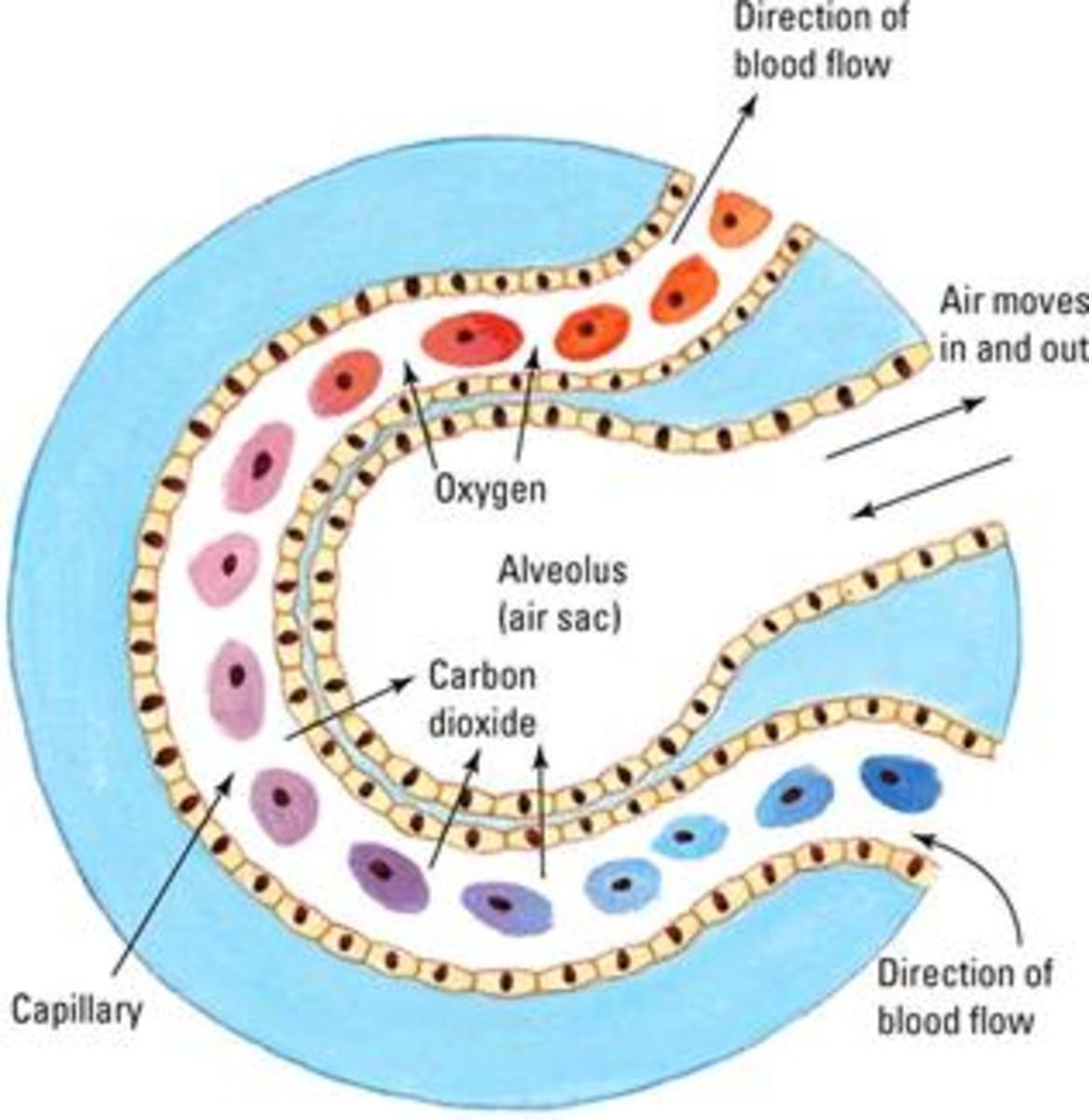
Deoxygenated red blood cells enter the capillary and travels around the outside of the alveoli. The alveoli's thin walls allow oxygen to diffuse through it and into the red blood cells, oxygenating them. Once this is done, the red blood cells continue their journey to the heart to be pumper around the body.
600
Name EVERYTHING YOU KNOW about regulating temperature!
Each correct statement earns 50-100 points.
600
What are the three types of muscles in your body? Explain how they are different from one another.
Cardiac muscle - makes up your heart.
Skeletal muscle - muscles that work with your skeleton to assist with your movement.
Smooth muscle - muscle that makes up your intestines.
600
Name EVERYTHING YOU KNOW about the immune response!
Each correct statement earns 50-100 points.
600
Draw a line graph that represents what happens to your hear rate when you exercise (POINTS AWARDED FOR EACH CORRECT ELEMENT OF THE GRAPH).
Must include: Title, x and y axis titles and numbers, data points, connected dots with a line.