Exponent Rules
Polynomials
Inverse & Composition
Radicals
Polynomial Applications
100
Use the product rule for exponents to multiply:
4x^3*5x^2
20x^5
100
Determine the degree of the following polynomial:
-3x^2+5x-1
Degree: 2
100
If f(x) = x^2-2x+3 and g(x)=2x-1 what is f(g(x))?
4x^2-2x+3
100
Simplify.
3sqrt(54) + 2sqrt(24)
13sqrt(6)
100
Recall that the perimeter of a figure is the sum of all the lengths of the sides. Determine the perimeter of the triangle and write the answer in standard form.
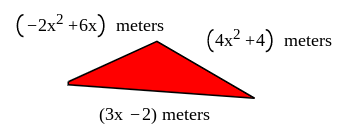
2x^2+9x+2
200
Use the quotient rule for exponents to divide:
(x^2y^5)/(xy^3)
xy^2
200
Add the following polynomials. Write your final answer in standard form.
(4x^2+4)+(19x^2-7)
23x^2-3
200
Use composition of functions to determine if f(x) and g(x) are inverses or not.
f(x)=x^2-2
g(x)=sqrt(x) + 2
They are not inverses. The inverse of f(x) would be sqrt(x+2)
200
-3sqrt(15) * (5 + sqrt(3))
-15sqrt(15) - 9sqrt(5)
200
Recall that the perimeter of a figure is the sum of all the lengths of the sides. Determine the perimeter of the figure in terms of z. Write your final answer in standard form.
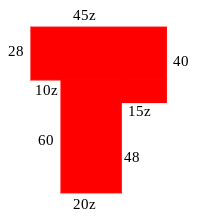
90z+176
300
Use the power rule to simplify:
(4x^2yz^3)^2
16x^4y^2z^6
300
Subtract the following polynomials. Write your final answer in standard form.
(x^2-x+4)-(x^2+x-2)
-2x+6
300
Find f(g(3))
f(x) = 2x-5
g(x) = x^2-3x
f(g(3))=-5
300
2 / -2 - 5sqrt(2)
2 - 5sqrt(2) / 23
300
Find the area of each figure in terms of x. Then, write a simplified polynomial describing the total area of the rectangles and squares combined.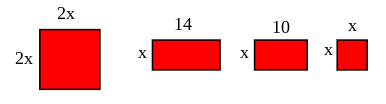
5x^2+24x
400
Use the quotient rule and the negative exponent rule to simplify:
(2x^2y^4)/(8x^5y^5)
(1)/(4x^3y)
400
Multiply the polynomials. Write your final answer in standard form.
(2x-5)(3x^2-x+6)
6x^3-17x^2+17x-30
400
What is the inverse of f(x) = 3x-11?
f^-1(x) = (x + 11)/3
400
(sqrt(3m^2))/(3 sqrt(2m^3))
sqrt(6m)/6m
400
Recall that area of a rectangle is length times width. Determine the area of the shaded region in terms of x.
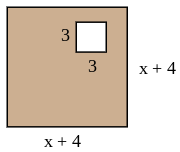
x^2+8x+7
500
Use the exponent rules to simplify:
(x^3y^4)^3*(3xy^2)^2
9x^11y^16
500
Multiply the polynomials. Write your final answer in standard form.
(4x-1)^2
16x^2-8x+1
500
What is the inverse of
f(x) = sqrt(3x-1)
f^-1(x) =(x^2+1)/3
500
Apply exponent rules and write final answer in radical form.
(6^(2/3))^(1/2)
cube root of 6
500
Determine the area of the shaded region.
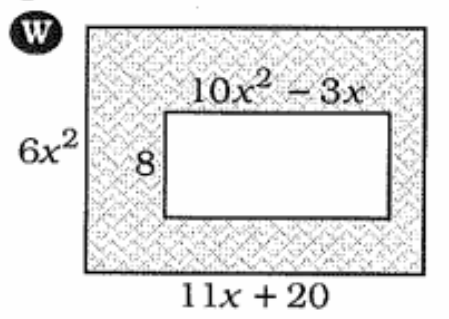
66x^3+40x^2+24x