Exp. Functions, Growth, and Decay
Inverses of Functions/ Graphing Log. Graphs
Logarithmic Functions
Laws of Logarithms (Properties)
Applications of Logarithms
100
Does this graph show exponential growth or decay?
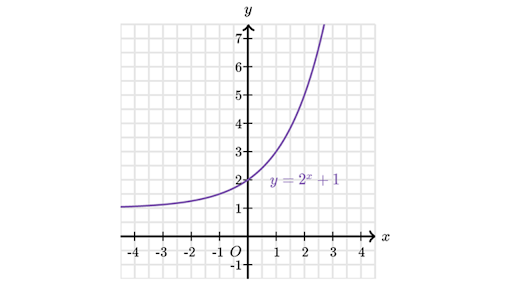
Exponential growth
100
What is the inverse of f(x)=log(x)?
f-1(x)=10x
100
Solve for x: log3z+45q(1)=x
x=0
100
True or False: log2x - log2y=log2(x/y)
True
100
Which of the following is the equation for compounding interest?
a. S=r(P+1/k)tr
b. r=PSk
c. S=P(1+r/k)kt
d. S=P(1+k/r)kt
c. S=P(1+r/k)kt
200
Does a base of 0.5 in an exponential function indicate growth or decay?
Decay
200
Find the inverse of this equation: f(x)=log3(2x+4)
f-1(x)=(3x/2)-2
200
Solve for x: log2x=3
x=8
200
Solve for x using the properties of logarithms: log26-log23=x
x=1
200
After 3 years, what is the balance of an account with an initial investment of $4500 that compounds 10% annually?
$4630.53
300
Is f(x)=zx an exponential function?
No, because the base isn't a constant.
300
Find the inverse equation of f(x)=∛(x+5)
f^-1(x)=x3-5
300
Solve for x: ln(-3)=x
x is undefined
300
Expand: log2√(X/Y3)
1/2(log2X)-3/2(log2Y)
300
If Bill has $2 that gets compounded by 70% monthly, how long will it take to have $3,000,000?
About 20.9 years
400
Does this equation's graph show growth or decay?
f(x)=1/3(2x)-1
Growth
400
Which equation represents this graph?
a. f(x)=log4(x)-6
b. f(x)=log3(x+3)-5
c. f(x)=log(2)
d. f(x)=ln(x+15)

b. f(x)=log3(x+3)-5
400
Solve for x: log3(x+3)-3=0
x=24
400
Condense into one logarithmic function: log3(x)-(1/3)log3(27)+log3(y)-2log3(z)
log3(xy/3z2)
400
How long would it take an investment of $5,000 that is compounded 2.5% quarterly to double?
About 1.54 years
500
List the order of transformations for the given function: f(x)=-(1/4)x+3-0.5
1. Translation of 3 units left
2. Vertical compression by a factor of 1/4
3. Reflection over the x-axis
4. Translation of 0.5 units down
500
Why doesn't the graph below accurately show the inverse of this equation? f(x)=⎷(x-6) +3

No, the left side of the parabola shouldn't be included since those values weren't included in the original function.
500
log4(2x+48)+1=x
x=4
500
Condense: 1/3[2ln(x+3)+ln(x)-ln(x2+2x-3)]
ln∛[(x(x+3)/x-1]
500
The population of a bacteria is 50,000 and increases by a growth rate of 85% per hour. How long will it take the population to double (days to nearest hundredth)?
29.76 days