Fatigue
Energy Systems
Glycolysis
Lipolysis/Krebs/ETC
Crossover Concept
100
Central and peripheral fatigue refer to which sections of the nervous system respectively?
Central = CNS
Peripheral = PNS
100
What is the energy currency of the body?
ATP
100
Glycolysis refers to the breakdown of which macromolecule?
Carbohydrate/glucose.
100
Which enzyme kicks off the Krebs cycle. Converts pyruvate into the molecule necessary to begin the cycle?
PDH pyruvate dehydrogenase
100
Crossover concept refers to what?
The point at which predominant fuel source shifts from lipids to carbohydrate.
200
Define fatigue
The inability to maintain power output or force during repeated muscular contractions
200
How do we harness energy from ATP?
Splitting the high energy phosphate bond. Turns ATP into ADP.
200
What is generally considered the "end product" of glycolysis?
Pyruvate. Lactate could also be considered a correct answer.
200
Pyruvate must be converted into what product to begin the Krebs cycle?
Acetyl-CoA is step one. I would also consider citric acid to be a nearly correct answer.
200
What would RER be when you are burning 100% fat for fuel? How about 100% carbohydrate?
0.7 for fat
1.0 for carbs
300
Accumulation of which metabolic byproducts are major drivers of fatigue?
H+ ions and inorganic phosphate
300
What are the three areas of the body's glucose pool?
Liver, skeletal muscle, blood
300
Which enzyme/step is considered the major rate limiter of glycolysis?
Phosphofructokinase, PFK
300
In the ETC, NAD+ and FAD are considered transporters of what?
Electron transporters
300
Endurance training pushes the body to use what for fuel?
Lipids/fats.
400
What is the generally considered the primary driver of fatigue from long duration exercise?
Glycogen depletion
400
How does lactate production from the ATP-PCr system compare to lactate production during anaerobic glycolysis?
The ATP-PCr system is alactic. Does not produce lactate.
400
What are the three main outcomes for blood lactate?
Blood: increase in blood lactate
Liver: converted back into glucose via cori cycle
Mitochondria: converted back into pyruvate and oxidized via Krebs cycle
400
Which molecule is the "final electron acceptor" in the electron transport chain.
Oxygen
400
Increasing exercise intensity increases energy production from the breakdown of which macromolecule?
Glucose. You burn more carbohydrates during higher intensity exercise.
500
What is the oldest theory of fatigue and what is the primary takeaway of that theory?
Catastrophe theory states that:
exercise intensity is reduced when something “catastrophic” occurs in the body
500
What does RER stand for and what does it measure?
Respiratory exchange ratio: measures CO2 expelled and O2 consumed. Used to approximate substrate utilization and exercise intensity.
500
Which enzyme converts glucose into glucose-6-phosphate?
Hexokinase
500
What is one of the major benefits to increased fat mobilization during exercise? What do we save?
You can save glucose/glycogen for when the body really needs it at the end of a race or endurance event. Increase lipolysis spares glucose.
500
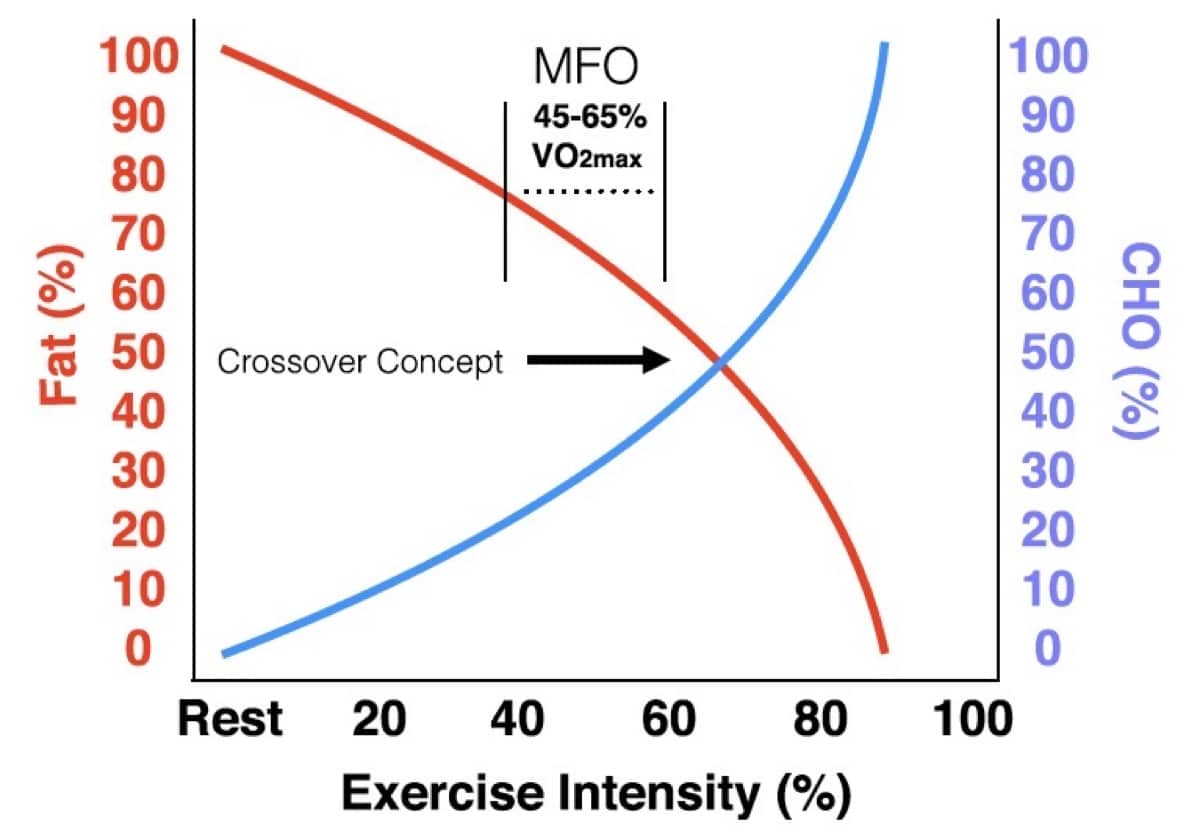 What does SNS stimulation do to crossover concept?
Increases CHO utilization and pushes graph to the left.