Rates
Quantum Models
Quantum Models part 2
Spectroscopy
Important Equations
100
These two pieces make up the units for the rate constant
What are molarity(concentration) and time?
100
The probability of finding a particle at a node in a wave-function.
What is zero?
100
The probability of finding the particle within the first two peaks for the n=3 state.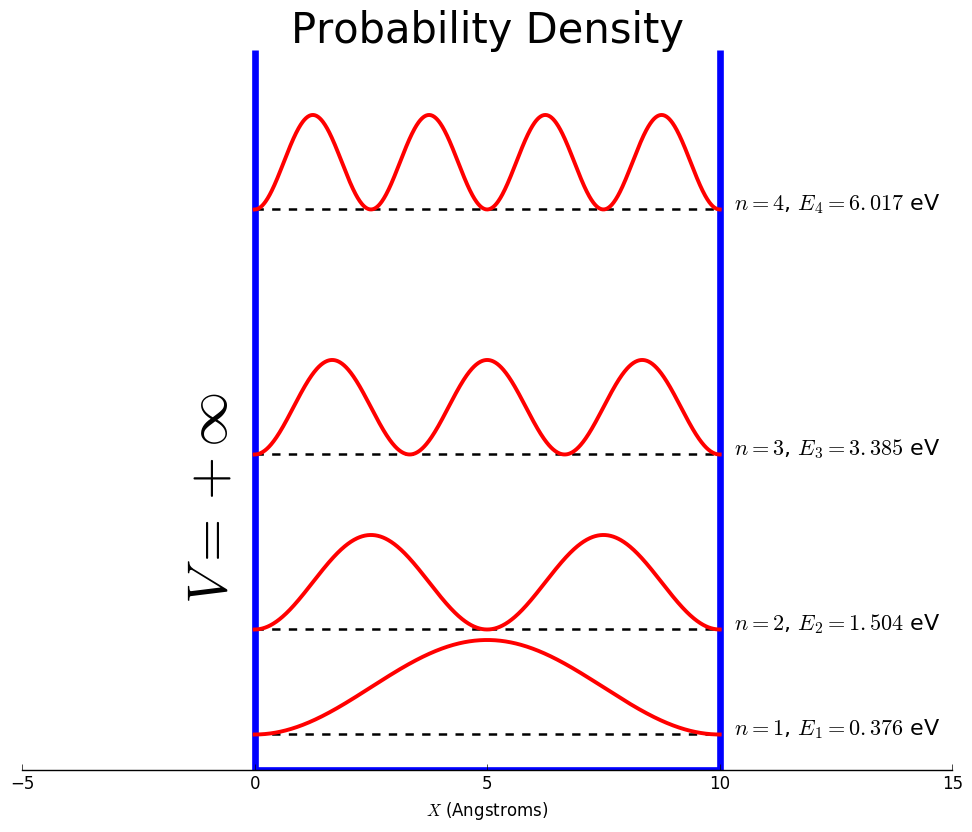
What is 2/3?
100
The major requirement for a molecule to have a rotational spectrum.
What is a permanent dipole?
100
v = (1/2π)√(k/μ)
What is the formula for the harmonic frequency?
200
The order of the reaction based on this diagram
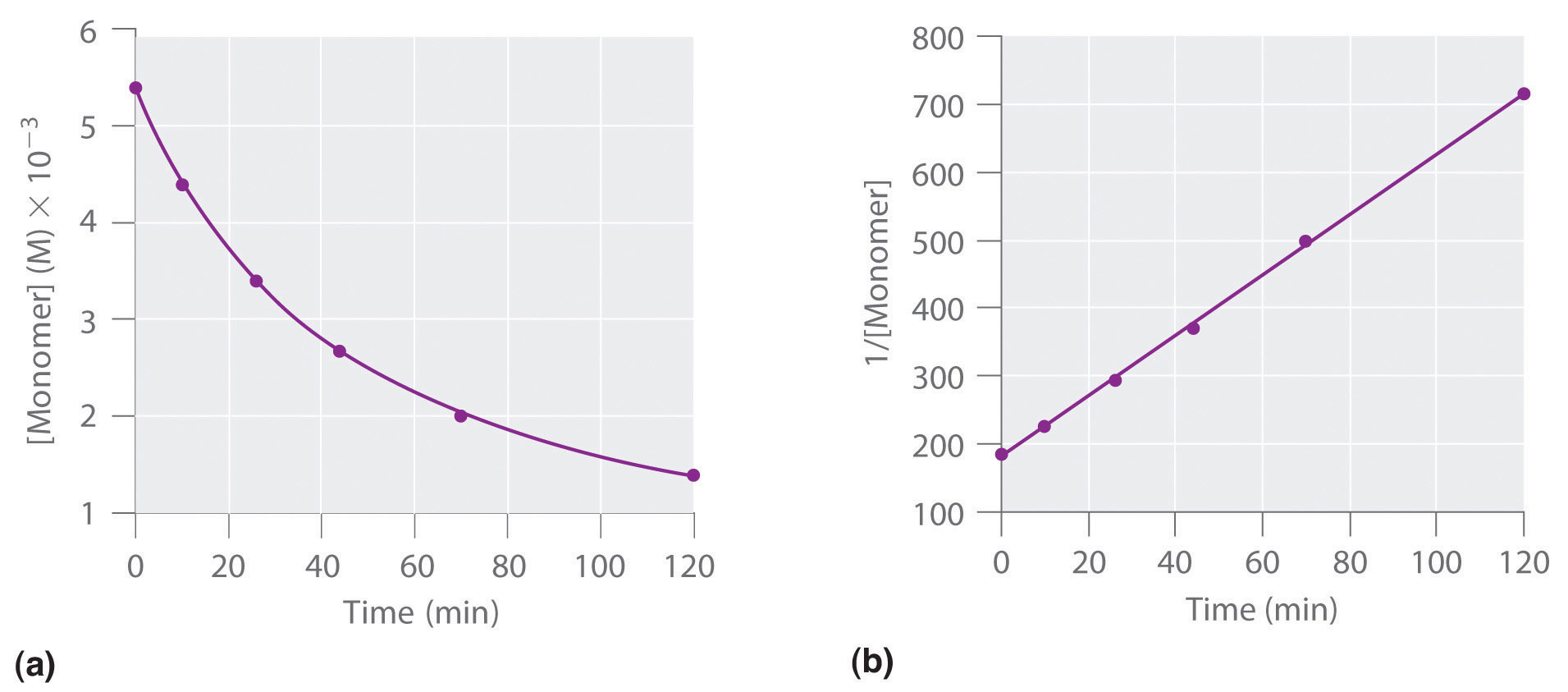
What is second order
200
The conditions for the formation of molecular orbitals.
What is symmetry and similar energy?
200
The model for the shown wavefunctions.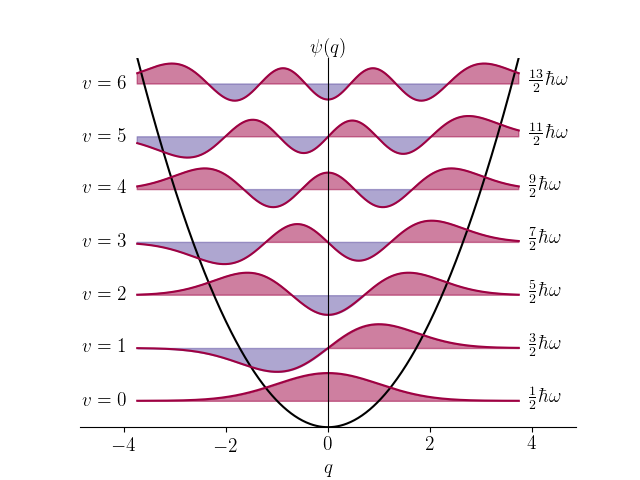
What is the harmonic oscillator model?
200
The type of light associated with molecular vibrations.
What is IR light?
200
ΔE= 2h(J+1)Be
What is the energy for a rotational transition?
300
These species are both made and consumed during a reaction mechanism
What is an intermediate?
300
The ionization energy for a Be3+ atom.
What is -217.6 eV?
300
The De Broglie wavelength for an electron moving at half the speed of light.
What is 4.85x10⁻¹² m?
300
This value dictates chemical shift in NMR
What is electron shielding?
300
nλ = 2d sin(θ)
What is Bragg's equation?
400
N2 + 3F2 -> 2NF3
F2 decreases at ______ the rate which NF3 increases
What is 3/2
400
The three conditions for a well behaved wave-function.
What is single valued, continuous, and quadratically integrable?
400
This part of the Hamiltonian prevents us from mathematically solving the Schrodinger equation for many electron atoms.
What is the electron-electron repulsion piece?
400
The seven types of crystal lattices
What is Triclinic, Monoclinic, Orthorhombic, Rhombohedral, Tetragonal
, Hexagonal, Cubic
400
ve+2(J+1)Be
ve-2JBe
What is the frequency of the roto-vibrational transition?
500
The graph below shows the time-dependent change in the concentration of NO. If NO decomposes at 520 °C based on the following equation,
2 NO(g) → N2(g) + O2(g)what is the average rate of consumption of NO over the time interval 0—40 s?
What is 0.005 M/s?
500
The energy of the 2nd vibrational excited state for a molecule with a fundamental frequency of 5.00x10¹³ Hz.
What is 8.28x10⁻²⁰ J.
500
The wave function for the n=3 state for a particle in a box.
What is ψ3= √(2/l)sin(3πx/l)
500
The selection rules for the vibrations of polyatomic atoms.
What is the change in vj = ±1 and the jth normal mode vibration must change the molecular dipole moment
500
=(n2h2)/(8ml2)
What is the energy for particle in a box?