Quick Call
Apply It
Think About It
Explain It
Challengee
Money Matters
100
What is a financial goal?
A. Something you want to buy or save money for
B. Something you have to do at school
C. A type of bank account
D. A way to earn marks
What is A: Something you want to buy or save money for
100
Maya wants to buy a $60 video game. She currently has $25.
How much more does she need to save?
What is: $90 − $30 = $60
$60 ÷ $10 = 6 weeks
100
Jordan wants to save $200 for a new bike. Which plan would make the most sense?
A. Spend all his money now and hope he has $200 later.
B. Set aside some money regularly until he reaches $200.
C. Borrow $200 from a friend immediately.
D. Stop tracking his money
B. Set aside some money regularly until he reaches $200.
100
Why might someone want to make a budget?
Expected answer: To plan where their money will go and avoid spending more than they have
100
Mia has $75.
Her budget says:
- Savings: $20
- Food: $15
- Entertainment: $25
- Gifts: $10
Does her budget balance? If not, by how much?
What is:
$20 + $15 + $25 + $10 = $70
She has $5 left over.
100
Your friend says:
"I spent all my money, but it's okay because I'll just get more next week."
What's the biggest problem with this thinking?
A. Money should never be spent.
B. They aren't planning for future expenses or savings.
C. They should never buy anything fun.
D. They need a bigger wallet.
B. They aren't planning for future expenses or savings.
200
Which is an example of a financial goal?
A. Make three new friends
B. Save $100 for a new bike
C. Read a book
D. Learn a new sport
What is: B. Save $100 for a new bike
200
Ethan receives $60 each month.
He plans to:
- Save $20
- Spend $15 on snacks
- Spend $12 on entertainment
- Spend $8 on gifts
How much money does Ethan have left after following his budget?
What is: $20 + $15 + $12 + $8 = $55
$60 − $55 = $5 left
200
Ava has been saving for a concert, but her family suddenly needs to spend money fixing their car.
What might happen to Ava's financial goal?
A. She may need to adjust her timeline or save less for a while.
B. Her goal automatically disappears.
C. She should spend all her remaining money.
D. Nothing can ever change a financial goal.
What is A:She may need to adjust her timeline or save less for a while.
200
Why is it helpful to have a specific financial goal instead of simply saying, "I want to save money"?
Expected answer: A specific goal gives you a clear amount and something to work toward.
200
Find the Mistake: Ethan receives $90.
His budget is:
- Savings: $25
- Snacks: $15
- Entertainment: $20
- Clothing: $30
- Unexpected expenses: $10
What is wrong with Ethan's budget, and how could he fix it
What is: $25 + $15 + $20 + $30 + $10 = $100
He has only $90, so he is $10 over budget.
He could reduce one or more spending categories by $10.
200
You have $25 and see:
🎮 Game — $20
🍕 Pizza — $12
🎧 Headphones — $25
💰 Savings — $10
Which combination can you actually afford?
A. Game + Pizza
B. Headphones + Savings
C. Game + Savings
D. Pizza + Savings
What is C. Game + Savings
300
What is a budget?
A. A list of things you want
B. A receipt from a store
C. Money you borrow from a friend
D. A plan for how you will use your money
What is: D - A plan for how you will use your money
300
Sofia wants to save $180 for a new bike. She planned to save $30 per month.
After two months, she has only saved $40 because she had some unexpected expenses.
How much more does she need to save, and how much would she need to save per month over the next 4 months to reach her goal?
What is: $180 − $40 = $140 remaining
$140 ÷ 4 = $35 per month
She would need to save $35 per month for the next four months.
300
Marcus has $80. He wants to:
- Save $50 for a new skateboard
- Buy a $40 video game
- Keep $20 available for unexpected expenses
Which statement is correct?
A. He can afford everything because he has $80.
B. He can afford the skateboard and game but not the unexpected-expense money.
C. He cannot afford all three because his plan would require $110.
D. He should spend the $80 on the game first and worry about the other goals later.
What is C:
Why?
$50 + $40 + $20 = $110, which is $30 more than he has.
300
Why might a person need to change a financial goal?
Expected answer: Their income, expenses, priorities, or life circumstances might change.
300
Sofia wants to save $240 for a new bike.
She plans to save $30 per month for 8 months.
After 3 months, she has saved only $70 because she had an unexpected expense.
How much more does she need to save?
How much would she now need to save each month over the remaining 5 months to reach her goal?
What is: $240 − $70 = $170 remaining
$170 ÷ 5 = $34 per month
She now needs to save $34 per month for the remaining 5 months.
300
Your family planned to save $100 this month, but the washing machine suddenly breaks and costs $80 to repair.
What might be a realistic response?
A. Keep the exact same goal no matter what.
B. Adjust the savings goal temporarily.
C. Pretend the expense didn't happen.
D. Spend the remaining money on wants.
What is B. Adjust the savings goal temporarily.
400
Which of the following is usually considered a NEED rather than a WANT?
A. New video game
B. Designer shoes
C. Food
D. Concert tickets
What is C - Food
400
Jordan has $75.
He wants to:
- Save $30 toward a new bike
- Buy a $20 video game
- Buy a $15 birthday gift
- Keep some money available for unexpected expenses
If Jordan follows this plan, how much money will he have left for unexpected expenses?
What is : $30 + $20 + $15 = $65
$75 − $65 = $10
400
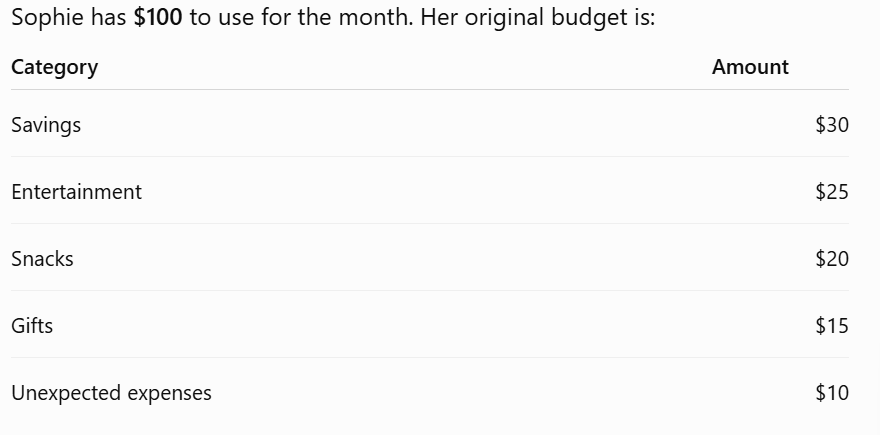
Sophie finds out that she needs to spend $20 on a school activity.
Which change would allow her to stay within her $100 budget while still saving $30?
A. Increase her total spending to $120.
B. Reduce some of her spending on entertainment, snacks, or gifts by $20.
C. Stop putting money aside for unexpected expenses and spend the extra $20.
D. Borrow $20 from a friend.
What is: B
Why?
Her savings goal stays the same, but she needs to adjust her spending in other areas to make room for the new expense.
400
Explain how a budget can help someone reach a financial goal.
Expected answer: A budget shows how much money they have available and helps them decide how much they can save toward their goal
400
Emma has $100.
Her budget includes:
- Savings: $30
- Clothing: $25
- Entertainment: $20
- Food: $15
- Gifts: $20
1. Is Emma's budget balanced?
2. If not, how much over budget is she?
3. Give one way she could adjust her budget without reducing her savings.
What is: $30 + $25 + $20 + $15 + $20 = $110
She is $10 over budget.
She could reduce entertainment, clothing, food, or gifts by $10.
400
You have $100 and three choices:
A. Spend all $100 today.
B. Save all $100 and buy nothing.
C. Create a plan that covers something you need/want while also putting some money toward savings.
Which approach gives you the opportunity to enjoy some of your money while still working toward a financial goal?
C. Create a plan that covers something you need/want while also putting some money toward savings.
500
What is one major benefit of setting a financial goal?
A. It guarantees you will never have unexpected expenses.
B. It gives you a plan and something specific to work toward.
C. It means you can spend all your money now.
D. It makes everything you want free.
What is B:It gives you a plan and something specific to work toward.
500
Ava receives $100 for her birthday. She wants to use the money to work toward several goals.
Her plan is:
- Put 30% into savings
- Spend $25 on a gift for her brother
- Spend $15 on a movie with friends
- Use the remaining money for a new game
Questions:
1. How much money does Ava put into savings?
2. How much money has she spent/saved before buying the game?
3. How much can she spend on the game?
4. If the game costs $40, can she afford it? If not, how much more would she need?
Step 1:
30% of $100 = $30 savings
Step 2:
$30 + $25 + $15 = $70
Step 3:
$100 − $70 = $30 available for the game
Step 4:
The game costs $40.
$40 − $30 = $10
Answer: Ava can only spend $30 on the game, so she would be $10 short.
500
Two students each receive $100.
Student A spends $80 immediately and saves $20.
Student B spends $40, saves $40, and keeps $20 available for unexpected expenses.
Which statement BEST explains the difference between their financial choices?
A. Student A made a bad choice and Student B made a good choice.
B. Student B has created more flexibility by balancing spending, saving, and unexpected expenses.
C. Student A should never spend money on things they enjoy.
D. Student B should have saved all $100.
What is B:Student B has created more flexibility by balancing spending, saving, and unexpected expenses.
500
Imagine your friend says, "I don't need a budget because I know how much money I have." What would you explain to them about the benefits of budgeting
Expected answer: A budget helps them plan ahead, track spending, make sure they can cover expenses, and work toward savings goals.
500
Mason has $200.
He wants to:
- Save $100 for a bike
- Buy a $45 birthday gift
- Spend $30 on entertainment
- Keep some money available for unexpected expenses
During the month, an unexpected expense comes up that costs $20.
Questions:
1. How much money does Mason have left after saving $100, buying the gift, and spending $30 on entertainment?
2. Can he pay the $20 unexpected expense without using his bike savings?
3. After paying the unexpected expense, how much money does he have left?
4. If Mason decides he still wants to have $20 available for another unexpected expense, how much could he spend on entertainment instead of $30?
Answer:
Step 1:
$200 − $100 − $45 − $30 = $25
He has $25 left.
Step 2:
Yes. He can pay the $20 unexpected expense without touching his $100 bike savings.
Step 3:
$25 − $20 = $5
He has $5 left.
Step 4:
If he wants to have $20 left after the unexpected expense:
He needs:
$20 + $20 = $40
available for unexpected expenses/remaining money.
He originally had $25 after his other spending, so he needs to free up:
$40 − $25 = $15
Therefore, he could spend:
$30 − $15 = $15
on entertainment instead.
Final Answer: Mason would need to reduce his entertainment spending from $30 to $15 to make room for both the unexpected expense and another $20 cushion.
500
You receive $100 unexpectedly. You have three choices:
A. Spend the entire $100 on things you've been wanting.
B. Save the entire $100 and don't spend any of it.
C. Make a plan that includes saving some money, spending some money, and keeping some money available in case something unexpected happens.
Which choice shows the best understanding of why people create budgets?
What is: C
Why?
A budget isn't about never spending money or never having fun. It's about making a plan for your money, balancing spending and saving, and being prepared for unexpected expenses.