Ch. 1 - What's Psychology?
Ch. 2 - Psyc's Scientific Method
Ch. 3 - Biological Foundations
Ch. 4 - Sensation and Perception
Ch. 5 - States of Consciousness
Bonus!
100
20 sec
What's the definition of Psychology?
The scientific study of behavior and mental processes.
1. It's scientific
2. Behavior - Observable and repeatable behavior, external factor
3. Mental processes - Why we do the things we do, internal factor
100
3 min
You're the experimenter here; you also need 2 answers here:
1. According to the scientific methods, after you make an observation, what do you do next?
2. What is the last step in the scientific method?
1. Create a testable hypothesis.
2. Fail to support or support
Don't forget to replicate as well.
100
2 min
What is the difference between afferent and efferent nerves?Afferent - Nerves that carry information from our external environment to the brain and spinal cord, via sensory receptors. "Afferent nerves arrive."
Efferent - Nerves that carry information out of the brain and spinal cord to other areas of the body. "Efferent nerves exit."
100
2 min
What is the difference between sensation and perception?
Sensation (objective/biological) is the process of receiving raw external stimuli from your environment.
Perception (subjective/personal) is the process of organizing and interpreting sensory information so that it makes sense to you!
100
1 min
How long is a circadian rhythm?
24 hours.
100
When your dogs hears you opening the treat container, he runs to the sound and starts to salivate without even looking at the treat.
The sound of the treat bag opener is a _________ __________
Breakdown: The sounds of a treat bag is a stimulus.
The dog salivating to the sound of a treat bag is not innate or natural, therefore it has learned to associate the sounds of the treat bag.
(sounds of treat bag = I'm going to get a treat!) this is a conditioned stimulus.
Answer: Conditioned stimulus.
200
2 min
What is the difference between structuralism and functionalism?
Structuralism focuses on identifying the structures of the human mind. - W.W.
Functionalism focuses on the functions and purposes of the mind and behavior in the person's adaptation to their environment. - William James
200
3 min
Needs: 2 correct answers!
1. Do we prove? If not, then what do we do instead?
2. What is a meta-analysis?
1. We never prove! We either support or fail to support
2. "study of studies." A summary of a large body of evidence from the research literature on a particular topic.
200
30 sec
How do neurons communicate, and what is the advantage of this type of communication?
Neurons communicate electrochemically, and the advantage is neuroplasticity.
200
30 sec
In our bodies, where does transduction occur, in order for us to see and hear?
Vision - Retina
Ear - Cochlea
200
30 sec
What are the unique features of REM sleep?
Vivid dreams and rapid eye movement (REM).
200
ACT IT OUT: Operant Conditioning Edition!
You will be given 3 minutes to come up with a real-word scenario of your assigned opearant conditioning.
Once your time is up, you'll perform for your peers. Try not to use any technical terminology to begin with!
Break it down:
Positive - Adding Something
Negative - Taking away something
The consequence of either adding or taking away something (this can go both ways not just "bad"):
Reinforcement - Increase behavior
Punishment - Decrease behavior
300
2 min
What's the difference between a clinical psychologist and a psychiatrist?
Clinical psychologist - holds a doctorate and focuses on talk therapy, behavioral intervention, etc.
Psychiatrist - holds an MD, attended medical school, and can actually prescribe psych meds.
300
2 min
Give an example of a case study.
A descriptive research method in which a researcher gathers detailed, qualitative, information about a single individual
Example: Studying the behavior and mind of a serial killer
:max_bytes(150000):strip_icc()/how-to-write-a-psychology-case-study-2795722-final-f90b37ae2de34cc29b53e303fc0eef5d.png)
300
1. Memory
2. Emotion
3. Relay Station
What parts of the brain correlate with 1, 2, and 3?
1. Hippocampus
2. Amygdala
3. Thalamus
300
2 min
What's this called? - Smallest intensity necessary for a stimulus to be detected, when you are first able to sense something.
Absolute Threshold
- By the appropriate sense organ 50% of the time
EX: In order for you to hear the couple in the apartment next door to you arguing, they have to be going at it loudly enough for your ears to hear
:max_bytes(150000):strip_icc()/200258527-003-56a793363df78cf7729749df.jpg)
300
1 min
Provide an example for both:
1. Lower level of consciousness
2. Altered state of consciousness
1. Can be daydreaming and includes automatic processing that requires little attention.
Ex: Typing on a keyboard (if you've built up that muscle memory), and starting up your car (having had years of driving experience).
2. Produced by drugs, trauma, fatigue, and possibly hypnosis.
Ex: Undergoing hypnosis for pain relief or feeling the effects after consuming alcohol.
300
This type of memory helps us process millions of bits from our senses and is very fleeting (matter of seconds).
What type of memory is this?
Sensory memory
400
1 min
What's an operational definition?
This can provide an objective description of how a variable is going to be measured and observed in a particular study.
400
3 min
What are the 3 different types of research methods? AND What is the key word assosiated with each one?
1. Descriptive - describe
2. Correlational - relationship
3. Experimental - causation
400
3 min
DRAW, LABEL, and IDENTIFY the brain's lobes!
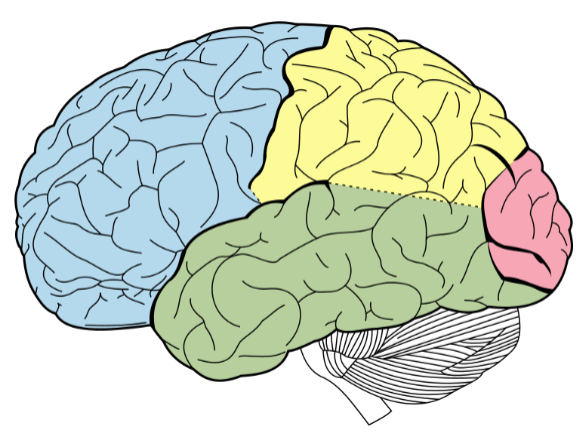
Frontal (executive function)
Parietal(body map) - Includes motor cortex and somatosensory cortex
Temporal(auditory)
Occipital(vision)
Cerebellum(coordination, balance, movement)
400
2 min
Tendency for one's sensitivity to stimuli to be lessened overtime during continuous exposure.
Sensory Adaption

400
What's the different between deductive vs inductive reasoning?
Deductive - Moves from general to specific
Inductive - Moves from specific to general
500
3 min
Provide an example for each:
1. Cross-sectional study
2. Longitudinal study
1. Selecting a child from each grade in a small elementary school to observe social media usage.
2. Monthly observations of the same participants, starting from birth, born into different socioeconomic backgrounds, to see whether or not their upbringings affect their brain development.
500
5 min
1. What are the 3 elements of a true experiment?
2. In this example, what are the I.V., D.V., E, and C?
A psychologist wants to test whether listening to music affects students’ memory. The researcher randomly assigns college students to two groups. One group studies a list of words while listening to music, while the other group studies the same list in silence. After five minutes, both groups take the same memory test to see how many words they can recall. By comparing the results of the two groups, the researcher can determine whether music influences memory performance.
1. Randomization, manipulation, control
2.
I.V. - Music
D.V. - memory test
E - groups that listen to music
C - Group with no music.
500
3 min
DRAW and IDENTIFY the basic anatomy of a neuron.
Remember: "To receive or not to receive."
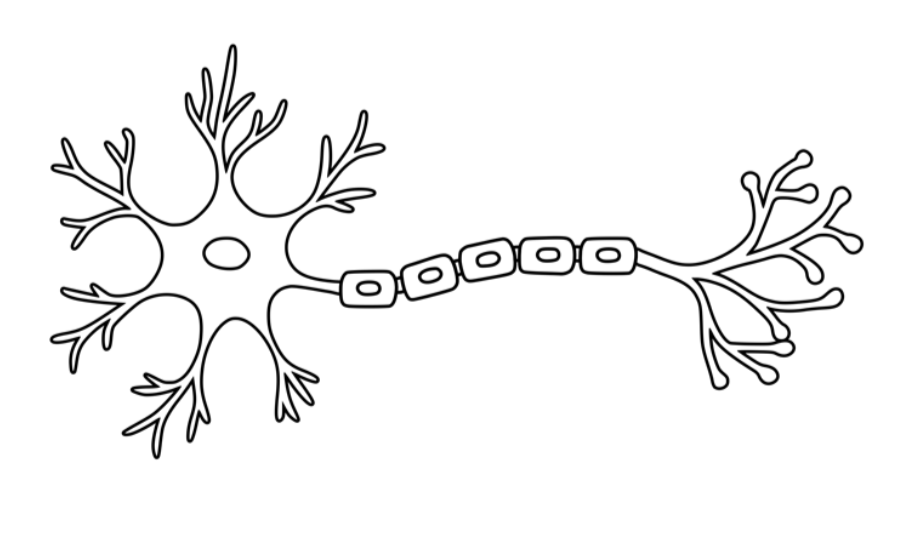
Dendrites(receive neurotransmitters) -> Cell body -> Axon -> Terminal buttons(release neurotransmitters)
500
3 min
It goes: sensation, transduction, then perception.
What are the definitions of each of these terms?
Sensation - (objective/biological) is the process of receiving raw external stimuli from your environment.
Transduction - (conversion) conversion of one form of energy into another, specifically the transformation of sensory input into neural chemical impulses.
Perception - (subjective/personal) is the process of organizing and interpreting sensory information so that it makes sense to you!
500
What does the g factor in Spearman's theory of intelligence mean?
G factor - General intelligence, an outcome of overall understanding of cognitive abilities.