Viscosity
Density
Buoyancy
Fluids
Calculations
100
What is viscosity?
The thickness of a fluid, the measure of how well it will flow.
100
What is its volume?
The amount of space that a object/material uses.
100
What is buoyancy?
The upward force exerted by a fluid.
100
What states of matter are considered fluids?
Liquids and gases
100
A block has a mass of 200 g and volume of 100 cm³. Find its density.
2 g/cm³
200
What is low viscosity?
It is when a fluid will flow freely and quickly, a thin fluid like water.
200
Less dense fluids will do this when placed on top of denser fluids.
They will float.
200
If buoyant force is greater than weight, the object will do this.
Float
200
What are the properties of fluids?
They flow and take the shape of their container.
200
What is the density of a rock that has a mass of 550g and a volume of 25cm3?
22g/cm3
300
According to the Particle Model of Matter, what happens to a fluid when the temperature rises?
The particles gain energy and move faster. This weakens the bonds between then and allows them to move more freely, lowering the viscosity.
300
What is the formula for calculating density.
Density = mass(g) / volume(mL or cm3)
300
A block has weight 20 N. The buoyant force is 25 N. What will happen?
The block will float
300
This property describes how easily a fluid flows, and is one of the major ways fluids are compared.
Viscosity
300
A gas is compressed from 80 cm³ to 20 cm³.
How many times smaller is it?
4 times smaller
400
What is flow rate?
The measurement of the distance travelled by a fluid in a certain amount of time—is used as an indicator of viscosity.
400
Using the particle model of matter, explain why a substance is more dense.
There are more particles packed into the same amount of space.
400
When an object is placed in water, and it floats because of buoyancy, what happens to the water?
It is displaced
400
Fluids expand and become less dense when this environmental factor increases.
Temperature
400
A floating object displaces 12 N of fluid.
What is its weight?
12 N
500
Rank these from low to high viscosity: cream, milk, mayonnaise, dish soap.
Milk, cream, dish soap, mayonnaise
500
What happens to a fluid when you add solutes like salt?
It becomes more dense.
500
This scientist is known for explaining buoyancy.
Archimedes
500
This device uses Pascal’s Law to lift heavy objects
Hydraulic lift
500
What did you find if the object has a mass of 107g and when put into a graduated cylinder the level goes from 10mL to 15mL?
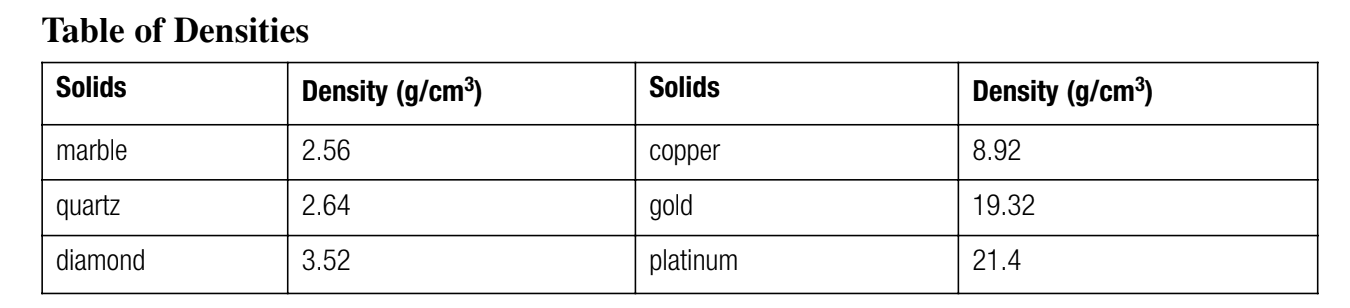
Platinum