Sound
Cinematography
Editing
Mise-En-Scene
Etc
100
____________________ sound originates from a source within the world of the film. _______________________ sound originates beyond that world.
What are diegetic, nondiegetic?
100
These are the essential lights in a classical Hollywood lighting setup.
What are key, back, and fill?
100
This is the principle in which two images are combined to create a new, or "third" meaning.
What is the Kuleshov effect?
100
T/F - Mise-en-scene is a formal characteristic specific to the medium of cinema.
What is false? The term comes from theater and means "putting in the scene." MES refers to all of the stuff put in front of the camera to be filmed.
100
Why can it be said that realism in movies is a kind of illusion?
A.Because there is no such thing as reality. B.Because realism ceased to exist as a viable artistic approach decades ago.
C.Because nothing captured on camera and projected on screen can technically be defined as “real.”
D.Because no matter how similar to our experience of the world it might appear, realism always entails mediation.
E.Because the concept of realism has always remained the same throughout the history of the arts.
What is answer D, D.Because no matter how similar to our experience of the world it might appear, realism always entails mediation.
200
Attack, sustain, and decay are components of the:
What is the sound envelope?
200
This type of lens achieves a perceived expansion of depth.
What is a wide angle (aka short focal length) lens?
200
These are the three types of match cuts.
What are graphic match, match on action, and eyeline match?
200
These are the two major components of mise-en-scene. The first is established in pre-production, and the second involves the relationship between onscreen elements within each finalized shot.
What are design and composition? (You should be able to define these for the exam; design is all the "stuff" and composition includes framing and kinesis)
200
This is the difference between form and content.
What is "content is what a story is about, form is how the story is about it."?
300
These are the three "stems" of film sound:
What are dialog (production and ADR), effects (SFX and foley), and music (composed or compiled)
300
These are three types of camera movement.
What are: Tilt, Pan, Tracking (dolly) shot, Crane, Steadicam, Handheld
300
Identify and describe at TWO continuity editing techniques and TWO discontinuity editing techniques.
What are: a) Match on action, Long take, Dissolves and fades, Cross cutting, Continuous diegetic sound, Sound bridge, establishing shot, 180 degree rule, eyeline match, shot reverse shot b) Jump cut, Nondiegetic insert, Repetition of shots or events, Freeze frame, Any violation of continuity rules
300
Describe the principle of lead room and describe how a filmmaker might use it.
Lead room is the space in front of the subject of an image, in the direction the subject is looking/moving. The amount of lead room, in conjunction with other compositional concerns, can communicate psychological and narrative conditions.
300
_______ meanings are available on the surface of a movie, often at the level of story. __________ meaning exists below the surface and requires interpretation of formal cues.
What are explicit and implicit meanings?
400
Describe the soundscape in this clip and explain the affect achieved by the sound choices. That is, what sound types are present, how are sounds combined with images, and what mood does the sound design convey?
Answers vary - this is the kind of answer you could write for your final essay (worth 20 points!)
400
These are three qualities of light.
What are source, quality, color, direction (will also accept brightness, temperature)?
400
These are two of the four primary "logics" under which images can be joined together in film editing.
What are spatial, temporal, rhythmic, and graphic?
400
The deep-space composition exemplified in The Rules of the Game (Renoir, 1939) features choreographed movement on multiple planes of action, which is generally considered a realist approach to kinesis. Which film theorist is associated with the celebration of cinematic realism?
Who is Andre Bazin?
400
Describe the difference between story and plot.
Story is everything that happens in the diegesis (including characters, events, and places not shown on screen) while plot is the purposeful selection and arrangement of elements to create a narrative.
500
Identify something that sound can do which the image cannot, and illustrate your answer with an example (preferably from a film screened in class).
Answers vary; e.g. provide narrative dimension, be more layered than images, sound can convey a sense of space beyond the screen, sound can "subjectivize" an objective image through point of audition sound
500
Describe all of the major cinematographic components you can identify in the image below. Consider depth, angles, distance, lighting, and overall composition.
https://shots.filmschoolrejects.com/to-catch-a-thief-1955-4/
Deep space and deep focus, high angle, long shot/extreme long shot (depending upon which characters you use as your frame of reference), rule of thirds, backlighting*
500
Draw a diagram illustrating the 180 degree rule and explain the utility of this guideline for filmmakers. Why might one want to defy the 180 degree rule?
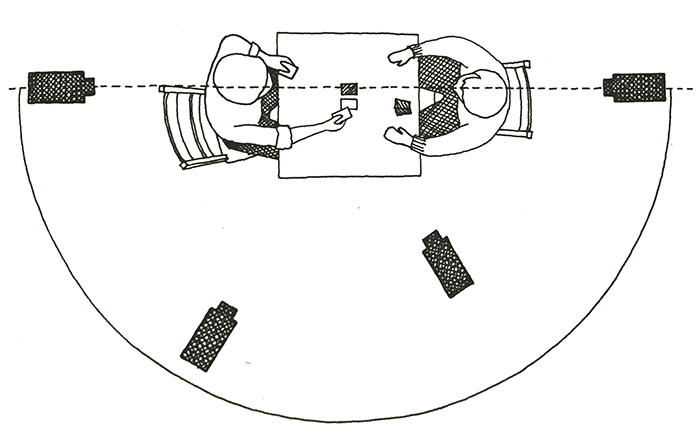
This "rule" allows filmmakers to combine camera positions for maximum impact while maintaining spatial continuity. Filmmakers might violate this rule to disorient the audience, among other things.
500
https://www.youtube.com/watch?v=wRuYIX8rjnw
How does miss-en-scene create meaning in this clip from Playtime (Tati, 1967)?
What is (answer will vary). A good answer could discuss the color palette, the way the action is choreographed, and the way the photographer banishes reality from her images in favor of fulfilling a tourist's preconceived ideas about what the place "should" look like.
500
These are the four major approaches to studying film within the discipline of Film Studies.
What are aesthetics, technology, economics and culture?