Safety & Sanitation
Kitchen Management
MyPlate
Carbohydrates
Lipids
Protein
Vitamins, Minerals & Water
100
What is the correct way to wash your hands before cooking?
Wet hands and arms, apply soap, scrub hands and arms for 10-15 seconds, rinse hands and arms, and dry. The whole process is at least 20 seconds.
100
How do you measure 1/4 cup of flour accurately?
Spoon the flour into a dry 1/4 measuring cup, overfilling, level off.
100
What are the five food groups on MyPlate?
Fruit, Vegetables, Grain, Protein & Dairy
100
What is the main function of carbohydrates?
To provide energy
100
Cholesterol is found in which types of foods?
Animal food sources
100
What is the main function of protein?
to build, repair and maintain body tissues
100
Which vegetables have the most vitamins and minerals?
Red, Orange and Dark Green
200
What should you do if there is a grease fire?
Baking Soda, Lid or Fire Extinguisher
DO NOT USE WATER!!!
200
Name the kitchen tools: 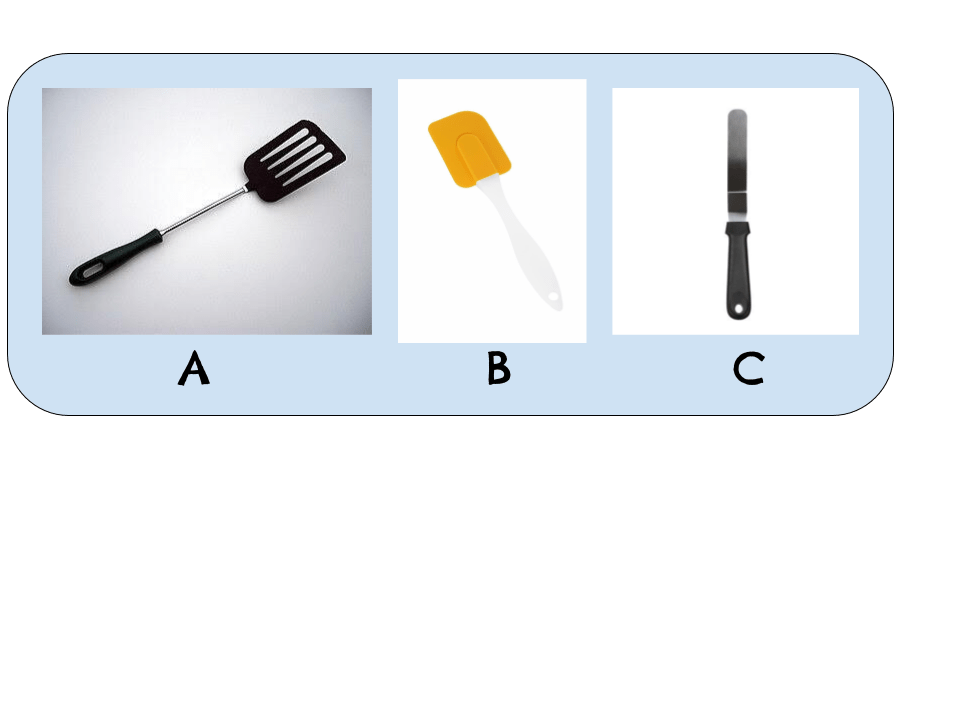
A. Turner
B. Rubber Scrapper/Spatula
C. Straight Edge Spatula
200
What are the six essential nutrients? How many calories do they each provide?
Carbohydrates-4, Lipids-9, Proteins-4, Vitamins-0, Minerals-0 & Water-0
200
What are the two types of carbohydrates we discussed? Give an example food for each.
Complex-Flour/Starches
Simple-Sugars
200
HDL is called "good" cholesterol because:
It helps remove excess cholesterol built up in the arteries
200
What pairing creates a complimentary protein?
Grain with a Nut, Seed or Legume
200
What three things destroy the nutrients in fruits and vegetables?
Heat, Air and Water
300
What temperature should chicken be cooked to for safety? Ground Meats? Steak, Pork and Fish?
Chicken- 165 degrees Fahrenheit
Ground Meats- 155 degrees Fahrenheit
Steak, Pork & Fish-145 degrees Fahrenheit
300
The recipe says to use 4 tablespoons of bread crumbs. The most effective way to measure it would be to use _______________.
1/4 cup
300
Foods that have solid fats and added sugars, but few nutrients have more:
Empty Calories
300
What are the three parts of the wheat kernel? Which is the most beneficial? Which is the least beneficial?
Bran
Germ-Most
Endosperm-Least
300
What are the four functions of lipids?
Carries vitamins KADE
Reserve/Back-up energy
Promotes healthy skin
Satisfies hunger & helps you feel full longer
300
The building blocks of protein are called.
Amino acids
300
Milk is fortified with these vitamins:
Vitamin A & Vitamin D
400
List the six things that bacteria need to be able to grow.
Food source
Acid level
Time
Temperature
Oxygen
Moisture
400
What three things are microwaves attracted to?
Water, fat, sugar
400
Half of your plate should be?
Fruits & Vegetables
400
What are the differences between cooking rice and pasta?
Rice-rice and water in pot together, boil, Lid on, 1:3 ratio (uncooked: cooked)
Pasta-Boil water first, then add pasta, Lid off, Al dente, 1:2 ration (uncooked: cooked)
400
When milk has been treated to break up and evenly distribute the fat, that process is called:
Homogenization
400
What is an emulsifier?
Something that allows two unmixable ingredients to mix
400
What are the other names for Vitamins C & Vitamin B9?
Ascorbic Acid and Folate/Folic Acid
500
What are the 8 Food Borne Illnesses we learned? What causes them?
Salmonella-Eggs, Chicken
E. Coli-Ground Beef, Undercooked Meats, Raw Milk
Botulism-Improperly canned foods
Campylobacter-Contaminated water
Clostridium Perfringens-Time & Temperature abused foods
Staph-Human Mucus and Infected cuts & sores
Norovirus-Sick food handler
Hepatitis A-Human Feces
500
Name and describe the three knives.
Chef's Knife-
- Used for chopping, slicing, dicing, and mincing a variety of foods
Paring Knife-
- Used for peeling, trimming, and detailed work like cutting small fruits and vegetables
Serrated Knife (Bread Knife)-
- Used for slicing bread, tomatoes, and other foods with tough exteriors and soft interiors
500
Choose a variety of _________ products. Check for added sugars. This is the Key consumer message for which food group?
Dairy
500
What are the differences between the muffin method and the biscuit method?
Muffin-Fat is part of the liquid ingredients, Do not over mix
Biscuit-Fat cut into dry ingredients, knead dough
500
What happens to cholesterol with each type of fatty acid?
Saturated-Raises both HDLs and LDLs
Polyunsaturated-Lowers both
Monounsaturated-Raises HDLs and Lowers LDLs
500
What is the difference between complete and incomplete proteins?
Complete-all 9 essential amino acids, animal sources + Soybeans & Quinoa
Incomplete-Does not have all 9, plant sources
500
Name and Explain the function of four Vitamins or Minerals.
Vitamin K-Helps blood to clot normally
Vitamin A-Maintains vision and immune system
Vitamin D-Build and maintain healthy bones and teeth
Vitamin E-Protects the membranes of red and white blood cells
Vitamin C/Ascorbic Acid-Helps to form collagen which holds the cells together and aids in healing
Vitamin B9/Folate/Folic Acid-Helps tissue to grow and cells to work
Sodium-Helps maintain fluid balance & blood pressure in the body
Potassium-Helps maintain a regular heartbeat and helps prevent muscle cramps
Iron-Helps to form the hemoglobin in red blood cells which carry oxygen throughout the body
Calcium-Builds strong bones & teeth