Formulas and Calculations
Newton's Laws & Force
Motion & Graphing
Waves & Energy
Real-World Physics
100
This equation is associated with Newton's second law.
What is F = ma?
100
This force always pulls objects toward Earth.
What is gravity?
100
Speed is calculated using this formula.
What is speed = distance ÷ time?
100
The distance between two trough and trough is called this.
What is wavelength?
100
Why do seatbelts keep you safe in a crash? Use Newton’s laws in your explanation.
Objects keep moving due to inertia (Newton’s 1st law), and the seatbelt provides the force that stops your body.
200
A car travels 100 m in 5 s. What is its speed?
What is 20 m/s?
200
This law explains why heavier objects need more force to accelerate.
What is Newton’s Second Law?
200
This describes the velocity between 15 and 40 seconds. (not looking for numerical value)
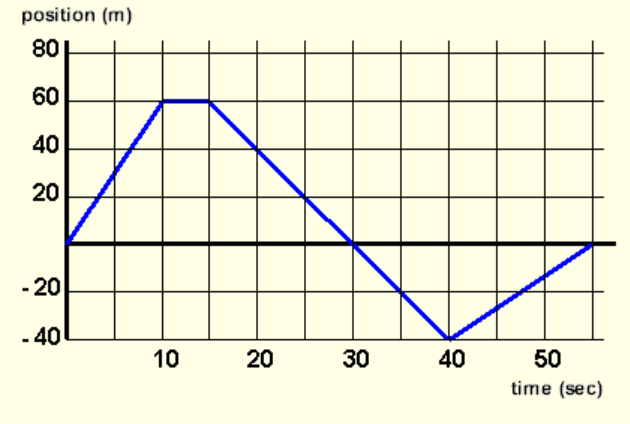
What is constant and negative?
200
This measures how many waves pass a point in a second.
What is frequency?
200
Why is it harder to stop a heavy truck than a bicycle moving at the same speed? Explain using mass and motion.
More mass → more inertia/momentum → requires more force to stop.
300
A 5 kg object accelerates at 4 m/s². Calculate the force acting on it and explain how mass affects the result.
What is 20 N, greater mass means more force is needed to cause acceleration.
300
You run into your friend while skating and both of you fall in opposite directions. This is an example of which law of motion?
What is Newton's 3rd law?
300
This is the acceleration of the graph below.
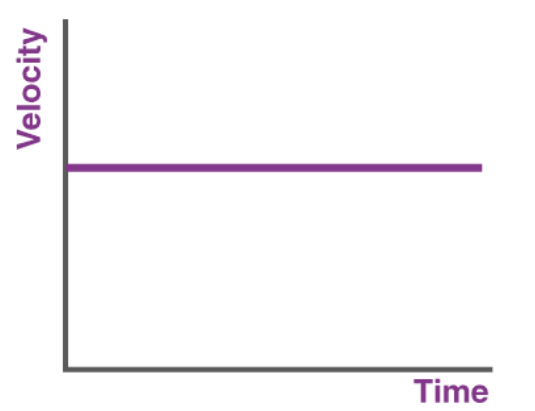
What is zero?
300
This is the measurement of a wave from rest to crest.
What is amplitude?
300
A soccer ball and a bowling ball are kicked with the same force. Which one will accelerate more, and why?
The soccer ball accelerates more because it has less mass → same force causes greater acceleration (Newton’s 2nd law).
400
Two objects are pushed with the same force. One has more mass. Compare their accelerations and explain why they are different.
With the same force, acceleration increases as mass decreases (Newton’s 2nd law).
400
A rocket launches because hot gases push downward, causing the rocket to move upward. This is an example of this law.
What is Newton’s Third Law?
400
This is defined as the rate of change of an object's position with respect to time, representing speed in a specific direction
What is velocity?
400
This type of wave moves particles up and down (perpendicular to motion).
What is a transverse wave?
400
Why do you slide forward when a car suddenly stops? Explain using motion and force concepts.
Your body keeps moving forward due to inertia until a force (seatbelt, friction) stops you.
500
A car increases its speed from 10 m/s to 25 m/s in 5 seconds.
Calculate the acceleration.
What is acceleration = 3 m/s²?
500
According to Newton’s second law, if you double the force while keeping mass constant, this happens to acceleration.
What is it doubles?
500
Draw a distance vs time graph that shows acceleration. Include axis labels.
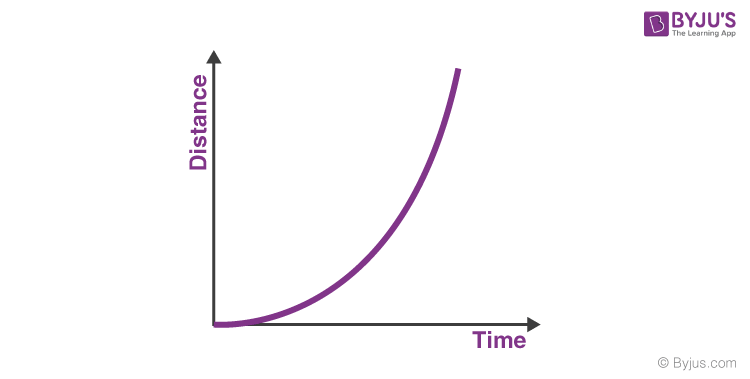
500
Two waves travel at the same speed. Wave A has a longer wavelength than Wave B.
Which wave has a higher frequency, and what does this tell you about its energy?
Wave B has the higher frequency and more energy. Shorter wavelength → higher frequency → more energy.
500
Airbags reduce injuries in a crash. Explain how they reduce force using time and motion concepts.
They increase the time over which you stop → reduces force.
