Center of Mass
Friction
Springs
Gravitation
Air Resistance
100
A ________, or group of multiple objects and fields, can be treated as a point mass located at the center of mass.
What is a system?
100
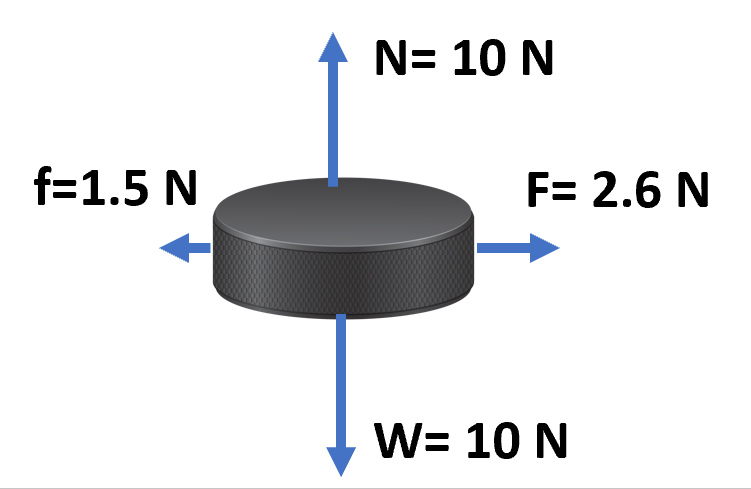
A hockey puck has a mass of 1.0 kg. The coefficient of kinetic friction between the puck and ice is 0.15. A force of 2.6 N is applied horizontally to the puck to accelerate it to the right, Draw and label all the forces acting on the puck.
100
The strength of a spring is given by its spring constant, k, with what units?
What are N/m or Newtons per meter?
100
The value of the Universal Gravitation constant
What is 6.67 x 10^-11 Nm^2/kg^2?
100
The name of the force causing an object to slow down in a fluid such as air or water.
What is drag?
200
True or False: The center of mass MUST BE a point that is on the object's body.
False: The center of mass may very well be a location not on the body. Example: Boomerang

200
A cup of coffee of mass 0.25 kg sits on the edge of a table. A person walks by and accidentally hits the cup with a force of 2 N. If the coefficient of static friction between the cup and the table is 0.7, what is the maximum static friction of the cup? Based upon the maximum static friction value, does the cup fall off the table? Why or why not?
fmax= 1.75 N
Yes, the cup of coffee falls off the table since the applied force is greater than the maximum static friction.
200
In the spring force formula, F=-kx, x represents....
What is the distance from equilibrium?
200
What is the difference between big G and little g?
Big G is for Universal Gravitation
Little g is for surface gravity
200
The net force is _______ when an object reaches terminal velocity.
What is 0?
300
If a rod has a uniform mass distribution, its center of mass will be _____________
What is the geometric center or halfway across?
300
A block of 40 kg is sitting on a table and is pulled by a rope. If the coefficient of kinetic friction between the table and block is μk=0.35, what tension is required in the rope to make the block move with an acceleration of 1.8 m/s^2?
T = 212 N
300
What is the spring force if a 5000 N/m and it is compressed 20cm?
What is 1000 N?
300
Which pulls harder gravitationally, the Earth on the Moon or the moon on the Earth? (Which has more Force?)
AND Which accelerates more?
Same Force (Newton's Third Law)
The Moon accelerates more.
300
DAILY DOUBLE!
Write a Differential Equation of Motion for an object falling with a drag force FD=Cv2
What is anything equivalent to
m (dv)/dt=mg-Cv^2
400
Determine the center of mass for system including:
a 100g meterstick
a 500g mass stuck to the 20cm mark
a 200g mass stuck to the 100cm mark
a 200g mass stuck at the 2.5cm mark
What is 35.5cm?
400
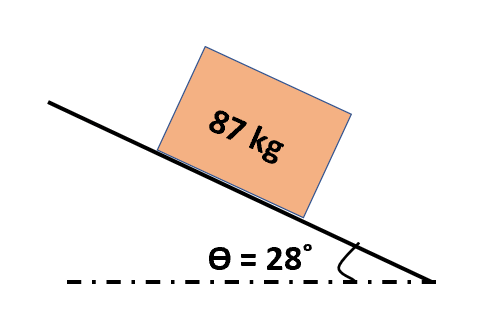
An 87 kg crate sits on a ramp that is at an angle of 28-degrees. If the crate accelerates down the ramps with an acceleration of 1.34 m/s^2, what is the coefficient of kinetic friction between the crate and ramp?
μk = 0.38
400
Which spring will be stretched the most?
Spring A, with k=400N/m and a 5.0kg mass hanging
Spring B, with k=300N/m and a 6.0kg mass hanging
Spring A, with k=200N/m and a 2.0kg mass hanging
Spring B
400
The force of gravitational attraction acting between a 10.5 kg object and the Earth when the object is 8.3 x 10^7 m from the center of the Earth
What is 0.61 N?
400
The terminal velocity of a falling object experiencing a drag force of FD=bv
What is
(mg)/b
500
Daily Double!
Determine the location of the center of mass for a 1m rod with a linear mass density function:
lambda(x)=50-30x^2
Where is x=43.75cm or x=.4375m?
500
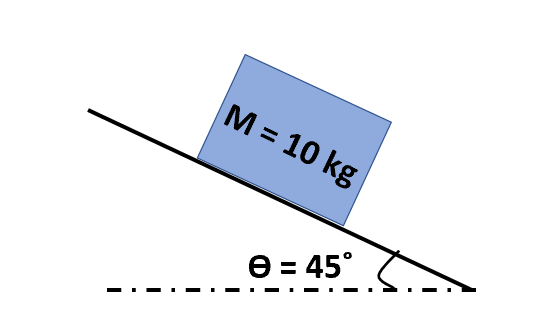
A block of mass M = 10 kg is sitting on an inclined surface at an angle of 45-degrees. Given the coefficient of kinetic friction is uk=0.5, what is the acceleration of the block down the ramp?
a = 3.6 m/s^2
500
How much more can two springs in series be stretched than two springs in parallel with the same force, assuming both springs individually have the same spring constant?
Two springs in series can be stretched 4 times farther than those same two springs in parallel with the same force.
500
The effect on gravity when both masses are doubled and the radius is doubled.
What is it stays the same?
500
An 5kg object is found experiencing a drag force with drag coefficient of 2kg/s, and has a velocity function defined below. After 20 s, how close is the object to terminal velocity?
v(t)=(mg)/b (1-e^(-(bt)/m))
The object is travelling at 24.99m/s, and terminal velocity is 25.00m/s. There is a difference of 0.01 m/s