The Dream Team
Seek & You Shall Find
Picture This!
Handle With Care
Bag It & Tag It
100
This member would interview a witness about what they saw.
Who is the detective?
100
This search pattern divides a crime scene into separate areas that can be assigned to different investigators.
What is a zone/quadrant search?
100
This type of photograph provides a broad picture of the crime scene.
What is an overall photograph?
100
This should already have been completed before an investigator collects a piece of physical evidence, so its original condition & location are preserved.
What is documentation of the evidence and its location?
100
Small evidence such as hairs, glass fragments, paint flakes, and fibers falls into this general evidence category.
What is trace evidence?
200
This person determines the cause of death in a suspected homicide.
Who is the medical examiner/coroner?
200
This search pattern is especially useful for searching a large, open area quickly with many investigators.
What is a linear/parallel search?
200
This type of photograph connects a specific piece of evidence to a known feature in the scene.
What is a mid-range photograph?
200
This type of evidence should generally be collected first because it is at the greatest risk of disappearing or being damaged.
What is fragile or easily lost evidence?
200
This folded paper container can be used to keep small trace evidence from being lost.
What is a paper bindle/druggist fold?
300
This member will usually secure the scene.
Who are first responders/police officers?
300
This search pattern can begin at a point of interest and move outward in a curved manner and can be completed with relatively few investigators.
What is a spiral search?
300
Investigators should take this photograph from a 90o angle above the evidence.
What is a specific photograph?
300
An investigator finishes collecting one item and is ready to collect another. This should be done before collecting the next item to help prevent cross-contamination.
What is changing gloves?
300
A damp, bloodstained piece of clothing is collected at a crime scene. This should be done with it before it is packaged and it should be placed in this type of package.
Air dry completely & placed in a paper/breathable container.
400
These investigators document the crime scene in detail and collect physical evidence.
Who are crime scene investigators?
400
Investigators would use this pattern if they want a more thorough search than a linear search and are willing to spend additional time searching the area.
What is a grid search?
400
This measurement method measures from the item to at least two fixed points to establish its location.
What is triangulation?
400
An investigator discovers an object that must be moved to collect it. Why should the investigator pay special attention to the area underneath or around the object as it is moved?
What is moving the object may reveal additional evidence?
400
This record documents the possession and transfer of evidence and helps establish that evidence has not been subjected to tampering or misconduct.
What is the chain of custody?
500
This member of the investigation team may determine whether a search warrant is necessary.
Who is the district attorney?
500
Investigators complete this examination after their initial systematic examination of a crime scene, looking for evidence they may have missed.
What is a secondary search?
500
An investigator photographs a piece of evidence in the middle of a room using an overall photo, a mid-range photo, and a close-up with a scale. The investigator then uses a measurement from the closest wall to place the evidence on the sketch.
Identify TWO problems with the investigator’s documentation.
- The specific evidence should be photographed both with & without a scale.
- An object away from a wall should be located using triangulation with measurements from at least two fixed points.
500
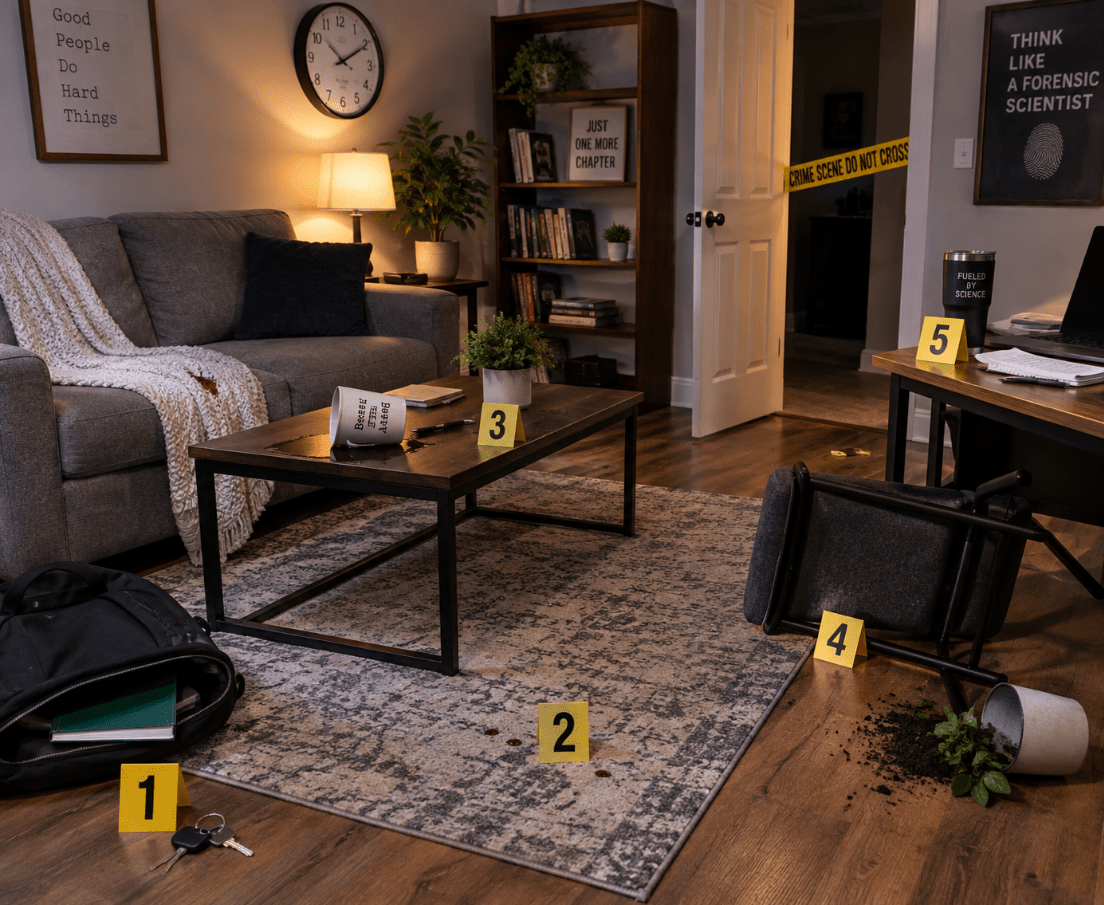 Evidence #1 is a set of keys, #2 is small trace evidence, and #3 is a liquid spill on the table.
Determine how each item is collected.
Different types of physical evidence require different collection and preservation techniques based on the nature and condition of the evidence.
1. Small trace evidence must be contained so it cannot be lost
2. Liquid evidence requires an appropriate leakproof/airtight container.
3.Keys can be placed in an evidence bag
500
FINAL JEOPARDY - Investigators discover a small piece of trace evidence at a crime scene. Before it is sent to the laboratory, name seven different actions investigators could take to properly document, collect, and preserve it.
Photographing the evidence before moving it, documenting its location, assigning/recording its evidence number, changing gloves before collection, using clean collection equipment, placing small trace evidence in an appropriately sized container or paper bindle, packaging it separately to prevent cross-contamination, properly sealing/labeling the package, and maintaining chain of custody