FORMATION
AGE OF FOSSILS
FOSSIL RECORD
Mis.
EXTINCTION AND BIODIVERSITY DATA
100
What is the basic definition of a fossil?
preserved remains/traces of once-living organisms
100
What is relative dating?
Relative dating orders events/rocks as older or younger, without numeric ages
100
What does the fossil record show about the existence of life on Earth?
It documents existence, diversity, and change of life over Earth history
100
What does "change over time" refer to in the context of life on Earth?
Change over time = evolution: populations of organisms change genetically and morphologically across generations/geologic time
100
What is an extinction event?
when a species or group ceases to exist
200
Name two conditions that increase the likelihood an organism will become fossilized.
Rapid burial, a lot of sediments, hard parts (bones/shells), mineral-rich waters; examples: river sediment, volcanic ash, tar pits
200
What principle states that in undisturbed rock layers, older layers are beneath younger layers?
Law of Superposition
200
Give two reasons the fossil record is incomplete.
Incomplete due to decay before burial, lack of hard parts, erosion, limited rock exposure, and sampling bias
200
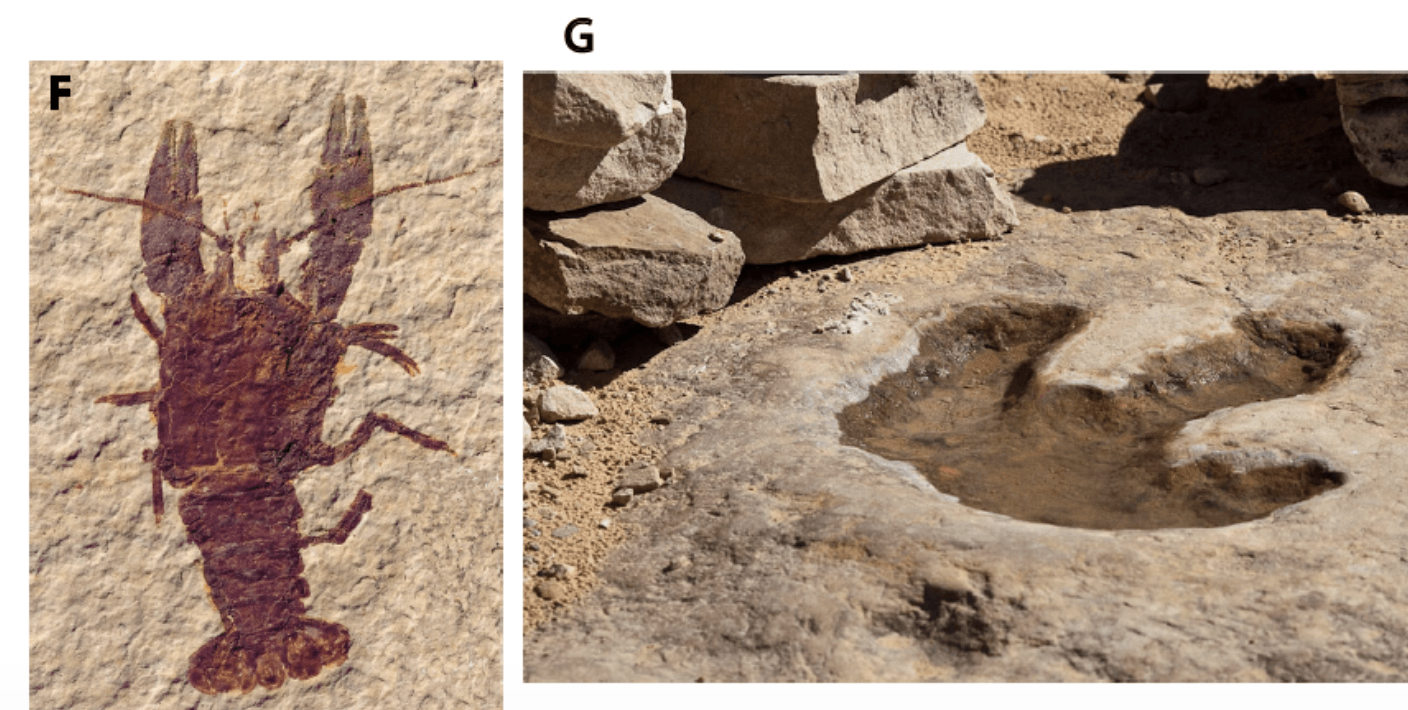 There are several types of FOSSILS. What are these known as?
Trace
200
Name one major mass extinction in Earth's history
Permian-Triassic extinction, Cretaceous-Paleogene (K–Pg) extinction, Ordovician–Silurian
300
Describe how rapid burial helps preserve an organism and name one environment where rapid burial commonly occurs.
Rapid burial protects remains from scavengers, decay, and physical disturbance; common in floodplains, river deltas, volcanic ash falls.
300
Define absolute (numeric) age and name one method scientists use to determine it.
Absolute age gives numeric age (years); radiometric dating
300
How can transitional fossils provide evidence for change in lineages? Give one well-known example
Transitional fossils show intermediate traits bridging major groups (example: Archaeopteryx between non-avian dinosaurs and birds; Tiktaalik between fish and tetrapods)
300
What kind of ROCK LAYER do we FIND FOSSILS?
Sedimentary rocks
300
Explain how scientists use fossil diversity counts through time to identify extinction events.
Fossil diversity counts (species/richness over time) show rises and falls; sharp declines across many groups indicate extinction events
400
Explain the difference between permineralization and carbonization as fossilization processes
Permineralization: minerals carried by water fill pore spaces of organic tissue and harden; carbonization: organic material is reduced to a thin carbon film leaving a silhouette
400
How would an index fossil be used to determine the relative age of rock layers? Give one characteristic of a good index fossil.
Index fossils are widespread, abundant, and lived during a short time span; matching an index fossil in two layers indicates similar relative age.
400
Explain how fossil assemblages from different continents provided early evidence of a shared ancient life.
Similar fossil assemblages on different continents (e.g., Glossopteris plants, matching Permian fossils) suggested past connections; supports continental drift
400
Each footprint is 10 cm long, evenly spaced about 1.2 meters apart.
Using the stride length and the hip length. Determine how does the animal moves?
Running
400
You are given a graph where both number of species and number of families drop sharply at a single boundary. Explain why this pattern supports a mass extinction rather than normal background extinction.
Sharp, synchronous drops across multiple taxonomic levels (species, families) and globally distributed fossils indicate a mass extinction, not localized or slow background rates
500
- A soft-bodied organism rarely fossilizes. Describe one exceptional preservation pathway that can preserve soft tissues and explain why it works.
Amber entrapment; they prevent decay and scavenging and preserve soft tissues.
Quick freezing of the entire organisms, that remains frozen until today
500
A volcanic ash layer above a fossil-bearing sedimentary layer is dated to 12 million years using radiometric methods. What does this tell you about the fossil's maximum possible age? Explain.
The fossil must be younger than or equal to the layer below and older than the ash layer; the ash dated at 12 Ma means the fossil is older than 12 million years (maximum age = older than 12 Ma); more precisely, the fossil is at least older than the ash—but if ash is above, the fossil is older than 12 Ma (fossil's maximum possible age is greater than 12 Ma)
500
Interpret this pattern: In a sequence of rock layers, marine invertebrate fossils become more diverse from older to younger layers, then suddenly many disappear in a layer. What might this pattern indicate? Describe at least two possible scientific interpretations.
Pattern suggests increasing diversity then sudden loss — could indicate a mass extinction at that boundary, environmental catastrophe, rapid climate change, or sampling/erosion issues; best interpretation uses multiple lines of evidence.
500
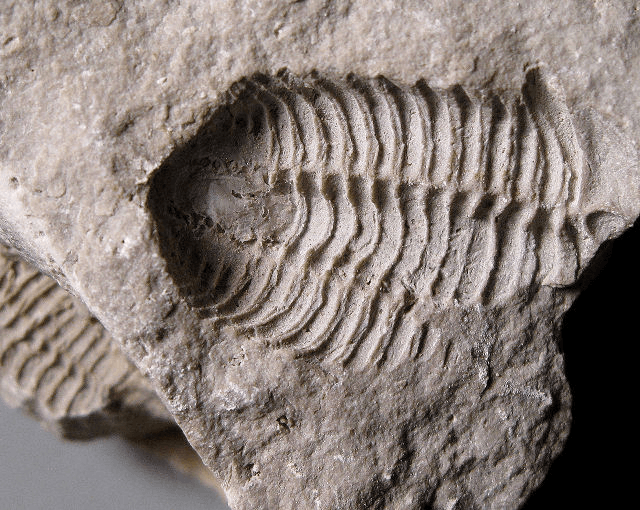 This TRILOBITE is an example of what MAJOR TYPE of FOSSIL?
MOLD
500
 How might species of flowering plants have survived the K-Pg extinction?
Flowering plants have adaptations that helped them survive extreme temperatures,such as not being as sensitive to cold or having harder seeds